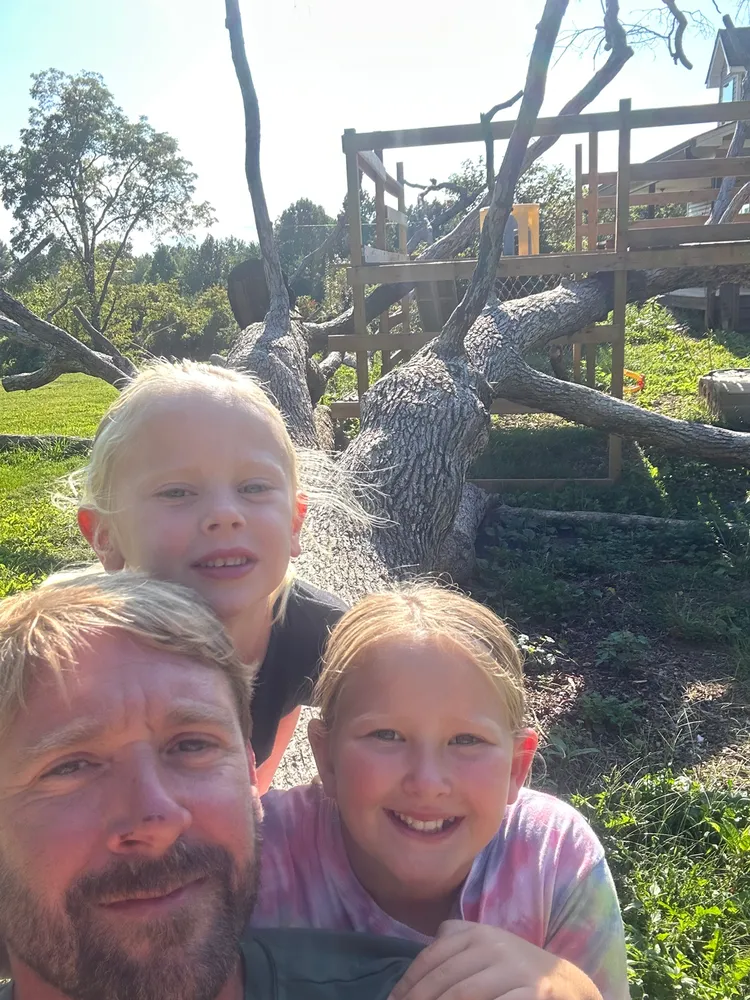

A year after Hurricane Helene, Butler Taylor says the recovery in his hometown of Arden, N.C., is still ongoing.
Part of the challenge inspired Taylor, a father of two, to repurpose an oak tree that had toppled during the storm. Now, it’s an interactive structure for his young daughters — one that took 25 trips to the hardware store to complete.
“Even though bad things happen, you can’t just stop,” says Taylor, 43, sharing the lesson he hopes to instill in his daughters, Della, 9, and Cora, 6. “You can’t throw up your hands and quit. You got to put your head down and keep going.”
Taylor estimates the oak is between 80 and 100 years old, though he hasn’t brought himself to cut through the trunk to count the rings. The tree, which his grandfather watched grow, was a cornerstone of Taylor’s own childhood, a place for picnics and ice cream under its wide, protective branches. Years later, his daughters loved swinging from it.
“They loved that swing because it was big, shady, and huge,” he says. “That’s probably the hardest part — watching them swing in it and now they don’t get to.”
:max_bytes(150000):strip_icc():focal(559x0:561x2):format(webp)/butler-taylor-2-092325-738395dc9a714f18a78a408efc2b96d5.jpg)
On Thursday, Sept. 26, 2024, the Category 4 hurricane began impacting western North Carolina after making landfall near Perry, Fla., bringing damaging winds and record-breaking flooding to many areas, particularly the higher terrains of the southeastern Appalachians.
At least 71 indirect deaths were linked to the storm, including 23 in South Carolina, 21 in North Carolina, 16 in Florida, nine in Georgia, and one each in Tennessee and Virginia, according to the National Hurricane Center. In addition, the agency reported 176 direct fatalities from wind, storm surge, flooding, or tornadoes, plus three deaths from unknown causes related to the storm — a total of 250 Helene-related deaths.
That Friday, Taylor and his wife Kindra traveled to Raleigh for a bluegrass festival, but the trip quickly turned stressful. Butler couldn’t reach his mother, who was watching the girls, for almost all of Saturday, Sept. 27, due to lack of cell service.
“We were terrified,” he recalls of the uncertainty about his family’s safety. On their return the next day, they had to navigate multiple detours around fallen debris and damaged roads. Thankfully, their home and property were mostly intact, aside from the fallen tree, and the reunion with his mother and daughters was “wonderful.”
More relatives joined as the family hunkered down together. They went without power or food for weeks, in a community Taylor describes as “pretty devastated.” Yet he’s proud of how neighbors came together.
“If you needed a chainsaw, you used your neighbor’s chainsaw,” he says. “If you needed food, your neighbor would share their food.”
:max_bytes(150000):strip_icc():focal(561x0:563x2):format(webp)/butler-taylor-5-092325-96d461c5948a4dfe9e34130c7bd9c1cd.jpg)
As the community slowly recovered, Taylor focused on the massive tree in his yard. His daughters were too enthralled climbing its branches to think about removing it.
“I’m no carpenter, but I wanted to have a platform where the branches still came up through,” Taylor says. Over a couple of months, he built a multi-tiered structure incorporating the fallen tree’s branches. The project was a success, giving his daughters a new way to play while preserving the tree’s history.
“They’ll have that memory,” he says. “They’ll still be able to play on the tree that my grandfather knew.”