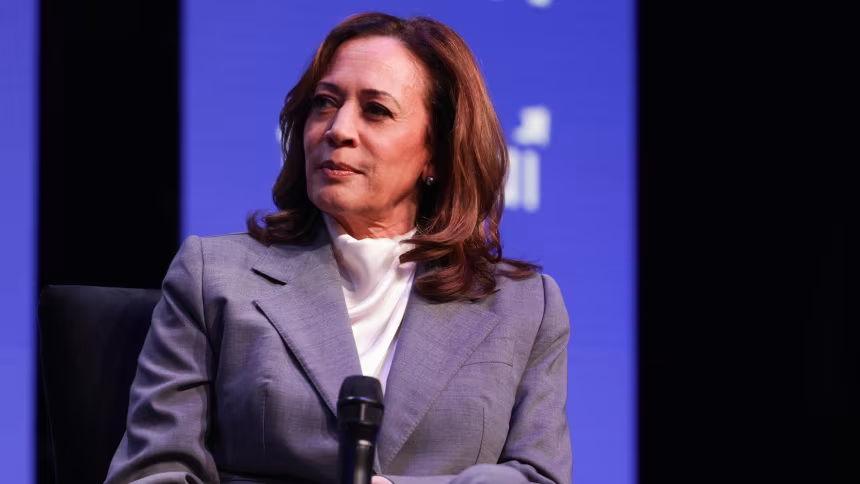

California Democrats are quietly grappling with what a potential Kamala Harris run for governor could mean—not just for the state’s top job, but for down-ballot races and the broader national political landscape.
When Rep. Dave Min, a freshman Democrat from California, was asked recently at the Capitol whether he wanted Harris to enter the governor’s race, he quickly cut off the conversation: “I have no comment,” he said, dodging further questions as he hurried onto the House floor.
Rep. George Whitesides, who narrowly flipped a Republican-held seat last cycle, paused before offering a careful response: “I welcome her to the race. I’m just really focused on my own race, but if that’s what she feels called to do, that’s her prerogative.”
Harris is reportedly weighing a gubernatorial run in 2026 against other possible options, including another White House bid. As she deliberates, California Democrats are weighing the pros and cons of her candidacy in a political climate still reshaped by President Donald Trump’s return to office.
A Divided Party
Supporters argue that Harris, with experience as California’s attorney general, U.S. senator, and vice president, has the resume and political clout to confront Trump-era policies head-on and address key state issues like housing and crime.
“She has the experience, the leadership, and the legislative understanding to tackle the biggest problems California is facing,” said Rep. Ro Khanna, who has had a complex relationship with Harris but now backs her potential candidacy.
Rep. Mike Levin, who held his San Diego-area district by 17,000 votes in 2024, said Harris would be a “formidable candidate” and could energize Democratic voters in a critical year.
But Harris skeptics within the party—most of whom speak anonymously—worry that she may lack the voter enthusiasm needed to help Democrats win back the U.S. House. They argue that her candidacy might instead boost Republican turnout and endanger newly flipped seats like those held by Min and Whitesides.
“There’s no groundswell for her candidacy,” one California House Democrat said. “She comes in with baggage. It could cost us the four or five seats we need to take back the House.”
Rep. Jimmy Gomez, who represents a safe Los Angeles seat, said some voters see the governor’s race as a fallback option for Harris after losing the vice presidency.
“Once you’ve been vice president, there’s only one job that feels like the next step,” Gomez said. “Running for governor just feels like a consolation prize.”
Former Speaker Nancy Pelosi, asked whether Harris should run, simply said: “I want her to do whatever she wants to do.”
Deliberation Mode
True to form, Harris is taking her time. Several people close to her told CNN she’s been asking allies whether they think she should enter the race, with some turning the question back on her.
She’s also reached out to former governors for insight into what the job entails, though not all have agreed to speak with her.
Harris recently canceled a planned August vacation, which one source said signals serious deliberation—but not necessarily a decision. In addition to weighing a governor’s run, Harris has asked for memos on alternative paths: launching a 501(c)(4) focused on youth civic engagement, forming a PAC to back other Democrats, or organizing a national listening tour with 2028 in mind.
Her team is also tracking the field: former HHS Secretary Xavier Becerra, former Rep. Katie Porter, and ex-L.A. Mayor Antonio Villaraigosa are all vying for the Democratic nomination. But Harris’ supporters question whether any of them have the name recognition, experience, or fundraising capacity to match her.
Few voters are focused on the race yet—the primary isn’t until June 2026, with the top two finishers advancing to the general election regardless of party.
Waiting for Harris
Some of Harris’ allies are quietly circulating internal polling showing she remains far more popular among Democrats than any declared candidate. Her detractors, meanwhile, are spreading data that suggests her presence on the 2024 ballot as the Democratic presidential nominee led to down-ballot losses across California.
Harris, still deeply angered by Trump’s presidency and determined to remain politically relevant, is expected to stay engaged in national politics regardless of her decision. But those close to her acknowledge that mounting a serious gubernatorial campaign—particularly one that doesn’t look entitled—would require a level of retail politics and Sacramento engagement she hasn’t fully committed to in recent years.
Her decision is also influenced by family members, some of whom reportedly prefer she pursue a less public, more lucrative post-political life.
“She should certainly run if that’s what she wants to do,” said Rep. Sydney Kamlager-Dove. “We’ve been rooting for her for so long. But these decisions are incredibly personal—especially after what she’s been through.”
Redistricting Complicates the Map
A new wrinkle has added urgency to the debate: the possibility of mid-decade redistricting.
Texas Gov. Greg Abbott has called a special session to redraw congressional lines, a move reportedly driven by Trump and aimed at eliminating several Democratic seats. In response, Democrats in states like California are threatening their own redistricting efforts, which could make races even tougher for members in narrowly held seats.
That prospect makes Harris’ potential impact on down-ballot races even more important.
Still, even critics admit that no other candidate would necessarily fare better in terms of coattails. And Harris allies argue that, in a high-stakes midterm dominated by Trump’s policies, her presence could energize Democratic turnout rather than suppress it.
Rep. Mark Takano, who represents Riverside, said that enthusiasm for Democrats has surged in response to recent pro-Trump crackdowns.
“After the ‘No Kings’ protests in Los Angeles and the recent shift back toward the center among communities of color, I think we’re seeing momentum again,” Takano said.
Meanwhile, Rep. Young Kim, a Republican representing a competitive Orange County district, offered her own take when asked about Harris entering the race.
“Seriously—good luck to her,” Kim said, before clarifying with a smile: “That was sarcasm.”