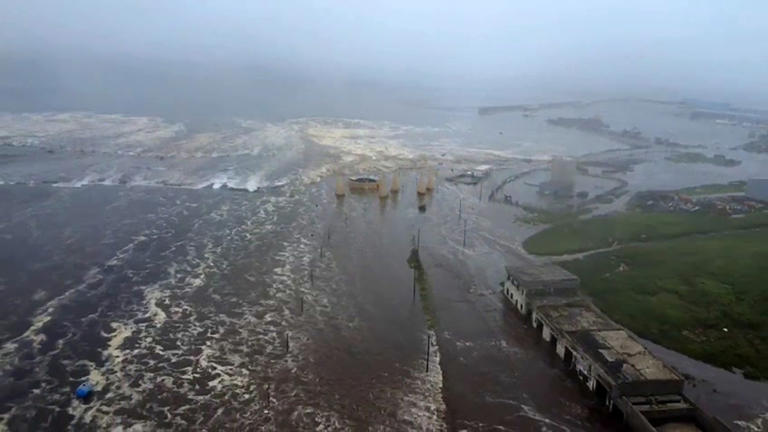

Tsunami waves began reaching Hawaii on Tuesday night after a powerful magnitude 8.8 earthquake struck off the coast of Russia’s Kamchatka Peninsula, triggering tsunami warnings and mass evacuations across the Pacific, including in parts of the U.S. West Coast.
Initially under a full tsunami warning, Hawaii saw the alert downgraded to an advisory after the first waves came ashore. The Pacific Tsunami Warning Center confirmed the reduced threat level just before 11 p.m. local time, and local officials announced that evacuees could begin returning from higher ground.
According to the National Weather Service, tsunami waves were first recorded in Haleiwa on Oahu around 7 p.m., followed by additional wave activity in Monterey and San Francisco, California. Some waves off Oahu measured up to 4 feet. No significant wave activity was observed near the Big Island.
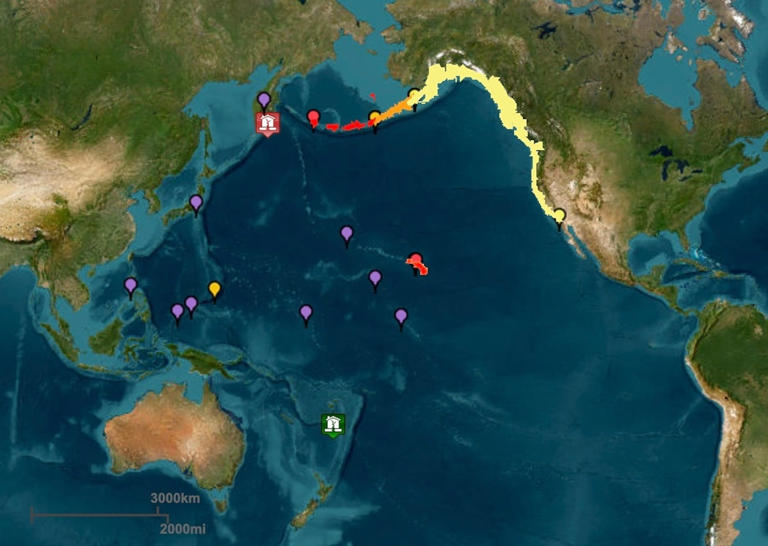
The Hawaii County Civil Defense Agency cautioned that the threat wasn’t over, warning that “follow-up” waves can often be larger than the initial surge. “Don’t return to evacuated areas until the Tsunami Warning is officially lifted,” the agency posted.
Hawaiian and Alaska Airlines both announced plans to resume normal flight schedules on Wednesday morning following earlier disruptions.
President Donald Trump responded to the disaster via social media, urging Americans to “STAY STRONG AND STAY SAFE” and encouraging the public to follow real-time updates on tsunami.gov.
Across Hawaii, sirens sounded every hour leading up to the anticipated impact, with residents advised to flee coastal and low-lying areas or seek shelter on higher floors. Officials emphasized that tsunami waves can wrap around islands and that every shoreline faced potential danger.
Hawaii Governor Josh Green warned the public not to underestimate the waves’ force. “A 3-foot wave riding on top of the ocean may not sound like much, but it’s a wall of water powerful enough to topple utility poles and scatter debris.”

Despite earlier reports of traffic jams as people fled the shoreline, Green noted that conditions had improved and said residents were evacuating in time. Honolulu Mayor Rick Blangiardi encouraged residents to stay calm but act decisively: “If you’re in a low-lying area, move to higher ground.”
West Coast, Alaska, and Global Alerts
In addition to Hawaii, tsunami alerts extended to Alaska’s Aleutian Islands and parts of Northern California, from Cape Mendocino to the Oregon border. Much of the rest of California, Oregon, and Washington remained under advisories as authorities continued to assess the threat.
Guam and American Samoa were also under tsunami advisories, as was much of the Pacific. The U.S. Geological Survey confirmed that the quake struck approximately 85 miles east of Kamchatka, at a depth of about 12 miles. The quake was followed by strong aftershocks, including magnitude 6.3 and 6.9 tremors.
Emergency services in Kamchatka reported localized damage and the evacuation of roughly 3,000 residents. All of northern Japan was also placed under a tsunami warning, prompting the evacuation of 2 million people. Japan’s meteorological agency warned that waves of up to 1 meter (3 feet) were expected to hit Hokkaido and other regions through the day.
Authorities in Chile, Peru, Mexico, Colombia, and several other Central and South American nations also issued tsunami warnings or watches. Pacific island nations including Fiji, Samoa, the Philippines, and Australia were warned to expect strong currents and dangerous surges.
In China, temporary tsunami alerts were issued for coastal areas including Shanghai and Zhejiang before being lifted.
As the situation continues to develop, global authorities are urging vigilance and caution. Experts warn that tsunami waves can arrive in unpredictable patterns and that the greatest danger may not come from the first wave but from those that follow.