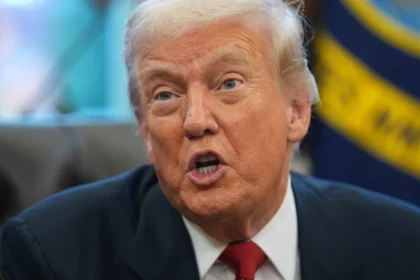
President Donald Trump has declared that the United States is “totally prepared” for nuclear conflict following threatening rhetoric from Russian leadership. In a significant military move, Trump ordered two nuclear submarines to be repositioned near Russia’s borders.
The announcement follows recent inflammatory remarks from Dmitry Medvedev, Deputy Chairman of Russia’s Security Council and former Russian president, who appeared to suggest nuclear retaliation against the U.S. was on the table.
In response, Trump issued a pointed statement on Truth Social, saying:
“Based on the highly provocative statements of the Former President of Russia, Dmitry Medvedev, who is now the Deputy Chairman of the Security Council of the Russian Federation, I have ordered two Nuclear Submarines to be positioned in the appropriate regions.”
Medvedev, who led Russia from 2008 to 2012, recently made veiled nuclear threats, stating:
“If some words of the former Russian president cause such a nervous reaction in the entire, formidable US president, then Russia is right in everything and will continue to go its own way. Let him remember his favorite films about the ‘walking dead’, as well as how dangerous a ‘dead hand’ that does not exist in nature can be.”
This cryptic reference to the so-called “Dead Hand” system—a Cold War-era nuclear retaliatory mechanism—was widely interpreted as a threat. He added that Russia “isn’t Israel or even Iran,” hinting at its nuclear capabilities.
On X (formerly Twitter), Medvedev posted:
“Each new ultimatum is a threat and a step towards war.”
Trump replied forcefully:
“Just in case these foolish and inflammatory statements are more than just that. Words are very important, and can often lead to unintended consequences. I hope this will not be one of those instances.”
Trump did not clarify whether the submarines are nuclear-powered or nuclear-armed, nor did he disclose their specific locations—information typically kept classified by the U.S. military.
In a Friday night interview with Newsmax, Trump said the submarines were already “closer to Russia,” explaining:
“We always want to be ready. And so I have sent to the region two nuclear submarines. I just want to make sure that his words are only words and nothing more than that.”
Timeline: Trump vs. Medvedev
- July 2025: Trump issues a 50-day deadline for Russia to deescalate the Ukraine war or face “severe” tariffs. Medvedev mocks the warning, calling it a “theatrical ultimatum.”
- Late July 2025: Trump shortens the deadline to just “10 or 12 days,” warning of sanctions and secondary tariffs on countries doing business with Russia.
- July 30, 2025: Trump publicly blasts Medvedev on Truth Social, calling him a “failed former President” and warning he is “entering very dangerous territory.” He also imposes a 25% tariff on India over its ties with Moscow.
- July 31, 2025: Medvedev responds with a post referencing Russia’s “Dead Hand” system, calling Trump’s response “jittery” and reinforcing Russia’s stance.
- August 1, 2025: Trump announces the deployment of two nuclear submarines near Russia, citing Medvedev’s “foolish and inflammatory statements.”
Trump’s remarks came just hours after Russian President Vladimir Putin revealed that Moscow has begun mass production of its hypersonic, nuclear-capable Oreshnik missile, which he claims may be deployed to Belarus—a key Russian ally bordering Ukraine—by the end of the year.
The U.S. Navy operates the world’s largest fleet of nuclear-powered submarines, including the USS Virginia, a 377-foot-long sub equipped with cruise missiles. Many American submarines are stealth-equipped, capable of delivering precision nuclear strikes. Larger nuclear-armed vessels can strike from thousands of miles away, reducing the need for close repositioning. It’s not yet clear which class of submarines Trump ordered into action.
This standoff unfolds against the backdrop of a fast-approaching deadline set by Trump. Initially a 50-day warning, he shortened it to just 10 days from July 29, urging Russia to take tangible steps to end the war in Ukraine or face new sanctions.
Despite this, Russia’s military campaign shows no signs of slowing. On July 31, a deadly strike killed 31 civilians—including five children—when a Russian missile hit a residential building in Kyiv.
‘Talk Doesn’t Mean Anything’
Trump expressed his growing frustration with Putin’s behavior, recounting what he described as unproductive conversations.
“I always hang up, [and] say, ‘Well, that was a nice phone call,’” Trump told reporters.
“And then missiles are launched into Kyiv or some other city, and I say, ‘That’s strange.’ And after that happens three or four times, you say, the talk doesn’t mean anything.”
Despite direct engagement, Trump said he remains “very unhappy” with Putin, particularly after last week’s conversation failed to advance peace talks—a goal the U.S. president has championed since returning to office.
While the U.S. moves to supply Ukraine with additional weapons, Putin continues to escalate nighttime bombing campaigns that now average nearly 1,000 per day.
Ukrainian President Volodymyr Zelensky and other European leaders have echoed concerns that Putin is not seriously considering peace. On X, Zelensky wrote:
“We understand who makes the decisions in Russia and who must end this war. The whole world understands this too. The United States has proposed this.”