
Washington (Bloomberg) – Washington D.C. is asking a federal court to immediately block President Trump’s attempt to take over the city’s police force, arguing that the move is illegal and could put public safety at risk.
The lawsuit, filed Friday by D.C. Attorney General Brian Schwalb, comes after tensions escalated between city officials and the Justice Department over Trump’s efforts to control the Metropolitan Police Department and deploy hundreds of National Guard troops in the nation’s capital.
Filed in Washington’s federal court, the complaint claims that Trump exceeded the powers Congress granted him. City officials are also asking a judge to stop the federal government from taking over the police force or issuing further orders. A hearing on the matter is scheduled for 2 p.m.
“The administration’s unlawful actions are an affront to the dignity and autonomy of the 700,000 Americans who call D.C. home,” Schwalb said. “We are fighting to stop it.”
The Justice Department declined to comment.
“The Trump administration has the lawful authority to assert control over the D.C. police, which is necessary due to the emergency that has arisen in our nation’s capital as a result of failed leadership,” said White House spokesperson Abigail Jackson.
Trump cited a “crime emergency” to justify using rarely-invoked presidential powers to increase the federal presence in local affairs, even though recent data—including from the Justice Department—show crime rates have been dropping.
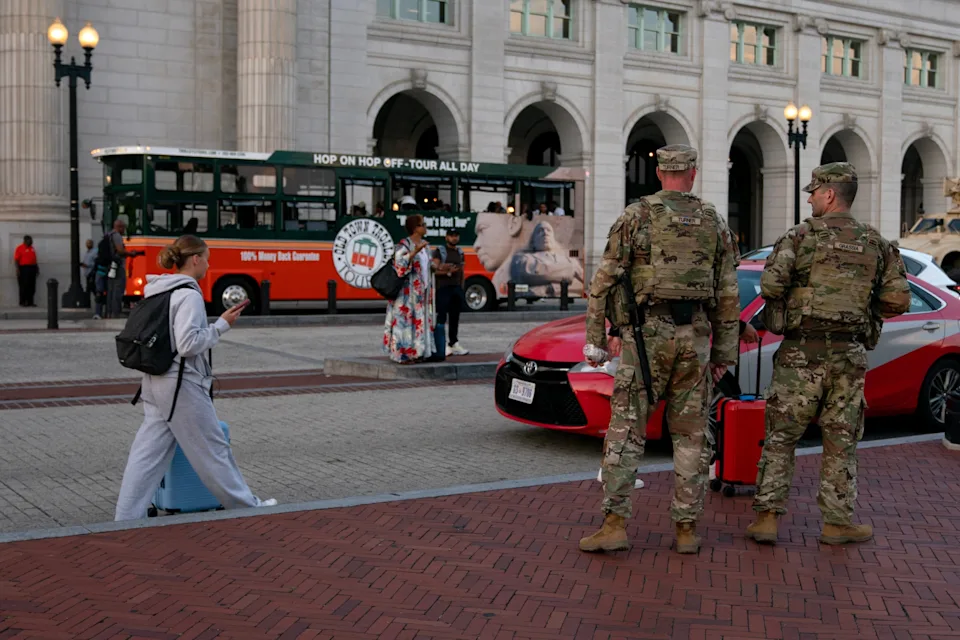
According to a White House official, more than 1,750 people, including D.C. National Guard members, took part in an overnight operation following Trump’s executive order. The operation resulted in 33 arrests, nearly half involving people in the U.S. illegally.
Tensions grew Thursday when D.C. Mayor Muriel Bowser and Schwalb rejected an order from Attorney General Pam Bondi, which would strip the Metropolitan Police chief of her authority and place the agency under federal control.
Bondi’s order named the head of the Drug Enforcement Administration, Terrence Cole, as “emergency police commissioner,” giving him the full powers of the city’s police chief. The order instructed Washington police leaders to get Cole’s approval before issuing directives, rescinded several department orders, and directed officers to strictly enforce laws against blocking streets or occupying public spaces.
Bondi criticized D.C.’s sanctuary policies for shielding people in the country illegally “from the consequences of federal law.” The lawsuit warned that Bondi’s order would disrupt the local police chain of command, “sow chaos among the more than 3,100 officers serving the District, and endanger the safety of the public and law enforcement officers alike.”
Washington has a unique relationship with the federal government. The Home Rule Act of 1973 allows the city to elect its own leaders and manage day-to-day affairs. However, Congress still oversees the district, local judges are nominated by the president and confirmed by the Senate, and federal prosecutors handle many local cases.
The law allows the president to take control of the police during certain emergencies for up to 30 days. Beyond that, Congress must approve any extension. The president also controls the city’s National Guard, another distinction from states.
The lawsuit claims Trump cannot “seize command and control over the police force himself,” but may only request assistance from the mayor in certain emergencies. The city also argues that using rising crime as justification for federal control is too broad and undermines Congress’s decision to leave daily governance to locally elected officials.
Mayor Bowser, who supports D.C. statehood, has opposed federal efforts to take over local governance. She has tried to cooperate with the White House during Trump’s term but emphasized that “there is no statute that conveys the District’s personnel authority to a federal official.”
Schwalb called Trump’s actions “unprecedented, unnecessary, and unlawful,” and sent a letter to D.C. Police Chief Pamela Smith on August 14 stating that Bondi’s order “is unlawful, and that you are not legally obligated to follow it.”