
President Donald Trump announced Monday that his administration plans to take over policing in Washington, D.C., framing it as an effort to combat rising crime in the nation’s capital. However, many of the president’s statements about public safety in the city either exaggerate or misrepresent the data, omitting important context.
Here’s a closer look at the facts:
Statistics challenge Trump’s claims about violent crime in Washington
TRUMP: “It’s getting worse, not getting better. It’s getting worse.”
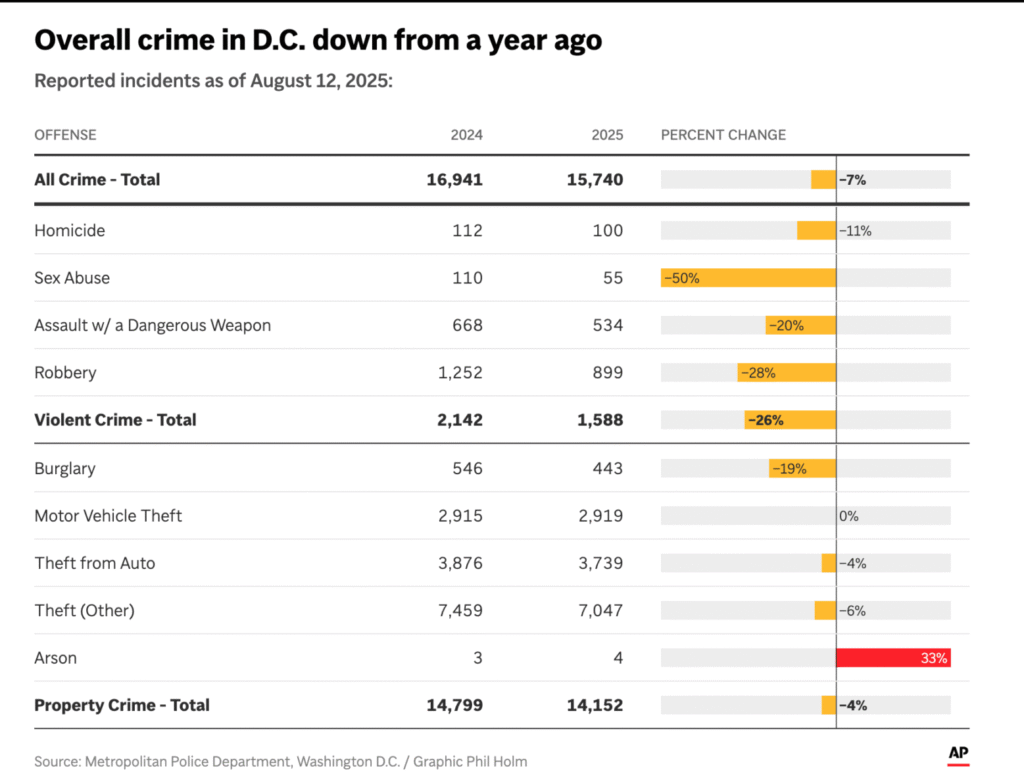
THE FACTS: Data from the Washington Metropolitan Police contradicts the president’s claim, showing that violent crime has declined since a post-pandemic peak in 2023. Homicides, robberies, and burglaries are down this year compared with the same period in 2024. Overall, violent crime is down 26% compared with a year ago.
A recent Department of Justice report confirms that violent crime has dropped 35% since 2023, returning to a long-term downward trend and placing the district’s violent crime rate at its lowest level in 30 years. Specifically, homicides decreased by 32%, armed carjackings by 53%, and assaults with a dangerous weapon by 27% compared with 2023.
While some authorities have opened investigations into allegations that city officials may have altered crime data, Mayor Muriel Bowser has defended the statistics, saying Trump’s depiction of lawlessness is inaccurate. “We are not experiencing a spike in crime,” Bowser told MSNBC Sunday. “In fact, we’re watching our crime numbers go down.”
Murders in 2023 were high, but not record-breaking
TRUMP: “Murders in 2023 reached the highest rate, probably ever. They say 25 years, but they don’t know what that means because it just goes back 25 years.”
THE FACTS: In 2023, the District of Columbia recorded 274 murders in a city of roughly 700,000—its highest total in 20 years. However, historical data from the 1970s, 80s, and 90s shows much higher numbers of homicides when the city had a smaller population. For example, there were 498 homicides in 1990, 509 in 1991, and 460 in 1992. Decades of crime statistics for the city are available online.
Comparing Washington’s murder rate to international cities
TRUMP: “The murder rate in Washington today is higher than that of Bogota, Colombia, Mexico City. Some of the places that you hear about as being the worst places on Earth, much higher. This is much higher.”
THE FACTS: Trump is partially correct. Washington does have a higher homicide rate than many other global cities, including some historically considered unsafe by Americans. But the context is key: violent crime rates in the U.S. are generally higher than in many other countries. While Washington ranks among the nation’s more dangerous large cities, others have even higher crime rates.
Trump links crime to cashless bail without evidence
TRUMP: “This dire public safety crisis stems from a public safety crisis that is directly from the abject failures of the city’s local leadership. The radical left City Council adopted no cash bail. By the way, every place in the country where you have no cash bail is a disaster.”
THE FACTS: Research has not established a direct link between cashless bail and crime rates. Many studies focus on defendant recidivism rather than overall crime trends and have produced mixed results.
A 2024 Brennan Center for Justice report found “no statistically significant relationship” between bail reform and crime rates. The nonprofit analyzed crime data from 2015 to 2021 for 33 U.S. cities, 22 of which implemented some form of bail reform. Co-author Ames Grawert, senior counsel in the Brennan Center’s Justice Program, stated that these findings hold true for trends in overall and violent crime.
Similarly, a 2023 study in the American Economic Journal found no evidence that cash bail increases court appearances or reduces crime among released defendants.
Kellen Funk, a Columbia Law School professor specializing in pretrial procedures, told The Associated Press that the president’s claim is “demonstrably false and inflammatory.”
Trump’s administration has cited a 2022 report from Yolo County, California, which looked at temporary cashless bail during COVID-19. Of 595 individuals released under the program, 70.6% were rearrested. However, Funk noted that D.C. reformed its cash bail system in the 1990s.
“What the President is declaring to be an ‘emergency’ is a system that has functioned effectively for nearly thirty years, including during recent historic lows in reported crime,” Funk said. He added that D.C.’s bail system has served as a model for bipartisan bail reform in New Jersey and New Mexico over the past decade.