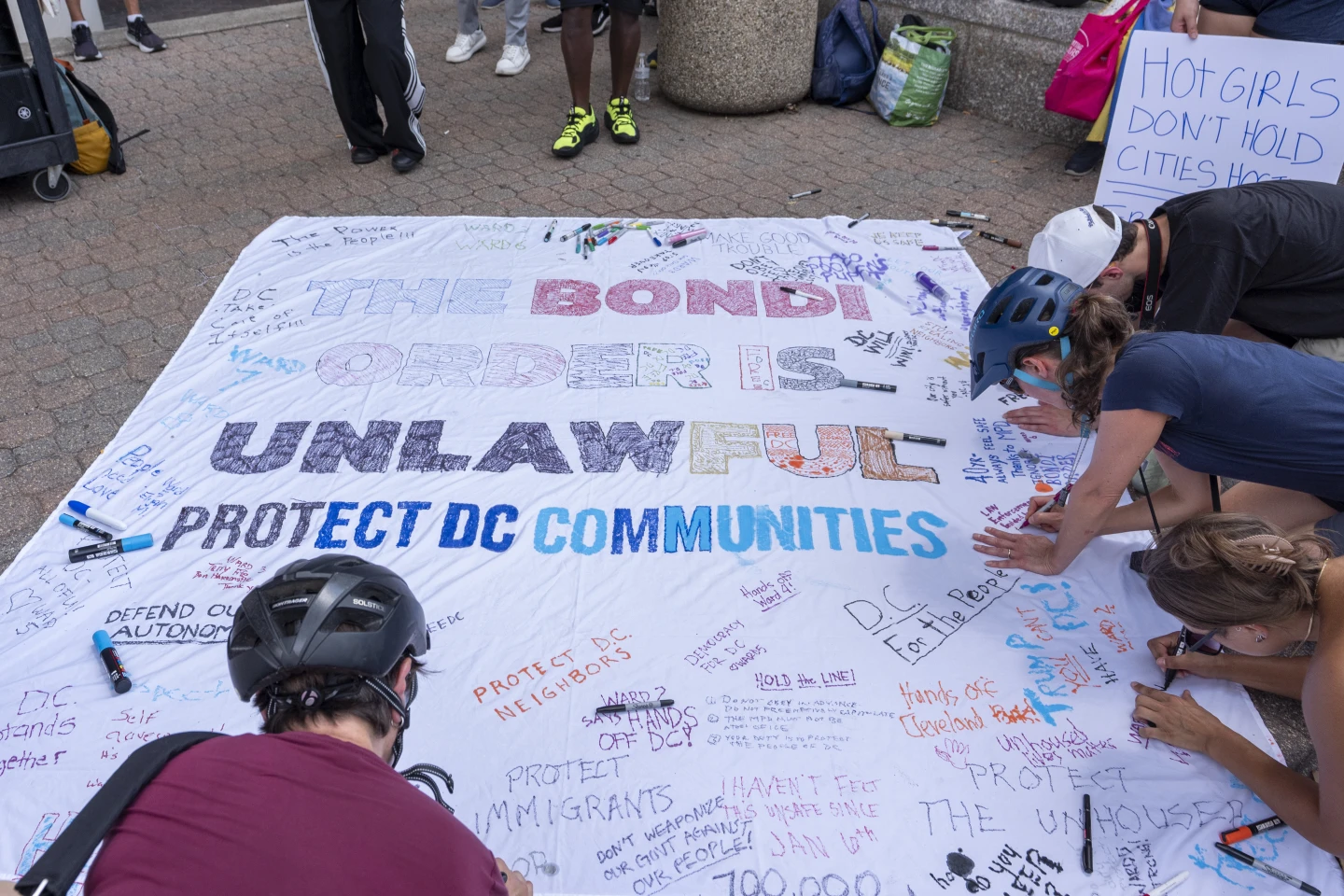

The left views President Donald Trump’s move to take control of Washington’s law enforcement as part of a larger push toward autocracy — what one activist called “vindictive authoritarian rule.” They see it as extreme during otherwise ordinary times in the capital. Supporters on the right, however, call it a bold step to break through Democratic bureaucracy and improve life in D.C.
The outcome of this debate may decide whether Washington — a city that represents both America’s achievements and its problems — becomes a Trump-era model for how cities are policed and run, or whether it is harmed by his approach.
Trump launched his Making D.C. Safe and Beautiful Task Force by putting around 800 National Guard troops on the streets. He claimed, “Our capital city has been overtaken by violent gangs and bloodthirsty criminals.”
He also focused on appearances. “If our capital is dirty, our whole country is dirty, and they don’t respect us,” he said.
Trump then raised the stakes by declaring federal control of the city’s police department and appointing an emergency chief. This shocked local leaders, who quickly sued to block the move. Police Chief Pamela Smith said, “I have never seen a single government action that would cause a greater threat to law and order than this dangerous directive.”
By Friday, Trump’s administration scaled back its effort. A judge questioned whether the president had the authority to seize the police department and pushed for compromise. For now, the Justice Department agreed to keep Smith in charge but said it would still guide law enforcement practices. Attorney General Pam Bondi also ordered the police to cooperate with federal immigration enforcement, no matter what local laws say.
Many in the heavily Democratic city disliked the National Guard deployment, but admitted Trump had the legal power to order it because of Washington’s unique status as a federal district. Still, his attempt to take direct control of the police — something not tried since D.C. gained partial self-rule in 1973 — crossed a line for local leaders.
Federal power on city streets
In the past, the U.S. military has appeared in American cities during riots or major disasters like 9/11. Trump, however, declared an emergency that city officials and many residents did not recognize. Violent crime in Washington has actually been falling, just as it has in many other U.S. cities.
Yet Trump often uses the language of crisis to justify his actions — from deportations to tariffs to past deployments of National Guard troops.
Washington is both a tourist hub and a living city. More than 25 million Americans and 2 million foreign visitors came in 2024. It’s where school trips bring kids to see history firsthand, and where neighborhoods range from billion-dollar homes to streets hit hard by drugs and poverty.
Decades ago, Washington faced riots in 1968 and the crack epidemic in the 1980s. But in the last 30 years, the city has grown wealthier and safer.
Critics see a “fake emergency”
Philadelphia District Attorney Larry Krasner mocked Trump’s move. “You’re talking about an emergency, really? Or are you just calling everything an emergency so you can roll tanks?”
Activists with the group Not Above the Law said Trump is simply grabbing power he shouldn’t have. Lisa Gilbert, co-chair of the coalition, warned, “Donald Trump will not stop until democracy is replaced by vindictive authoritarian rule.”
Baltimore Mayor Brandon Scott also criticized the plan, saying it distracts from the economy and America’s global standing. He argued that local police already work with federal agents on major cases like gun trafficking. “How is pulling them off that job to just patrol streets making our country safer?” he asked.
But D.C. Police Union leader Gregg Pemberton supported Trump’s intervention — with limits. “We stand with the president in recognizing that Washington, D.C., cannot continue on this trajectory,” he said, though he stressed the takeover shouldn’t be permanent.
A bigger question ahead
The Home Rule Act allows a president to control the police department for 30 days before Congress must decide whether to extend it. Trump’s use of this law inspired some Republicans to consider giving him even more authority.
Rep. Andy Ogles of Tennessee even proposed eliminating the time limit altogether, saying it would let Trump “crush lawlessness, restore order, and reclaim our capital once and for all.”
That raises a larger question: If Trump thinks his approach works in Washington, will he try to apply it to other U.S. cities he believes need “fixing”?