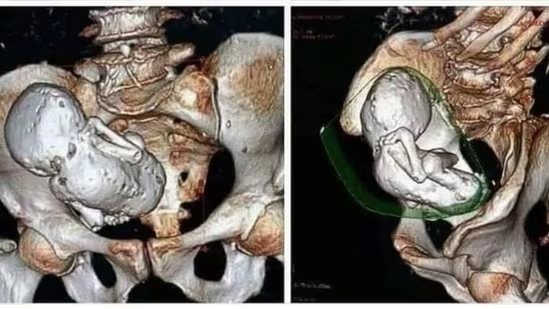

This unusual case sheds light on the complexities and mysteries of human biology. Here’s what you should know about a calcified fetus.
Have you heard of the rare medical phenomenon called a lithopedion, where a fetus dies in the womb and gradually becomes calcified? On June 25, X account Non Aesthetic Things, which has 4.8 million followers, shared a ‘CT scan of a calcified fetus,’ noting that it had been present for roughly 30 years.
Non Aesthetic Things tweeted alongside the CT scan: “This CT scan belongs to a 73-year-old woman in whom doctors discovered a 30-year-old calcified fetus.” The presence of a calcified fetus for three decades is an extremely rare phenomenon and offers fascinating insights for medical professionals. Social media responses to the case were a mix of shock, fascination, and curiosity.
Social media reacts to the ‘stone baby’
Reacting to the post, one X user asked, “Really?? Fake?? Is it possible for a 73-year-old woman, who has never had a medical service, including a CT scan, to realize she had a calcified fetus in her? Impossible!!!” Another commented, “How did she carry that fetus for so long… didn’t she feel discomfort?”
A third user added context: “CT scan shows the moment doctors found a ‘stone baby’ inside the womb of a 73-year-old woman from Algeria. The stone baby, or lithopedion, forms when a pregnancy develops in the abdomen rather than the uterus. When the pregnancy fails, the body cannot naturally expel it. Instead, the body calcifies the fetus, essentially turning it into ‘stone’ using an immune process designed to protect against foreign objects in the system.”
Is this even possible?
Interestingly, a similar case was reported in 2013 when ABC News shared the story of an 82-year-old Colombian woman who discovered a 40-year-old ‘stone’ fetus while seeking treatment for pelvic pain. Dr. Kim Garcsi of University Hospitals Case Medical Center in Cleveland explained that the condition is extremely rare, with only around 300 cases documented in medical literature.
Dr. Garcsi said lithopedion occurs when a pregnancy forms in the abdomen instead of the uterus. If the pregnancy fails, often due to insufficient blood supply, the body cannot expel the fetus. In response, the body calcifies it, using the same immune mechanism that protects against foreign objects. While unusual, this process is a natural way the body safeguards health.
Note to readers: This article is for informational purposes only and is not a substitute for professional medical advice. Always consult your doctor with any questions about medical conditions.