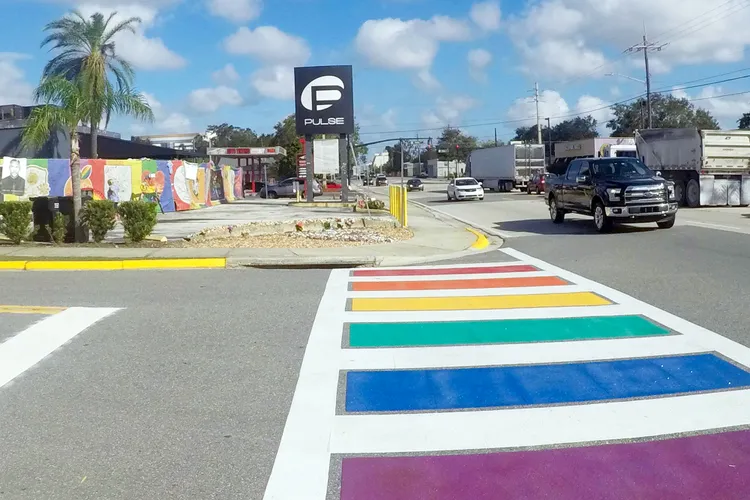

A rainbow crosswalk honoring the 49 victims of the 2016 Pulse nightclub massacre was removed overnight on Wednesday, following a directive from President Donald Trump’s administration.
The crosswalk was located on Orange Avenue in Orlando, Florida, adjacent to the abandoned club that remains a memorial to those who lost their lives.
Orlando Mayor Buddy Dyer called the sudden removal a “cruel political act” in a statement on X.
“We are devastated to learn that overnight the state painted over the Pulse Memorial crosswalk on Orange Avenue,” he said. “This callous action of hastily removing part of a memorial to what was at the time our nation’s largest mass shooting, without any supporting safety data or discussion, is a cruel political act.”
Governor Ron DeSantis, whose Florida Department of Transportation oversaw the removal, defended the move on X, stating, “We will not allow our state roads to be commandeered for political purposes.”
The directive originated from the Trump administration. On July 1, Secretary of Transportation Sean Duffy sent a letter to governors of all 50 states and Puerto Rico urging compliance with his “SAFE ROADS Initiative,” which aims to eliminate “distractions” on non-freeway roads.
While the letter did not specifically mention rainbow crosswalks, Duffy clarified his stance when reposting it on X:
“Taxpayers expect their dollars to fund safe streets, not rainbow crosswalks,” he wrote. “Political banners have no place on public roads. I’m reminding recipients of @USDOT roadway funding that it’s limited to features advancing safety, and nothing else. It’s that simple.”
Local Democratic leaders, however, argue the decision is not about safety.
“That’s a totally ridiculous and absurd excuse for what is very clearly an attempt to erase LGBTQ identities and just be anti-queer,” state Senator Carlos Guillermo Smith said of the policy.
Dyer emphasized that the Pulse memorial was “installed in close coordination with the state and adhered to national safety standards.”
“In fact, the crosswalk that is part of the Pulse Memorial was installed by the state,” he added, referring to the installation—sometimes called “Rainbow Crossing”—completed in October 2017.
:max_bytes(150000):strip_icc():focal(999x0:1001x2):format(webp)/pulse-night-club-082125-3137dabecf2a41b4b9f7523e5264cfe9.jpg)
“This crosswalk not only enhanced safety and visibility for the many pedestrians visiting the memorial, it also served as a visual reminder of Orlando’s commitment to honor the 49 lives taken on June 12, 2016,” Dyer continued. “While the state works to erase the memory of the victims by painting over the crosswalk, our community’s commitment to honoring them and completing the memorial will never waver.”
Within hours, volunteers took to the sidewalk with chalk, coloring the new black-and-white crosswalk into a rainbow once again.
Next year will mark the 10th anniversary of the shooting, which occurred in the early hours of June 12, 2016.
A man armed with two semi-automatic guns bypassed a uniformed officer working as a security guard and entered the club, firing at random. Forty-nine people were killed, 58 injured, and many more trapped during the terrifying onslaught.
The Pulse massacre was the deadliest mass shooting in U.S. history until the 2017 Las Vegas shooting and remains the deadliest attack against LGBTQ+ people in the nation’s history.