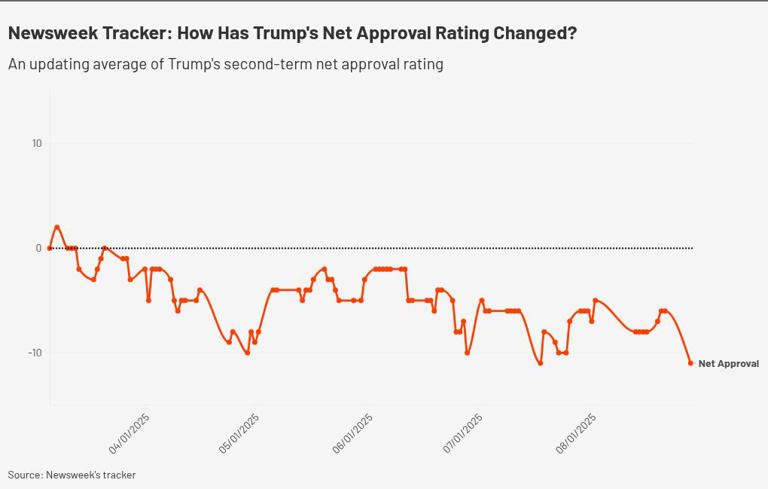
Donald Trump’s net approval rating has fallen to its lowest point since he took office, according to Newsweek’s tracker.
Newsweek’s tracker shows Trump’s net approval rating at -11 points, with 43% of Americans approving and 54% disapproving. This is lower than the previous low of -10 on July 25 and down from -6 just last week.
Why It Matters
Trump’s record-low net approval rating shows that public opposition to his presidency is growing. His approval rating, a key measure of how Americans feel about him, has steadily declined since he returned to office earlier this year. Many Americans are unhappy with his handling of the economy, tariffs, and immigration.
This rating could have important effects on the Republican Party, especially ahead of the New Jersey and Virginia gubernatorial races and the 2026 midterm elections, where Republicans hope to keep control of Congress. Historically, the party in the White House usually loses seats in midterms. During Trump’s first term, Democrats gained 41 seats in the House.
What To Know
Recent polls show Trump’s popularity at record lows. In Quinnipiac’s latest poll, Trump’s net approval rating fell to -18 points, with 37% approving and 55% disapproving—down from -14 last month and +3 in January.
A SoCal Strategies poll also gave Trump a record low rating this month, putting his net approval at -3 points, down from +13 in January. Other surveys, including those by Echelon Insights, YouGov/Economist, and Quinnipiac, show Trump underwater on nearly every issue.
Economy
Americans are worried about the economy. A Verasight survey found that a third of Americans say their finances are worse than a year ago, and most believe Trump’s policies have hurt the economy. Tariffs are unpopular: only 36% support his import taxes, while 56% oppose them. Many voters reject higher prices in exchange for job protection by a 21-point margin.
Pollster G. Elliott Morris said, “While people may like job protection in theory, they react negatively when it leads to higher prices in real life.”
Other polls confirm this dissatisfaction. A YouGov/Economist survey found that only 39% approve of Trump’s handling of jobs and the economy, while 54% disapprove. Inflation is his biggest weakness: 34% approve of how he handles it, while 61% disapprove. Job growth has slowed, with 73,000 jobs added in July compared to 147,000 in June, according to the Bureau of Labor Statistics.
National Guard Deployment
Polls show many Americans are skeptical of Trump’s plan to send federal troops to Washington, D.C., claiming the city had been “overtaken by violent gangs and bloodthirsty criminals, roving mobs of wild youth, drugged-out maniacs and homeless people.”
This move was unusual and raised questions about constitutional limits and city control. Trump also suggested Chicago could be next.
Public opinion is split along party lines. An AP-NORC survey found that 55% of Americans support military help for police, but only a third back federal control of city police. Eight in ten Republicans support the move, while most Democrats oppose it.
The Quinnipiac poll showed 56% of voters opposed sending federal troops to D.C., while 41% supported it. Support is mainly among Republicans, and opposition is stronger among Democrats and independents. Women are more opposed than men.
Foreign Policy
Trump has also been active internationally, especially on the Russia–Ukraine war and Israel–Palestine conflict, but polls suggest Americans aren’t fully behind him.
In Ukraine, he extended sanctions on Moscow, condemned missile strikes, pledged missile systems to Kyiv’s allies, and threatened tariffs if countries continued trading with Russia. He also sent U.S. submarines near Russia and tried ceasefire talks that failed.
In Israel, Trump said Israel could decide on a full Gaza occupation. The Quinnipiac survey shows only 40% of voters trust him to negotiate peace in Ukraine, while 59% do not. On Israel-Palestine, 60% oppose sending more U.S. military aid to Israel, with Democrats and independents largely against it.
Public opinion is shifting: 37% sympathize more with Palestinians, 36% with Israelis, and 27% are undecided—the highest support for Palestinians and lowest for Israelis since polling began. Half of voters think Israel is committing genocide in Gaza, while 35% disagree.
Analyst Tim Malloy said, “Support for Palestinians grows while backing for military aid to Israel drops. Many voters strongly disapprove of how Israel is handling Gaza.”