

After removing or forcing out dozens of immigration judges, the Trump administration plans to fill these positions with military lawyers under the Department of Justice.
Last week, the Justice Department’s Executive Office for Immigration Review said it could hire “any attorney” to act as a temporary immigration judge, even if they have no experience in immigration law.
Defense Secretary Pete Hegseth approved sending up to 600 military lawyers to assist the Justice Department in immigration courts across the country, according to a memo dated August 27.
The Pentagon will send groups of 150 military attorneys “as soon as practicable,” the memo said. Chief Pentagon spokesman Sean Parnell told The Independent that the military is “identifying qualified” attorneys to “help further combat a backlog of cases by presiding over immigration hearings.”
“The Department remains committed to supporting our partners, bringing the skill and dedication of America’s service members and civil servants to deliver justice, restore order, and protect the American people,” Parnell added.
The Justice Department referred The Independent’s request for comment to the Pentagon.
Immigration courts are dealing with a huge backlog of more than 3.7 million cases, which include asylum claims and decisions on whether immigrants can be quickly deported.
More than 100 immigration judges have been fired or forced out since Trump took office. Unlike federal courts, immigration courts operate under the Justice Department and the attorney general’s office.
New guidance from Attorney General Pam Bondi allows “any attorney” to serve as an immigration judge for terms of up to six months, which can be renewed. Critics say this could let inexperienced judges decide the futures of tens of thousands of people, potentially advancing the administration’s anti-immigration agenda.
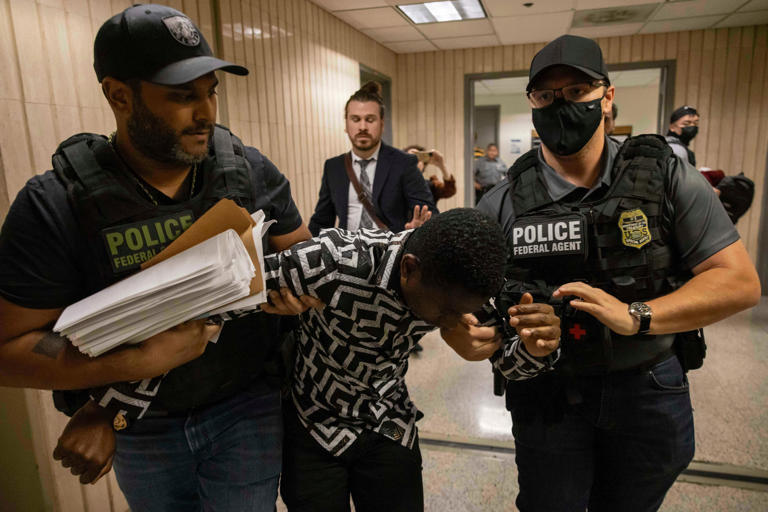
After Trump took office, the Justice Department told judges to approve motions from government lawyers to dismiss immigrants’ cases, making them easier to arrest and deport. This has led to federal agents patrolling court halls and detaining immigrants immediately after hearings. Currently, more than 60,000 people are in immigration detention centers nationwide.
Before last week’s rule change, temporary judges had to be former appellate immigration judges, administrative law judges at the Executive Office for Immigration Review, or attorneys with over 10 years of immigration law experience. Now, experience in immigration law is not required.
The rule states, “Immigration law experience is not always a strong predictor of success” as a judge.
Aaron Reichlin-Melnick, a senior fellow at the American Immigration Council, said attorneys from the Judge Advocate General’s Corps (JAG) have served as immigration judges before, “so I am not of the belief that they will all become rubber stampers.” But he added that the “command pressure to deny” cases will be high.
There are also not enough courtrooms to quickly add hundreds of new judges, making logistics “a complete disaster,” Reichlin-Melnick said.
Rear Admiral Donald J. Guter, a retired Navy Judge Advocate General, called the plan “unprecedented and unwise.” He said it risks militarizing civilian functions, reduces readiness, and involves a specialized area where JAGs lack training.
Like the deployment of National Guard troops and Marines into Los Angeles streets, this move could politicize the military, making it less prepared for its main missions, Guter and other former JAG attorneys wrote in The Bulwark.
The union representing immigration judges, the International Federation of Professional and Technical Engineers, said it supports hiring temporary judges “through a transparent, merit-based process” that considers legal experience and knowledge of immigration law. Hiring inexperienced judges could slow the system and increase appeals, the union said.
The administration’s actions to remove legal protections from immigrants mid-case have expanded the number of “undocumented” people, supporting the president’s push for mass deportations.
A federal judge in New York last month criticized the administration for arresting immigrants after hearings, calling it a “game of detention roulette” that violates due process. Another judge blocked rapid deportations, saying it could wrongly remove people who have lived in the country for years.
District Judge Jia M. Cobb in Washington, D.C., warned that prioritizing speed could cause mistakes, depriving people of the chance to challenge allegations of unlawful entry.


