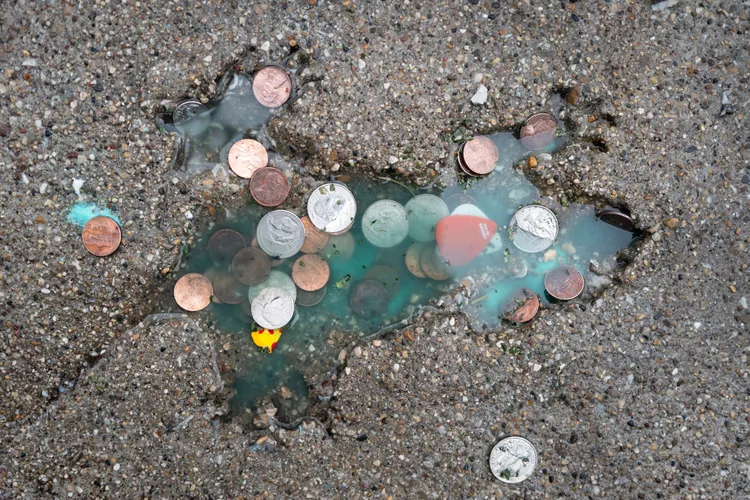

The infamous “rat hole,” a peculiar imprint etched into a patch of concrete on Chicago’s North Side, may not have been made by a rat after all. According to a new study published in Biology Letters on Oct. 15, 2024, researchers found that a different — and furrier — creature was likely responsible.
The unusual mark became a quirky local attraction in Roscoe Village, drawing crowds of curious visitors and even hosting a wedding before city officials removed it in April 2024. But the recent analysis suggests that the legendary “rat hole” was, in fact, the work of another animal.
“While the public attributed the mark to a brown rat, no formal analysis had been conducted to confirm its identity,” the researchers explained. “Using clear anatomical landmarks, we compared measurements from the ‘Chicago Rat Hole’ to eight sympatric rodent species.”
Their findings revealed a 98.67% likelihood that the imprint belonged not to a rat, but to a squirrel — most likely an Eastern gray squirrel, a fox squirrel, or possibly a muskrat.
Even so, the humble patch of concrete took on a life of its own. Visitors treated it like a shrine, leaving offerings such as coins, flowers, figurines, and even medication. Although the mark had existed quietly for decades, it rapidly evolved into a neighborhood landmark. A nearby softball team adopted a rat as its mascot, and locals christened the spot “Splatatouille” after a playful naming contest.
While the exact origin may never be known for certain, the “rat hole” lives on in local memory. A Riot Fest Historical Society plaque now marks the site, according to the Associated Press.
The researchers concluded with a reminder that curiosity drives discovery:
“While we acknowledge the playful spirit of this investigation, our broader aim is to highlight that scientific inquiry begins with curiosity and observation — qualities that are not exclusive to professional scientists, but accessible to anyone interested in understanding the natural world.”