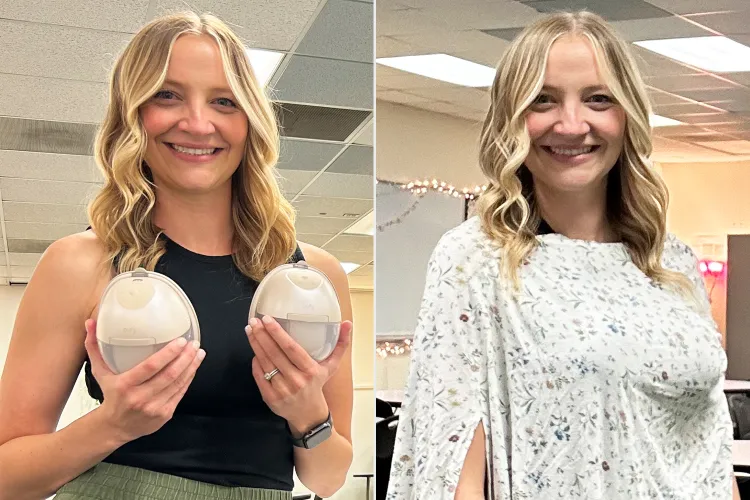

In the fall of 2025, Kayla Kipley, a high school English teacher of nine years, found herself facing a new challenge when she returned to the classroom after maternity leave.
After giving birth to her second child in April, the 32-year-old was determined to continue breastfeeding her son — a decision that held both personal and financial importance for her family.
Returning to work meant she now needed to pump every few hours throughout the day, even during critical teaching periods.
“When I pumped for my daughter, I had a pump that required it to be plugged into an outlet while it was on, so I was stuck in my chair,” Kipley recalls. “I was also lucky that my planning period and lunch fell perfectly on the times I needed to pump, so I was never in need of coverage.”
That was four years ago. Now, with a full schedule that includes an added class each day and no planning period, finding time to pump has become more difficult.
Although her administration offered support so she could step away from class twice a day, she declined, unwilling to disrupt her students’ learning.
:max_bytes(150000):strip_icc():focal(599x0:601x2):format(webp)/kayla-kipley-110425-3-5d4ff38530f04e3693993e6ff6594c14.jpg)
“While taking a 30-minute ‘break’ in the middle of my busy teaching day sounded wonderful, I knew it wouldn’t be fair to my students,” Kipley says, adding that teachers are under increasing pressure to perform and meet higher academic expectations.
“I knew if I was gone for 30 minutes during my freshman English class, their overall academic experience would suffer, which gave me a lot of anxiety.”
Instead, she came up with a solution that allowed her to stay present in the classroom: pumping while actively teaching.
Determined to find an approach that worked, Kipley began researching wearable pumps.
To her surprise, she discovered that they’re designed specifically with working mothers in mind — compact, discreet, easy to clean and quiet enough to use during a busy school day.
“I go into a separate room to put the pumps in my bra, and I go into that same room to remove the pumps,” she explains. “I only pour my milk during a passing period and clean my pumps during this time as well.”
To prevent leaking, avoid clogs, and manage discomfort, Kipley pumps every three hours throughout the day.
Her schedule usually looks like this: pumping before leaving for work at 7 a.m., again during her second-period class at 10 a.m., and once more during fourth period around 1 p.m.
:max_bytes(150000):strip_icc():focal(574x0:576x2):format(webp)/kayla-kipley-110425-2-4194d813a4b743a8851a56c09baaa9bf.jpg)
After school, she nurses her baby at home, which eliminates the need to pump for the rest of the day.
Kipley says her students have been nothing but understanding since she began pumping in class.
She explained her situation on the first day of the school year and has experienced no negativity from them.
“I told them it would only be for 30 minutes of the class period, you might hear light buzzing coming from me, and this is why I wear a very large poncho nursing cover,” she says.
Kipley often plays soft background music, such as Lo-fi, during lessons to help mask the sound of the pump.
“I also keep a distance from my students while I pump. I stay near my desk or teach in the front of the room,” she adds. “Wearing the large nursing cover seems to add a layer of comfort for both me and them.”
Three months in, her students have become accustomed to her routine, with some asking curious and respectful questions about the process.
“My second-period freshmen are all 13 and 14 years old. They have never been disrespectful or immature about any of this,” she notes. “I think a lot of that has to do with the way they have been raised, and I am incredibly thankful for parents raising their babies this way.”
However, when Kipley started sharing informational videos online about pumping while teaching, she encountered backlash.
“I think a lot of criticism stems from those who have not been exposed to motherhood, nursing or pumping,” she says. “I understand that these things may sound intimidating to these specific people. That’s okay. This is why I started sharing my journey and talking about motherhood on my TikTok account.”
She finds strong support from her family, friends, students and school administration.
“I’m extremely blessed with the amount of support I have received from them and my colleagues,” she says. “I pump during staff meetings as well, which always leads to encouraging words and conversations.”
However, as of November 2025, Kipley says she is no longer allowed to use her classroom to film pump-and-pour videos — even though she only did so when no students were present.
“I tried to push back that I was simply trying to spread awareness and share my experiences. District officials are not budging,” she says. While the district does not want her filming in school, she remains allowed to pump in class.
Still, Kipley intends to continue documenting her journey, even if she films from home or her car, with the hope of encouraging other mothers and teachers.
Stepping into this routine, she never expected the positive influence it would have on her students.
“I just want to teach my students to be accepting of everyone in all stages of life,” she says. “I want them to see the bigger picture before passing judgment.”