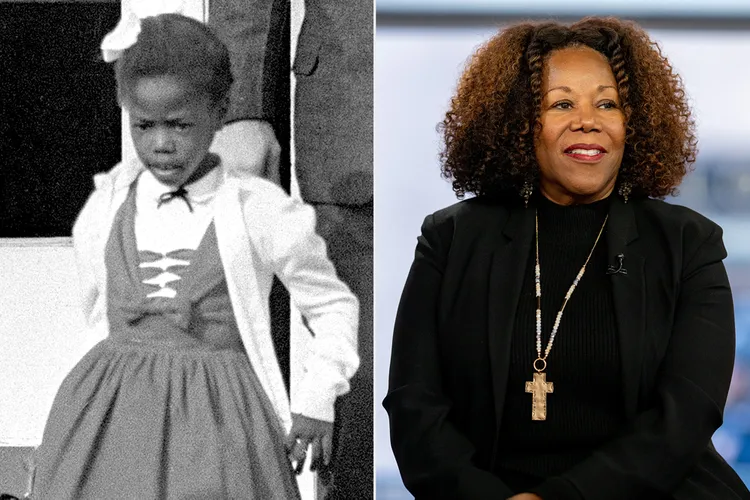

On Nov. 14, 1960, 6-year-old Ruby Bridges made history — though she had no idea at the time she was stepping into the center of a national civil rights battle.
She became the first Black child to attend an all-White elementary school in the American South, escorted by federal marshals as she entered William Frantz Elementary School in New Orleans. Outside the school doors, she faced furious crowds who hurled insults and threw food. Inside, she was urged by her parents simply to behave on her first day. The gravity of the moment was still far beyond her understanding.
“In my tiny mind I thought this was just something that happened on my street and in my community,” she later reflected. “I didn’t realize that it was a part of a much broader movement.”
:max_bytes(150000):strip_icc():focal(472x216:474x218):format(webp)/ruby-bridges-111225-144a58b05d954ce18694b0e3990a8380.jpg)
Decades later, Ruby remains a prominent voice for justice, equality and education. With the 65th anniversary of that courageous morning now being remembered, here’s a closer look at her story — and her continued influence today.
Who is Ruby Bridges?
Born Sept. 8, 1954, in Tylertown, Mississippi, Ruby was the eldest of eight children. Her parents, Abon and Lucille Bridges, moved the family to New Orleans in 1956 seeking better opportunities, especially education. Both had been forced to leave school early to work in the fields, and they wanted something more for their children.
“They really wanted opportunities for their children that they were not allowed to have,” Ruby told The Guardian in 2021.
:max_bytes(150000):strip_icc():focal(19199x7958:19201x7960):format(webp)/Ruby-Bridges-bcfefb80a6c94109b4f1ff370afa7649.jpg)
Just months after she was born, the Supreme Court ruled in Brown v. Board of Education that racial segregation in public schools was unconstitutional — a decision that would bring Ruby to a pivotal moment in history.
The Day That Changed Everything
Although the Supreme Court had banned segregation years earlier, Louisiana resisted integration. In 1960, a federal judge ordered the state to begin the process. Officials tried to limit who could enroll by creating a difficult entrance exam — one that only five Black children passed. Ruby was assigned to William Frantz Elementary.
Her father feared for her safety, but her mother insisted she should have the same educational opportunities as anyone else.
On her first day, white parents pulled their children out of school. Protesters screamed threats and displayed horrifying symbols of hate. Only one teacher — Barbara Henry, a newcomer from Boston — agreed to teach Ruby, spending the entire year with her alone in a classroom.
:max_bytes(150000):strip_icc():focal(489x254:491x256):format(webp)/ruby-bridges-william-frantz-elementary-school-111225-fb0acb39e7cb48b2a0a64f1bf5dd8869.jpg)
Threats continued throughout the year, even targeting Ruby’s family. Her father lost his job. Her grandparents were forced off their land in Mississippi. And still, Ruby continued to show up every day.
“I used to have nightmares,” she later recalled — particularly about a protester’s baby-sized coffin holding a Black doll.
By second grade, much of the hostility had faded, and more students returned. Each year brought more integration, sparked by the bravery of a single 6-year-old.
“After the first year, no one really discussed it,” she wrote of the gradual change.
Life After Grade School
Ruby finished her elementary years at William Frantz and went on to graduate from an integrated high school in New Orleans. She later worked for American Express for 15 years and married Malcolm Hall in 1984. They have four sons.
She originally set her sights on simply building a new life outside Louisiana, but a devastating tragedy changed her path again.
Ruby Bridges Today
In 1993, Ruby’s brother was murdered, and she returned to New Orleans to care for his daughters — who attended the same school she once helped integrate. Seeing the school in decline pushed her toward activism.
She founded the Ruby Bridges Foundation in 1999 to promote tolerance and eliminate racism before it begins — in childhood.
:max_bytes(150000):strip_icc():focal(577x474:579x476):format(webp)/ruby-bridges-2-111225-46d83dfa320a47879305e146b6d6f543.jpg)
“We all know that babies come into the world with a very unique gift, and that is a clear heart,” she said. “Racism is a grown-up disease. Let’s stop using our kids to spread it.”
Tragedy struck again in 2005 when her eldest son, Craig, died in a shooting — fueling her mission further.
Ruby has also become an acclaimed author. Her works include:
- Through Her Eyes (1999)
- Ruby Bridges Goes to School: My True Story (2009)
- This Is Your Time (2020)
- I Am Ruby Bridges: How One Six-Year-Old Girl’s March to School Changed the World (2022)
“All of us can do something,” she says. “It doesn’t have to be amazing. It’s about taking your gift and using it for good.”
How Her Impact Is Honored
Ruby’s courage has been recognized across the world — in books, art, film and public monuments.
Her identity was initially kept confidential for safety. But her story soon gained national attention. John Steinbeck wrote about her in Travels with Charley (1962). Two years later, renowned artist Norman Rockwell painted “The Problem We All Live With,” capturing Ruby’s brave walk into the school. The painting later hung in the White House during President Barack Obama’s first term.
:max_bytes(150000):strip_icc():focal(472x369:474x371):format(webp)/ruby-bridges-today-show-111225-5ca8e2a8165f43cba59835d8402fd5e4.jpg)
Disney told her story in the 1998 film Ruby Bridges. A statue of her now stands outside William Frantz Elementary — a lasting symbol of what one small child can achieve.
“I think kids will look at it and think to themselves, ‘I can do something great too,’ ” she said at its unveiling. “Kids can do anything, and I want them to see themselves in the statue. Hopefully that will remind them that they can change the world.”