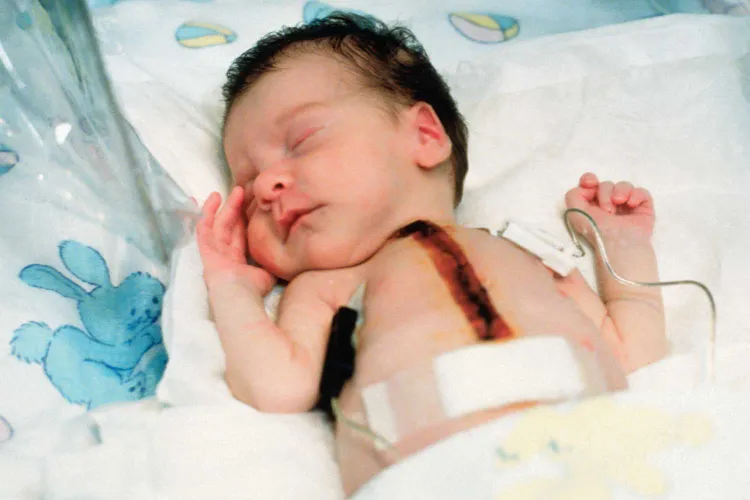

When a premature infant needed a life-saving solution, doctors turned to a source few expected — a baboon heart. The bold procedure ignited national fascination and a firestorm of ethical discussion.
Nicknamed Baby Fae, the little girl was born on October 14, 1984, with a severely underdeveloped heart. Weighing just 5.9 pounds, she quickly began struggling to breathe. Within days, doctors warned her parents that she was running out of time. Then came an extraordinary proposal from specialists at Loma Linda University Medical Center: a baboon-to-human heart transplant.
Baby Fae’s parents agreed to the unprecedented operation. On October 26, pediatric cardiac surgeon Dr. Leonard Bailey implanted the walnut-sized heart of a 7-month-old baboon into the infant’s chest — a medical milestone that pushed the boundaries of science and ethics.
Almost immediately, controversy erupted. Animal rights groups protested, while medical ethicists questioned whether all human donor options had been explored. UCLA’s Dr. Paul Terasaki argued that the surgeons “did not make any effort to get a human infant heart because they were set on doing a baboon.”
:max_bytes(150000):strip_icc():focal(781x374:783x376):format(webp)/Animal-Rights-Advocates-Protesting-loma-linda-1984-111125-c5f130ef17dc47aeb68e9862182bc215.jpg)
Despite the uproar, the public was captivated by Baby Fae’s gentle smile — a symbol of courage in the face of impossible odds. Yet, after 21 days, her tiny body began rejecting the new organ, and she passed away with her parents at her side.
Her mother Teresa and father Howard later recalled the agonizing decision and the hope that drove it. They were told that without an extraordinary intervention, their daughter would not survive. Howard explained that they weighed every option before saying yes: “If we didn’t try — this or some other procedure — we would always wonder if we had given our best shot at giving her life.”
Teresa expressed a similar resolve, insisting that compatibility, not sentiment, guided their decision. “The soul is not in the heart,” she said. “The soul of a human is in the brain… How can it be wrong to try to save a little girl’s life?”
After the operation, the couple stayed close, visiting often while doctors fought to stave off rejection. When the end came, they felt gratitude rather than anger.
:max_bytes(150000):strip_icc():focal(726x643:728x645):format(webp)/baby-fae-people-magazine-cover-111125-e62c943e64134a46826328e92b8b2c28.jpg)
“There was no blame laid anywhere,” Howard said. “We were just glad for the time we did have with her.”
Even after their loss, Teresa held no regrets. “Getting that baboon heart tripled her lifetime,” she said. “From what they learned in Fae’s case I’m sure the next baby they do it with will live longer.”
The story of Baby Fae remains a defining moment in the evolution of transplant medicine — a bold step that paved the way for future breakthroughs and reshaped the conversation about how far science should go to save a life.