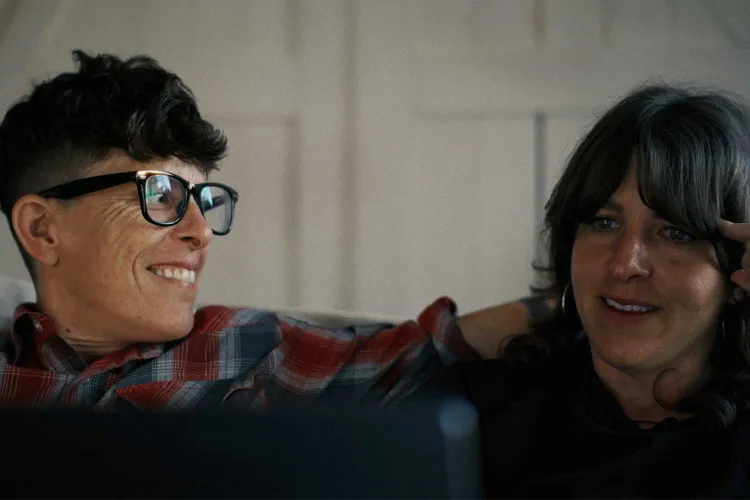

The first time Megan Falley watched the documentary Come See Me in the Good Light without her spouse, poet Andrea Gibson, she cried through every frame.
“I felt like I could pluck Andrea out of the screen,” says Falley, 37.
Now streaming on Apple TV, the film follows the last chapter of Gibson’s life as they grew more and more ill with ovarian cancer that doctors said could not be cured. Gibson, who used they/them pronouns, died in July at 49 years old.
And yet Come See Me in the Good Light is not simply a story about dying.
Like Gibson’s poetry — which turned them into a kind of spoken-word “rock star” and helped make them Colorado’s poet laureate — the film feels intimate, musical and glowing. It’s a patchwork of small, vivid moments from what turned out to be nearly the final year of their life.
:max_bytes(150000):strip_icc():focal(840x472:842x474):format(webp)/come-see-me-in-the-good-light-andrea-gibson-2-111925-f20b8caab7694b5abce566868f2543b5.jpg)
Director Ryan White and longtime producer and collaborator Jessica Hargrave say the feel of the documentary was shaped by the way Gibson and Falley chose to live. What began as a straightforward end-of-life chronicle slowly transformed into something else: a portrait of Gibson’s tenacity, humor and deep love — for Falley, for their community, for the world surrounding them.
White says the crew’s access to the couple’s lives grew over time, until they felt “like a little family.”
“It was the assumption that we would be documenting Andrea through their final breath, and Andrea understood that as well. We would talk about it all the time,” he recalls. “The first thing that Andrea said to me when I met them was, ‘I guess you’re going to be with me when I die.’ ”
Eventually, that understanding shifted — perhaps in exactly the way Gibson hoped it would.
“I think Andrea kind of knew all along that this would not be a death film,” White says. “But they were going to let us come to that conclusion on our own and not force it.”
He remembers using the phrase “dying gracefully” during production and seeing how gently Gibson pushed back.
“Andrea was very kind, so they weren’t going to say to us, ‘You guys, that’s not what I’m showing you,’ ” White explains. “They said something like, ‘Oh, that’s so interesting you used the phrase “dying gracefully,” because what I think I’m doing is hopefully living gracefully.’ ”
Editor Berenice Chavez was the first to truly see what Come See Me in the Good Light could become. Working with hours upon hours of footage shot between January 2024 and January 2025 — roughly one week a month with Gibson and Falley — she began stitching together a film centered less on decline and more on how fully Gibson continued to live.
“I’ve never met anyone who says such beautiful things so casually while they’re making dinner,” Hargrave says. “That’s why we were like, ‘Don’t turn the cameras off. Just keep it going as much as possible.’ ”
White agrees. “Andrea and Megan as people — they’re the least boring people even doing the most boring of things, because they’re f—— hilarious and they’re f—— poets.”
As Gibson faced their mortality, they kept turning toward a different kind of bucket list: not grand trips or dramatic gestures, but the thousands of tiny details that make up a day — car rides, birdsong, shared jokes, kitchen chatter.
“We started seeing all of the joy and all of the humor that this couple was going through,” White says. “And we started to shift and wonder, why does the hero have to die at the end of the film?”
In the documentary, Gibson doesn’t die. They lived long enough to attend the film’s premiere at the Sundance Film Festival, where it won an audience award.
:max_bytes(150000):strip_icc():focal(779x481:781x483):format(webp)/come-see-me-in-the-good-light-andrea-gibson-111925-ac5d7f9b2f584c3c8ca3beecc4ed3d95.jpg)
Falley says Gibson believed that sharing their experience would help others — and not just people facing cancer.
“They felt it would help anyone see that there isn’t necessarily a prescription of emotion that is required for any situation in life,” she explains. “The only thing we really have control over is how we decide to view or experience what we have, or what happens to us. And in any of those situations, you can choose to dance, you can choose to love bigger, you can choose more presence.”
“There’s so much possibility in just watching how Andrea moved through it all,” Falley adds.
One thread that runs through the film is Gibson’s ongoing battle with the couple’s flimsy mailbox.
“For a while, I thought of the mailbox just as a funny gag throughout the movie,” Falley says. “And then over time I realized, oh, I actually think this is a metaphor for Andrea: This mailbox gets knocked over and rebuilt constantly.”
A writer herself — she has taken over Gibson’s beloved newsletter, Things That Don’t Suck — Falley says she feels most connected to her spouse through language.
“I think the response to what I’ve been writing now, it seems to really be helping people,” she says. “And that feels almost like a continuation of Andrea’s legacy that I can carry in my own way.”
“Andrea helped people through life,” she says softly, “and now I get to help people through Andrea’s death.”
Falley still lives in the Longmont, Colorado, home she shared with Gibson. It’s large for one person, but she doesn’t plan on leaving.
“Andrea, who was not attached to anything physical, was really attached to that home,” she explains. “We constantly redecorated it. We didn’t build it together — but we built what almost feels like an altar to our love, like a living altar.”
She is deeply grateful for the documentary, too — a record of everything they navigated side by side. She’s watched Come See Me in the Good Light at least 10 times, probably more.
“I want to soak in every opportunity I can to see their face and hear their voice and watch our love,” she says.
Recently, Falley wrote about the ways Gibson’s presence still seems to flare up in her everyday life: revisiting their favorite store, World Market; trying to dream of Gibson after following the advice of an Instagram-famous medium.
While sitting in a hotel room in San Francisco, she shared a new story — another small sign she feels came from her spouse, glimpsed through whatever thin place lies between life, death, memory and time.
Riding an elevator in her hotel, Falley noticed a piece of generic wall art, the kind that appears on floor after floor in big hotels. Tucked into the image was a dark little silhouette that looked, to her, exactly like Gibson.
“It’s on every single floor. Every floor is identical, and it’s this one picture,” she says. “And so I keep watching the doors open and see them, and the doors close.”
“For me,” she says, “it was just a message of: here you are, this is where you’re supposed to be — and here I am as well.”