
A Canadian woman is speaking out about the “devastating” illness that doctors say forced a life-saving quadruple amputation.
In June, Jane Haley, a 41-year-old accountant from Alberta, Canada, developed strep throat. After taking antibiotics for about a week to 10 days, she felt like she was recovering. But two months later, her health suddenly spiraled.
“Towards the end of August I started to have pain in my jaw and cheek and then in the left side of my neck,” Haley told Kennedy News and Media via The Sun. “I thought it was just my glands swelling up to take care of an infection or whatever was happening in my jaw.”
At first, Haley believed she was having a flare-up of TMJ disorder, a condition that causes pain in the jaw joint and surrounding muscles. When the discomfort worsened and turned into swelling in her neck along with vomiting, she called for medical advice and was told to go to the hospital immediately. She was admitted on August 24.
“That was the last thing I remember,” she said. “One minute I was fine and the next minute I wasn’t fine and I was rushed to ICU.”
:max_bytes(150000):strip_icc():focal(599x0:601x2):format(webp)/quadruple-amputation3-112025-226776fc85534bb3b0270fd57faa429a.jpg)
Soon after arriving, Haley’s heart rate and blood pressure crashed. Doctors placed her in a medically induced coma and diagnosed her with Group A Streptococcus that had progressed into toxic shock syndrome.
Toxic shock syndrome (TSS) is rare but life-threatening. It occurs when toxins produced by bacteria trigger a severe immune response, leading to shock and organ failure. Haley deteriorated rapidly, suffering fever, seizures, and multiple-organ failure. As blood flow to her extremities collapsed, her hands and feet began to blacken from extensive tissue damage.
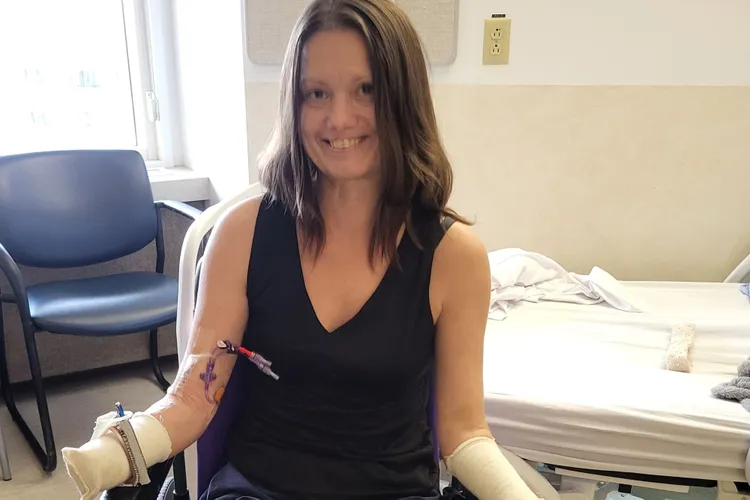
“It was devastating at the time to see my hands,” she said. “My feet hadn’t changed color at the time so I had a bit of hope that I would still walk. It took only two weeks for my hands to look how they looked in the photos, it happened rapidly.”
Doctors ultimately told Haley that saving her life meant amputating all four limbs.
After about a month in the hospital, she was transferred by air ambulance to undergo surgery. On October 1, her hands were amputated. Less than two weeks later, both legs were amputated below the knee.
By then, Haley said the pain had become unbearable.
“It was disgusting that the bottom of my foot was black and it looked almost like an insole. The dead skin was separating from the old skin, the pain was constant,” she recalled. “It started out as a little crater [on my foot] and this got bigger and bigger [until the dead skin] could flap at me when I flexed my foot.
:max_bytes(150000):strip_icc():focal(599x0:601x2):format(webp)/quadruple-amputation4-112025-02ef0271a8244a8f91eacb03582d87f1.jpg)
“It was so extremely painful that I thought anything had to be better than this. I was ready to go and get this amputated,” she said. “It was either save my life or save my limbs and the doctors chose to save my life. I’m happy that they made this decision as I’m still here to talk about it today.”
Haley is now recovering and facing a long road of rehabilitation. Her family has started a GoFundMe to help cover physical and mental-health therapy, adaptive mobility equipment, and eventually prosthetics so she can regain independence.
“All I’m doing now is I’m in survival mode and I’m looking forward [to my future],” she said. “I’m happy to be living each day and approaching things that people take for granted every day. I’ve had several moments where I’ve broken down but I think for the most part I am a strong person. I don’t like to look back and say ‘what if?’”
“If I put myself in this mindset it brings down my whole day,” she added.
Haley hopes that sharing what happened will help others recognize how quickly severe infections can escalate — and why getting treatment early matters.
“This could have happened to anyone and it’s a silent killer. It’s a miracle I was on the way to the hospital, as this could have happened at home,” she said. “I want people to be more aware of what this is and how serious it can be. If this reaches out to people and even saves just one life, it’s worth it.”