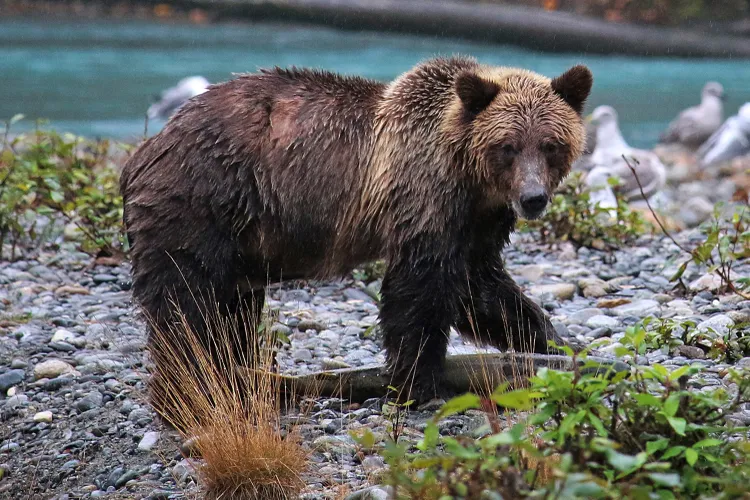

Authorities in British Columbia are continuing an urgent search for a mother grizzly and her two cubs, four days after the animals charged a group of elementary school students and teachers on a midday outing — an incident local officials describe as one of the most alarming wildlife encounters the region has seen.
The attack happened Thursday, Nov. 20, near the Four Mile subdivision of Bella Coola, a community linked with the Nuxalk Nation, the Provincial Health Services Authority previously confirmed in a statement. Students, some as young as 9, were eating lunch along a trail when a bear suddenly emerged from the trees and began attacking without warning.
As chaos broke out, three teachers stepped between the bear and the children. One emptied two full cans of bear spray with little effect. Another physically jumped onto the bear, striking it repeatedly. A third used her crutches to hit the animal until it finally retreated into the forest.
Three children were taken to a nearby hospital — two with life-threatening injuries — and one adult was airlifted to Vancouver for treatment, Inspector Kevin Van Damme said in a video update posted to Facebook. Seven additional people were treated locally for less severe injuries.
“Our thoughts are with the victim[s] and their families,” Van Damme said. “We wish them a full and speedy recovery.”
:max_bytes(150000):strip_icc():focal(749x0:751x2):format(webp)/nuxalk-first-nation-acwsalcta-school-bella-coola-british-columbia-112125-2-e0cf17bf0b08488f8f1d3865db70d684.jpg)
British Columbia’s environment minister, Tamara Davidson, praised the quick-thinking staff members who intervened, saying they put themselves at great risk to protect their students.
Conservation officers say an attack on such a large group is highly unusual and has left the local community deeply shaken. Outdoor activity across the area has slowed significantly as officers search for the sow, described as highly aggressive, and her two cubs.
Over the weekend, teams combed a large stretch of rugged terrain along the valley, but steep rock faces, dense forest, and early-winter conditions have made tracking the animals difficult.
“This is one of the most dangerous situations our officers face — especially when a mother bear is involved,” Sgt. Jeff Tyre of the Conservation Officer Service said during a Sunday briefing.
Search teams plan to continue looking for the bears through the week. Officers hope to capture the animals alive in order to obtain DNA samples and confirm whether they were responsible for the attack, though Tyre emphasized that locating wildlife in such conditions is unpredictable.
With temperatures dropping, officials say the bears may soon enter hibernation, tightening the window for crews to safely intervene.
Grizzly bears have lived alongside the Nuxalk Nation for generations, and the valley is promoted as a gateway to the Great Bear Rainforest. Residents say, however, that the number of grizzlies passing through the region has risen noticeably in recent years, disrupting a long-standing balance.
:max_bytes(150000):strip_icc():focal(749x0:751x2):format(webp)/nuxalk-first-nation-acwsalcta-school-bella-coola-british-columbia-112125-1-0b30cc13fb724e349b19cf7d264a0329.jpg)
Indigenous leaders attribute the change to a combination of human-driven impacts — including logging — and environmental pressures such as drought, wildfires, and the decline of natural food sources.
At the same time, homeowners have reported more frequent encounters and property damage. One Bella Coola couple told CityNews they returned home from an outing last month to find their metal front door torn away and their kitchen ransacked. Their refrigerator had been dragged outside, a furnace destroyed, and a recently filled propane tank emptied.
The BC Wildlife Federation, which advocates for hunters, has linked the rise in bear–human conflicts to the province’s 2017 ban on grizzly trophy hunting, arguing the decision was driven more by public pressure than by scientific evidence. The group says conservation officer calls related to grizzlies have doubled since the ban.
That push to reinstate the hunt is controversial and has divided some within the hunting community.
Critics say hunting as a primary management tool is an outdated approach and instead highlight Indigenous-led stewardship models. Nicholas Scapillati, executive director of the Grizzly Bear Foundation, pointed to Nuxalk leadership and other First Nations communities as examples of more sustainable ways of interacting with wildlife.
“As we see a change in food sources and forest fires, things are fluctuating. Bears are on the move and moving around in different ways. And so we need to think differently than how we have for centuries in this province,” Scapillati told The Guardian.
He added that “First Nations communities have been leaders in this area. And so not only do they need support for us now in this time with this rare attack, but they also need support on the plans they’ve shown us are needed to do what they’ve long known is possible: coexistence with bears.”
Officials are asking anyone with information about bear sightings in the Bella Coola area to call 1-877-952-7277.