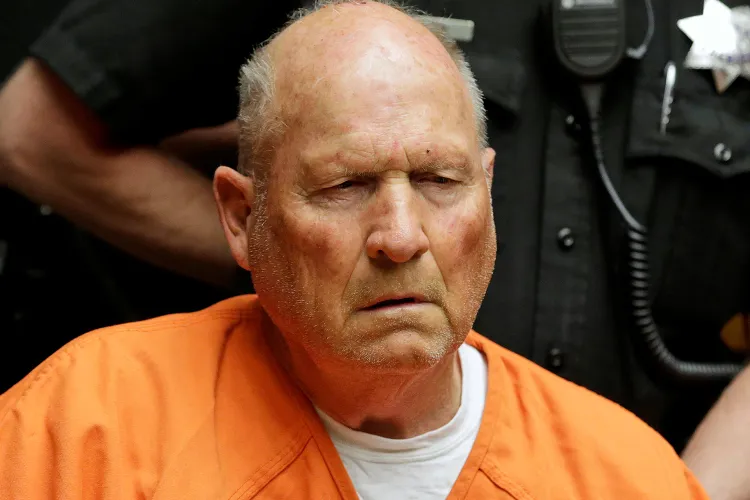

On April 24, 2018, Joseph DeAngelo — the man later unmasked as the Golden State Killer — was arrested at his home in Citrus Heights, Calif., accused of a series of murders and rapes that terrorized parts of California throughout the 1970s and ’80s.
After his arrest, the former police officer and mechanic was taken to an interrogation room. There, according to Sacramento County District Attorney Thien Ho, the lead prosecutor on the case and author of the book The People vs. the Golden State Killer, DeAngelo was left alone for two hours while investigators watched from another room, allowing him, in Ho’s words, “to stew in his own juices.”
DeAngelo had an “uncanny ability to sit there for half an hour and not even move. You could barely tell he was breathing,” Ho recalls. “He had such an amazing ability to be patient and sit there. You can imagine him standing in some bushes watching you through your window in the same way.”
When investigators finally tried to question him, DeAngelo largely stared straight ahead, saying little or muttering to himself, Ho says.
“I’ve done nothing, I’ve done nothing,” DeAngelo said, according to Ho’s book. “I’ve dreamed about him [unintelligible mumbling] . . . I was strong.”
At one point, detectives asked DeAngelo about the 1980 murders of husband and wife Lyman and Charlene Smith in Ventura County, then left him alone again.
:max_bytes(150000):strip_icc():focal(703x247:705x249):format(webp)/thien-ho-111425-86d80c2c1cde4e9686b7fe00fdfe4f77.jpg)
DeAngelo allegedly then “made puzzling statements about his struggle against an unidentified ‘him,’” Ho writes.
“I did all that . . . I didn’t have the strength to push him out. He made me. He went with me. It was like, in my head, I mean, he’s a part of me. I didn’t want to do those things. I pushed Jerry out and had a happy life. I did all those things. I’ve destroyed all their lives . . . I raped. So now I gotta pay the price,” DeAngelo said, according to the book.
“DeAngelo was claiming that an alter ego named Jerry made him hurt, rape, and kill his victims,” Ho writes.
In a later interview, Ho says DeAngelo — dressed in cargo shorts, tube socks and a T-shirt — drew on “a little bit of legal knowledge” from his time in law enforcement and appeared to be laying the groundwork for a dissociative identity disorder defense.
“‘Jerry made me do it,’” Ho says, summarizing DeAngelo’s claim. “That Jerry was inside of him. And so he tried to establish this split personality defense, but he did it in such an amateurish way that he defeated his own insanity defense, because in the State of California, you only get it if you don’t understand the nature or the wrongfulness of your crimes. Obviously, he understood it, because he said, ‘Jerry made me do it. I didn’t want to do it,’ so he understood the wrongfulness — but he still tried to create that defense, which you don’t often see, that sort of manipulation, from a typical defendant.”
:max_bytes(150000):strip_icc():focal(693x0:695x2):format(webp)/joseph-DeAngelo-2-111325-355e65d12aa042558c5bd9830b91daad.jpg)
Ho says it wasn’t the first time DeAngelo — who was also known as the Visalia Ransacker, the East Bay Rapist and the Original Night Stalker — attempted to feign instability. In 1979, DeAngelo was detained at a store for allegedly stealing dog repellent and a hammer. When deputies arrived, he reportedly faked a heart attack and began screaming incoherently.
“He’s a master manipulator,” Ho says. “He started to pretend like he was crazy in front of security. He later admitted to the police that, ‘I just pretended to be crazy because I didn’t want them to call the police. They might let me go.’”
DeAngelo, who was ultimately identified through DNA testing and genetic genealogy, pleaded guilty in June 2020 to 13 murders and numerous other crimes, a deal that allowed him to avoid the death penalty.
:max_bytes(150000):strip_icc():focal(599x0:601x2):format(webp)/the-people-vs-the-golden-state-killer-111425r-4eba92ad16e346169e70c8e9c328e8d9.jpg)
His criminal career began as a burglar in Visalia, Calif., where he is suspected of committing more than 100 home burglaries between April 1974 and December 1975.
His first known murder was that of Claude Snelling, a journalism professor and public information officer at the College of the Sequoias. Snelling was fatally shot in September 1975 while trying to stop the kidnapping of his 16-year-old daughter.