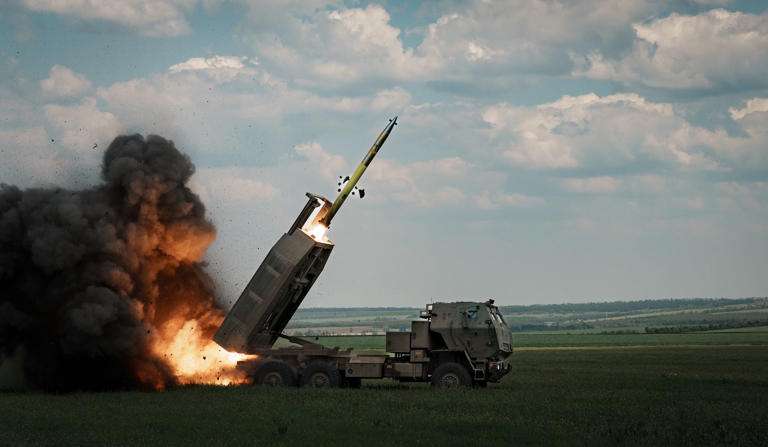

A NATO member that shares a border with Russia is doubling down on its purchase of the US-made High Mobility Artillery Rocket System (HIMARS), a weapon that has played a central role in Ukraine’s resistance to Russia’s invasion.
Estonia’s defense ministry told Business Insider that it has an agreement with the US to acquire six additional HIMARS launchers and is currently waiting for confirmation of delivery dates from Washington.
“It is important for Estonia to have the ability to influence the enemy deep within its territory,” the ministry said, adding that boosting long-range strike capability requires more rocket systems.
Estonian Defense Minister Hanno Pevkur previously told Breaking Defense that Estonia aims to buy six more HIMARS units, and possibly additional systems later. He said the government has been in contact with manufacturer Lockheed Martin, but any sale still needs approval from the Pentagon.
Estonia is moving ahead after already receiving its first six HIMARS in April. The ministry said those initial deliveries were only the beginning of “developing our deep-strike capability.”
Pevkur told Business Insider in March that Estonia regards HIMARS as critical to its long-range firepower, particularly after watching how Ukraine has used the system.
HIMARS in Ukraine reshaped the battlefield
The launcher first arrived in Ukraine in June 2022, becoming the first major Western heavy weapon system sent to Kyiv after months of debate over escalation risks and fears that advanced equipment could be captured if Ukraine collapsed.
Its deployment marked a turning point. HIMARS was eventually followed by other marquee systems, including US-made Patriot air defenses and F-16 fighter jets.
Armed with HIMARS and Guided Multiple Launch Rocket Systems (GMLRS), Ukraine was suddenly able to erode Russia’s artillery advantage and hit high-value targets — ammunition depots, command centers, and other assets that had previously been safely positioned far behind the front. Ukrainian forces also used HIMARS to strike Russian troops and aircraft.
Over time, however, Russia’s expanding electronic-warfare and jamming capabilities, along with the arrival of newer long-range systems, have reduced HIMARS’ prominence. Ammunition shortages have further constrained its use, though the system remains in service and Ukraine expects more launchers and rockets. In October, President Volodymyr Zelenskyy again highlighted HIMARS as a priority capability.
NATO’s Front-Line States Race to Build Deep-Strike Power
Estonia is one of several European countries alarmed by Russian aggression, and Pevkur said Ukraine has clearly shown that deep strikes are essential in modern high-intensity warfare.
He noted that Ukraine has repeatedly hit targets far behind Russian lines — including positions, weapons, stockpiles, and even oil infrastructure deep inside Russia — using long-range missiles and drones.
According to Pevkur, deep-strike assets are an area where NATO members “need to invest” and “need to have a lot more than what we have today.” He stressed that allies must study Ukraine’s experience — what works, what doesn’t, and how Russia adapts — so their own forces are as prepared as possible.
He added that fielding HIMARS is not only about capability but also about signaling: it sends a clear “deterrence message” to Moscow.
Estonia’s Baltic neighbors, Latvia and Lithuania — also NATO allies bordering Russia — are making similar moves. Latvia has an agreement with the US for six HIMARS systems, with deliveries expected by 2027, while Lithuania is buying eight, with the first units due to arrive this year.
The Baltic states have been among NATO’s most vocal advocates for higher defense spending and stronger support for Ukraine. Their defense budgets rank among the alliance’s highest as a share of GDP, funding projects such as border fortifications, air defense systems, armored vehicles, and drones.
Pevkur told Business Insider that it is in the broader West’s interest to ensure that countries on NATO’s eastern edge are heavily fortified — both to deter Russia and to be able to stop it if it ever tests the alliance’s resolve. As he put it, “The eastern flank is the front door of NATO, so we need to keep it closed.”