
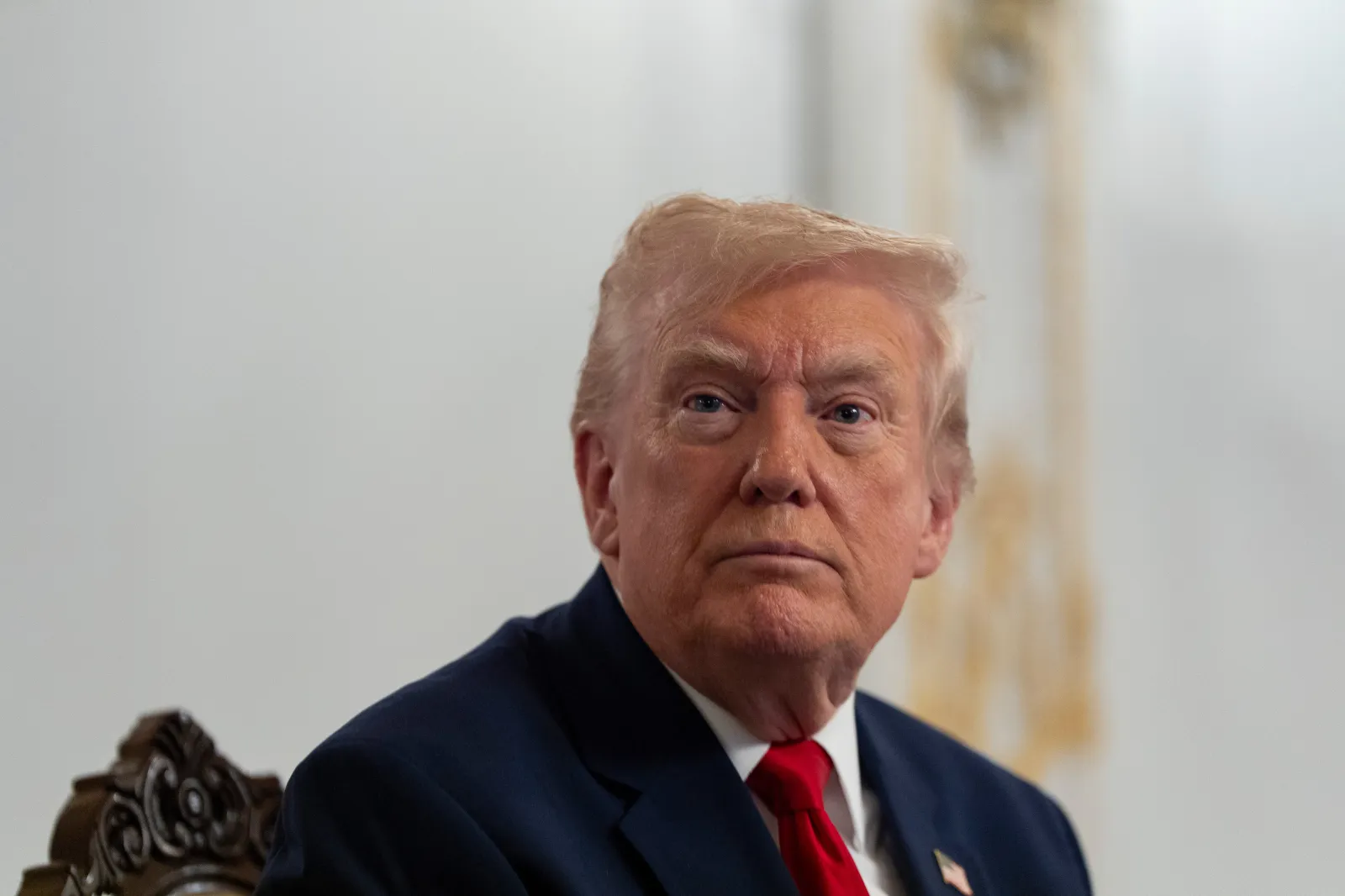

President Donald Trump has said he wants to “substantially” reduce — and possibly eliminate — federal income tax, arguing that booming tariff revenues and new investment generated by his trade policies could pay for it.
Delivering a Thanksgiving message from his Mar-a-Lago estate in Florida, Trump pointed to investment pledges from foreign governments and companies expanding production in the U.S., as well as money collected from import duties.
“Over the next couple of years, I think we’ll substantially be cutting—and maybe cutting out completely—income tax,” Trump said. “We could be almost completely cutting it because the money we’re taking in is going to be so large.”
Why It Matters
The administration has repeatedly floated the idea of slashing or abolishing income tax and replacing that revenue with tariffs. But most tax and budget experts say the math doesn’t come close to adding up.
Last year, the Internal Revenue Service (IRS) collected nearly $2.7 trillion in income taxes. By contrast, tariff revenues — even after recent increases — fall far short of that total, making it highly unlikely they could fund existing government programs on their own.
What To Know
In October, during his presidential campaign, Trump cited the United States in the late 19th century as a model, noting that the country then “had all tariffs, it didn’t have an income tax.” Days later, he told Joe Rogan he was considering getting rid of the income tax altogether if he won a second term.
Earlier this year, Commerce Secretary Howard Lutnick said the president was exploring eliminating income tax for people earning under $150,000 annually, with a longer-term goal of abolishing the IRS altogether.
Income tax currently makes up more than half of total federal revenue. According to the latest Treasury Department data, individual income taxes accounted for 54 percent of government receipts, with $217 billion of the $404 billion collected last month coming from this source. The government spent about $689 billion in that same month, and combined with shutdown impacts and delayed benefit payments, ran a $284 billion deficit — despite a record $31 billion in net tariff revenues for October.
For the full Fiscal Year 2025, which ended September 30, the government collected $195 billion in customs duties, more than 250 percent higher than the previous year, while bringing in nearly $2.7 trillion in income taxes.
That gap has led economists to question whether tariffs could remotely replace income tax revenues while still allowing Washington to fund current programs and reduce the national debt.
“Simply put, no. It wouldn’t even be close,” Kimberly Clausing, professor of Tax Law and Policy at the UCLA School of Law, told Newsweek in January.
Daniel Shaviro, a professor of taxation at NYU Law, called Trump’s latest proposal “complete fantasy” and told Newsweek that tariffs “probably can’t even supply even as much of 10 percent of the revenues derived from U.S. individual income tax revenues alone.”
Beyond the direct tariff revenues, Trump has highlighted large investment pledges from corporations and foreign governments since the start of his second term. The administration has claimed the U.S. is on track to receive around $21 trillion in pledges this year.
However, an analysis by Bloomberg Economics found the real number to be far smaller. It concluded that many announced figures are spread over several years, reflect mutual trade commitments rather than direct payments, and often do not flow to federal coffers. Adjusting for those factors, Bloomberg estimated the actual amount closer to $1.5 trillion annually.
Shaviro dismissed those investment promises from other countries as “just talk,” adding that even significant private-sector investment in U.S. assets “would do nothing whatsoever to reduce U.S. government fiscal needs.”
What People Are Saying
Stephen Moore, an economist and former economic adviser to Trump, told Bloomberg: “Even if [Trump is] wrong by a factor of 10, we’re still talking $2 trillion. Even if he’s off by a factor of a hundred, that’s still a lot of money.”
During his Thanksgiving address, Trump said:
“We’re taking in, think of it, hundreds of billions. Next year, it’ll be a trillion dollars or more, but we’re taking in all this money while protecting our country. And we’re respected again. They actually respect us. And they made the deals. I mean, they respect us, but they pay us. As an example, Japan $650 billion, South Korea $350 billion, European Union $950 billion. And they are building plants now in the United States because they don’t want to pay tariffs.”
What Happens Next
The legality of Trump’s tariff strategy is currently before the Supreme Court. The administration appealed lower court rulings that found the president exceeded his authority by imposing tariffs under the 1977 International Emergency Economic Powers Act. The Court began hearing arguments in early November, and the administration expects a ruling before the end of the year.
Trump has said that even if the Court curtails his authority under that law, he can turn to other legal provisions to continue the policy. Still, he has warned that an adverse decision would be “devastating” for the country and threaten the investments he says depend on the tariffs remaining in place.


