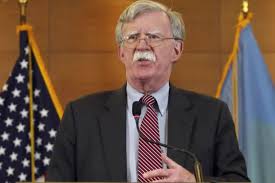

Former National Security Adviser John Bolton is brushing aside speculation that the United States is on the verge of launching a military operation in Venezuela, saying there is no active plan for intervention and that deployed U.S. personnel are largely engaged in routine duties.
In recent comments about the ongoing political and economic crisis in Venezuela, Bolton said that American soldiers stationed in the region are not preparing for war. Instead, he described them as “enjoying the Caribbean and going for walks,” suggesting that their presence should not be interpreted as a sign of imminent conflict.
Bolton’s remarks come amid renewed debate over how the U.S. should respond to the situation in Venezuela, where years of economic collapse, shortages and political turmoil have forced millions to flee the country. Some hawkish voices in Washington have argued that more aggressive measures — including the threat or use of force — could be needed to push the Venezuelan leadership toward democratic change.
Bolton, who has long been seen as a hard-liner on foreign policy, sought to distance himself from calls for a military solution. While he emphasized that the U.S. retains the ability to act if its interests or citizens are directly threatened, he stressed that recent movements of American forces in the broader region are part of normal rotations, training and strategic positioning — not the prelude to an invasion.
“There is no secret operation about to be launched,” he said, characterizing talk of a looming U.S. assault on Venezuela as “exaggerated speculation.” He added that U.S. leaders are closely watching developments on the ground, but that any suggestion of an already-approved plan to send troops into Venezuelan territory is “simply wrong.”
Focus on Diplomatic and Economic Pressure
According to Bolton, the preferred tools for dealing with Venezuela remain diplomatic isolation and economic pressure, rather than direct military action. Over the last several years, the U.S. and a coalition of partners have imposed sanctions on key figures and entities linked to the Venezuelan government, aiming to cut off financial lifelines and press for negotiations.
Bolton argued that these measures, coupled with international attention on human rights and democratic norms, are more likely to produce lasting change than a military intervention that could entangle the U.S. in a prolonged conflict. He pointed to the risks of unintended consequences, including regional instability and the possibility of drawing in other powers with interests in Venezuela.
“The United States has a full range of options,” he said, “but that doesn’t mean the first or best choice is to send in troops. The goal is to support the Venezuelan people and encourage a peaceful, democratic transition, not to create a wider crisis.”
Allies, Critics and Domestic Politics
Bolton’s comments are also being viewed through the lens of domestic politics, where foreign policy decisions — especially those involving the use of force — can quickly become flashpoints. Some U.S. lawmakers have warned that any hint of intervention in Venezuela could fuel anti-American sentiment in Latin America, damage relationships with regional partners, and distract from other global priorities.
Human rights advocates and Venezuelan diaspora groups have been divided over the role the U.S. should play. While many have urged Washington to maintain pressure on the Venezuelan government and continue providing humanitarian assistance to refugees, others worry that talk of military action could be used by Venezuelan leaders to justify further crackdowns at home.
Bolton acknowledged these concerns, saying that U.S. policy needs to balance moral support for democratic movements with realism about what military force can and cannot achieve. He reiterated that, for now, the emphasis remains on sanctions, diplomacy and international coordination.
Troops in the Region, but No “Countdown Clock”
The presence of U.S. forces in the Caribbean and nearby territories has fueled rumors of a buildup, particularly when photos of ships or aircraft circulate on social media. Bolton argued that such imagery is often taken out of context, noting that the U.S. routinely conducts naval patrols, joint exercises and counter-narcotics operations in the area.
“When people see a U.S. ship or a unit in the Caribbean, they sometimes imagine there’s a countdown clock to an invasion,” he said. “In reality, these are standard deployments. The men and women serving there are carrying out their missions, training, and, yes, sometimes enjoying the scenery when they are off duty.”
He added that if the U.S. were to consider a major military operation, it would be preceded by open debate, consultation with Congress and clear communication with allies — not hinted at through vague troop movements.
What Comes Next for Venezuela
As conditions in Venezuela continue to evolve, Bolton suggested that the United States will keep reassessing its approach. That could mean adjusting sanctions, increasing humanitarian aid, or working more closely with regional organizations to encourage negotiations between the government and opposition.
For now, though, he insists that predictions of U.S. soldiers storming Venezuelan beaches are misplaced. “People should be careful about jumping to the conclusion that every U.S. ship or unit in the Caribbean means war,” he said. “Our focus is on peaceful pressure and support for the Venezuelan people — not on launching a military invasion.”