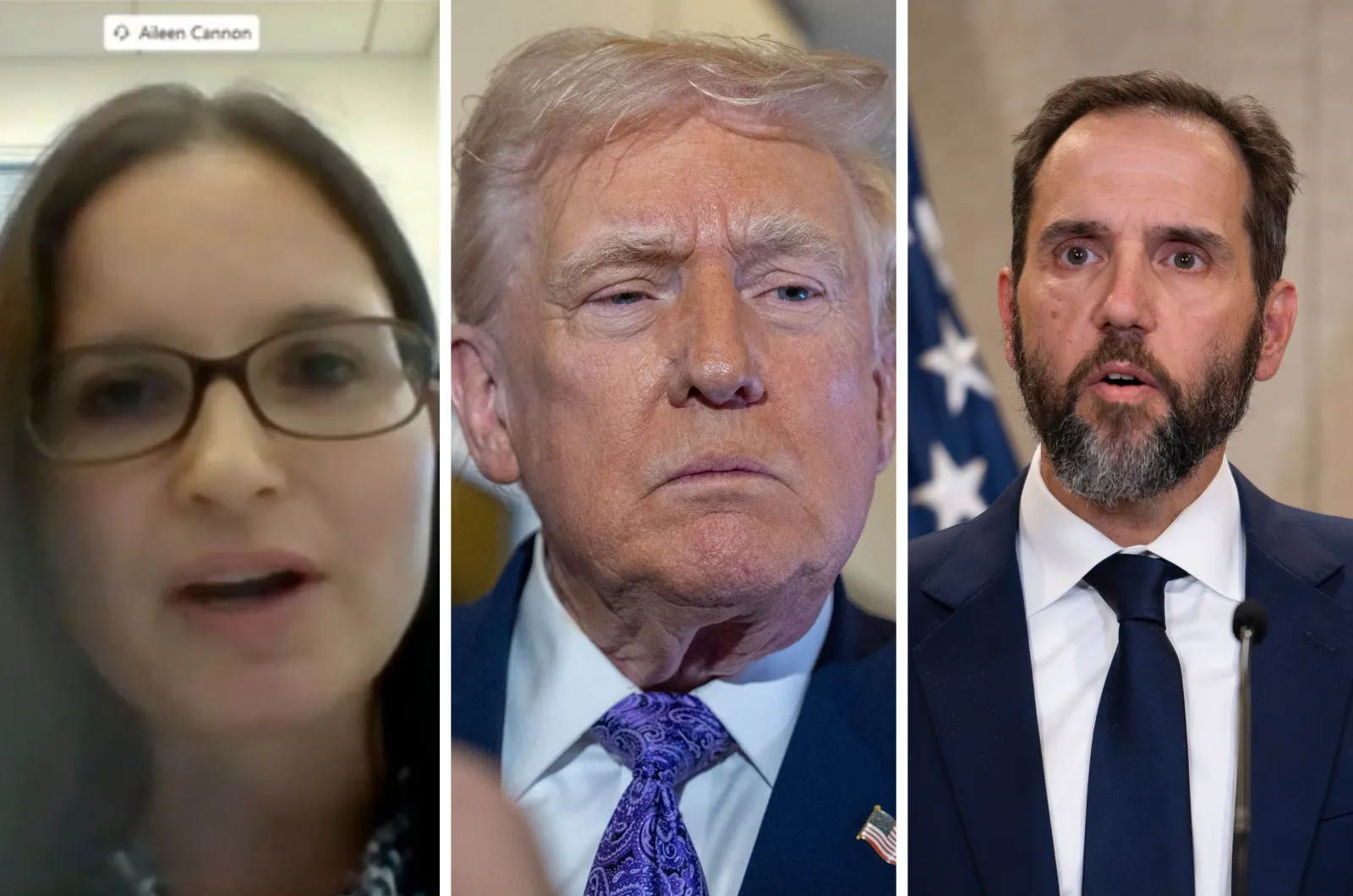

U.S. District Judge Aileen Cannon now has roughly two months to decide whether to lift her order blocking the release of Special Counsel Jack Smith’s still-secret second report on President Donald Trump’s handling of classified material.
In a new filing and joint status report submitted on December 1, 2025, the Justice Department and former defendants Waltine Nauta and Carlos De Oliveira informed Cannon that the Eleventh Circuit Court of Appeals has given her 60 days to resolve long-pending motions from transparency groups seeking access to the report.
Why It Matters
Volume II is the only comprehensive, unreleased account of the federal investigation into Trump’s handling of classified documents. Its findings could shed light on unresolved questions about a high-profile case that was ultimately closed before trial.
By giving Judge Cannon a 60-day clock to decide whether to keep the report sealed, the Eleventh Circuit has turned a long-stalled legal fight into a time-sensitive test of judicial power and public access.
The deadline adds pressure on a judge whose stewardship of the Trump documents case has repeatedly drawn scrutiny and raises broader questions about how much control a single district court can exert over information with national and historical significance.
What To Know
The appellate panel issued its directive on November 3, 2025, stating that it would hold two mandamus petitions “in abeyance for a period of 60 days to permit the Court to resolve the motions to intervene.”
Counting forward from that order, Cannon’s deadline lands on or about January 2, 2026.
This timing aligns with earlier analysis of the Eleventh Circuit’s instructions and marks a new point of urgency in a dispute where Cannon’s delays have already prompted appeals court involvement.
Background on the Fight Over Volume II
Volume II of Smith’s final report—focused on alleged obstruction and the retention of national security documents at Trump’s Mar-a-Lago residence—has been kept from the public since January 21, 2025. On that date, Cannon barred the Justice Department from releasing it outside the department.
Transparency advocates, including the Knight First Amendment Institute and American Oversight, say the injunction no longer has any legal basis after the underlying indictment was dismissed in July 2024.
They asked the Eleventh Circuit to step in back in September 2025, after Cannon went months without ruling on motions to lift her order.
According to the latest status report, the appeals court issued its November 3 directive “without ordering an answer from the Respondents pursuant to Fed. R. App. P. 21(b)(1),” underscoring its expectation that the district court act promptly.
Where the Parties Stand
In the new filing, both the Justice Department and counsel for Nauta and De Oliveira reiterate their view that the transparency groups should not be allowed to intervene in the closed criminal case.
They urge Cannon to “deny the pending motions without reaching the merits,” and say they are incorporating arguments already laid out in a March 14, 2025 filing.
The Justice Department also repeats that it “understands and appreciates the arguments made” by the former defendants regarding the “extraordinary prejudice” they claim could result from public release of Volume II. The department says it “does not object” to their position that Cannon’s January 21 order should remain in place.
If Cannon does lift the injunction, the parties agree that the Justice Department should be required to give 60 days’ written notice to defense counsel before releasing any redacted version of the report.
The filing says that such notice would allow Nauta and De Oliveira “to seek appropriate relief from this Court if the Attorney General expressed an intention to release Volume II outside the Department of Justice.”
Meanwhile, the Knight First Amendment Institute continues to argue that Cannon’s original justifications for blocking release have expired.
Senior counsel Scott Wilkens recently said in correspondence that there is “no legitimate reason for the court’s months-long delay” and that the report, which he called “of singular importance to the public,” should be released “without further delay.”
Other organizations, including American Oversight and The New York Times, are pursuing separate FOIA lawsuits seeking access to the same report.
Appellate Pressure and Next Steps for Cannon
Cannon must now decide whether to lift, modify, or reaffirm her January 21 injunction before the early-January deadline.
If she denies the transparency groups’ motions—or fails to rule within the 60-day window—the issue is likely to go straight back to the Eleventh Circuit, which has previously limited her authority in the Trump documents case.
The joint status report emphasizes that appellate scrutiny remains active and, for the first time since Cannon blocked release of Volume II, places a firm timetable on how long the report can remain under seal.
What People Are Saying
Scott Wilkens, Senior Counsel at the Knight First Amendment Institute, said:
“The First Amendment gives the public a right of access to this report, and the court should publish at least a redacted version of it right away.”
Jameel Jaffer, Executive Director of the Knight First Amendment Institute, added:
“There is no legitimate reason for the report’s continued suppression, and it should be posted on the court’s public docket without further delay.”
What Happens Next
Judge Cannon now has until early January 2026 to decide whether to lift or maintain the injunction preventing release of Volume II of Special Counsel Jack Smith’s report.
If she grants the motions from the Knight First Amendment Institute and American Oversight, the Justice Department could begin preparing a redacted version for public release, subject to the proposed requirement that counsel for Waltine Nauta and Carlos De Oliveira receive 60 days’ written notice before any disclosure.
If Cannon denies the motions—or does not rule before the Eleventh Circuit’s deadline—the case is expected to return to the appeals court, which could revive the pending mandamus petitions or take further steps to compel a decision.
At the same time, separate FOIA lawsuits in Washington, D.C., and New York will move forward on their own tracks. Even if Cannon rules swiftly, additional appeals or redaction disputes could push any eventual public release of the report into later next year.