
President Donald Trump has invoked executive privilege in an effort to block his courtroom opponents from obtaining certain evidence in a long-running civil lawsuit that accuses him of inciting the violence at the Capitol on Jan. 6, 2021.
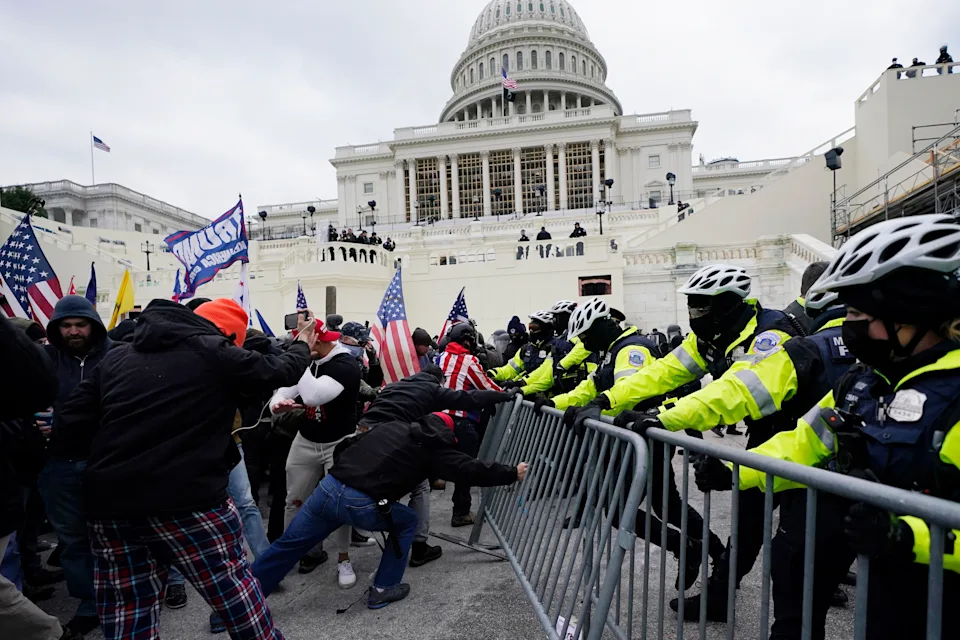
The Justice Department disclosed Trump’s assertion of privilege on Wednesday during a hearing in the five-year-old case, which was filed by police officers injured while trying to push back the mob that stormed the Capitol. The officers contend that Trump’s fiery remarks to his supporters — and his call for them to march to the Capitol — helped spark the attack that nearly disrupted the peaceful transfer of power to Joe Biden and left about 140 officers hurt.
Trump’s move is the latest in a broader campaign to reshape the narrative around his efforts to overturn the 2020 election. He has pardoned more than 1,500 people charged in connection with Jan. 6 and, last month, issued a sweeping pardon for several high-profile allies who faced legal exposure over their role in those efforts. In recent months, he has also repeatedly amplified baseless and provocative claims suggesting the FBI deliberately triggered the chaos at the Capitol.
Exactly which documents Trump is seeking to shield remains unclear. However, a White House spokesperson confirmed Wednesday that the president has opted to resist the disclosure of certain materials subpoenaed from the National Archives and Records Administration last year.
“The President asserted executive privilege over the discovery requests in this case because the overly broad requests demanded documents that were either presidential communications or communications among the president’s staff that are clearly constitutionally protected from discovery,” spokesperson Abigail Jackson said in a statement.
Lawyers for the injured officers have complained of lengthy delays in obtaining Trump-era White House records now housed at the National Archives. While the Biden administration frequently declined to assert executive privilege over Trump records when they were sought by investigators, it did not act on the document request tied to this lawsuit before Biden left office in January 2025.
Trump previously fought congressional efforts to access his records, pressing the dispute all the way to the Supreme Court. The justices ultimately let stand a lower-court ruling allowing the Archives to hand over the documents. Still, a sitting president’s position on executive privilege generally carries significantly more weight than that of a former president.
During Wednesday’s hearing before U.S. District Judge Amit Mehta, Justice Department attorney Alexander Haas said he did not yet have specifics on how many records were covered by Trump’s privilege claim or whether a detailed log had been compiled. He indicated he would provide the court with that information in a report next week.
Haas did, however, confirm that Trump is resisting at least some of the plaintiffs’ efforts to obtain documents.
“My understanding is that the review is complete,” Haas told Mehta. “My understanding is some portion of the records the president has asserted privilege over.”
The scope of the subpoena at issue, issued about a year ago, is public. It requests records related to the Jan. 6 Ellipse rally where Trump spoke, all documents and communications concerning “efforts to get Defendant Trump to issue statements regarding violence” that day, material addressing the risk of violence on Jan. 6, communications about alleged election fraud, the certification of electors, and “any strategy to overturn the results of the November 2020 Presidential Election.”
In response to this lawsuit and others — including a case brought by Democratic lawmakers — Trump has argued that he is immune from civil liability because he was acting in his official capacity as president on Jan. 6. His legal team has also claimed that his remarks at the Ellipse were protected political speech under the First Amendment and therefore cannot serve as the basis for liability.
Judge Mehta, an appointee of President Barack Obama, rejected those arguments as grounds to dismiss the cases in a 2022 ruling. He concluded the lawsuits could move forward, citing indications that Trump may have been aware some of his supporters were armed and that he had discouraged security screening that might have intercepted those weapons.