
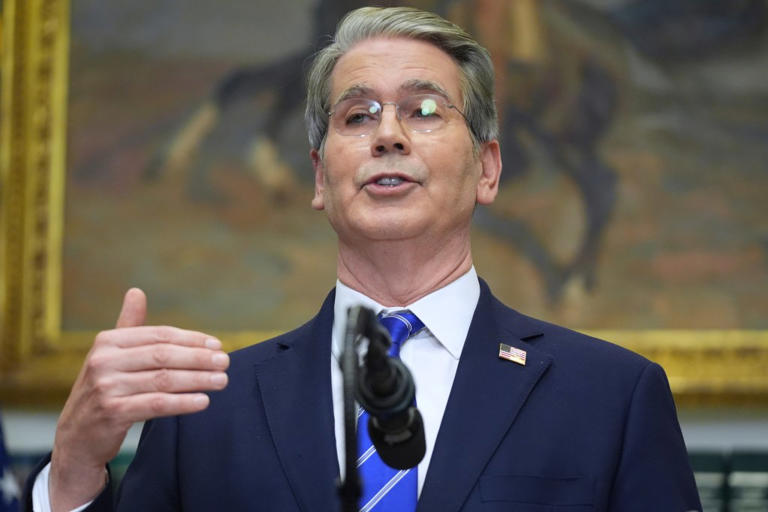

Treasury Secretary Scott Bessent says the Trump administration has a fallback plan to keep broad tariffs in place even if the U.S. Supreme Court rules that the emergency-powers authority currently used to justify them is invalid.
Speaking at the DealBook Summit, Bessent was asked “what kind of planning you’ve been doing” in case the court strikes down the legal basis for the tariffs. In response, he laid out how the White House could rebuild its tariff framework using other trade laws.
Why It Matters
The Supreme Court is weighing whether former President Donald Trump can rely on the International Emergency Economic Powers Act (IEEPA) to impose sweeping tariffs. Lower courts have ruled that the statute does not clearly authorize such duties, and a decision is expected this month.
The ruling could redefine the scope of presidential authority over tariffs and reshape U.S. trade policy, influencing negotiations with key trading partners and opening the door to potential refund claims from importers.
Inside Bessent’s Tariff Logic
Bessent’s remarks came in an interview with New York Times journalist Andrew Ross Sorkin at the DealBook Summit on December 3 at New York’s Lincoln Center. Sorkin began by highlighting tariffs as one of the biggest philosophical and practical shifts in recent U.S. economic policy.
He asked Bessent how his views on tariffs had evolved—pointing out that Bessent previously argued tariffs were inflationary and unlikely under Trump—and invited him to explain what changed after he became Treasury Secretary.
Bessent responded: “I have been very consistent on this, the tariffs are a shrinking ice cube. The ultimate goal is to rebalance trade and to bring back domestic production,” adding, “I don’t believe tariffs are a tax.”
Bessent Pushes Back on Supreme Court Speculation
Bessent said a ruling from the Court could arrive “at any moment,” but that he remains “optimistic” about the outcome. He disputed media narratives that several justices seemed skeptical of the administration’s tariff authority.
Pointing to Justice Amy Coney Barrett’s comment that unwinding the tariffs “would be a mess,” Bessent argued that her remark had been read the wrong way. According to him, Barrett “actually meant it as we’ve got to be very judicious… very prudent about doing this.”
He confirmed that the administration has contingency plans if the justices ultimately rule against them.
“We can recreate the exact tariff structure with 301s, with 232s, with the—I think they’re called 122s,” he said, referring to three different statutory tools for trade actions.
Some authorities, such as Section 122, do not permit long-term tariffs, but Bessent said others could reproduce key parts of the existing regime.
What Are Sections 301, 232 and 122?
- Section 301 of the Trade Act of 1974 allows the U.S. to impose tariffs or other measures in response to unfair trade practices by foreign governments, including intellectual property theft or discriminatory trade barriers.
- Section 232 of the Trade Expansion Act of 1962 authorizes tariffs on imports that threaten U.S. national security, enabling restrictions on goods like steel or aluminum if they are considered crucial for defense or critical infrastructure.
- Section 122 of the Trade Act of 1974 lets the president impose temporary tariffs or quotas—generally for up to 150 days—when the U.S. faces serious balance-of-payments deficits, making it a short-term lever compared with Sections 301 and 232.
Bessent said the Supreme Court case partly centers on the breadth of presidential emergency powers. He argued that the fentanyl crisis illustrates a legitimate reason for invoking emergency authority, noting what he described as China’s increased cooperation after facing U.S. tariff threats.
“If the fentanyl crisis wasn’t an emergency… then what was?” Bessent said.
He added that when China announced new licensing requirements tied to rare-earth elements, “President Trump was able to threaten them with a 100% tariff. They immediately came to the negotiating table.”
Economic Stakes: Inflation, Refunds and Trade Balance
Bessent also discussed the economic fallout that could follow if the Court orders the tariffs undone.
He referenced reports that Costco may seek tariff refunds and questioned how refunds would work if foreign exporters had already cut pre-tariff prices. Those adjustments, he suggested, make it difficult to calculate what, if anything, should be reimbursed.
Bessent maintained that the goal of the tariffs is not to raise revenue, but to reset trade relationships and spur domestic industry.
He described China as “a very different economic animal” that is willing to lower export prices and said Chinese suppliers have “consistently cut prices” in response to U.S. measures.
On inflation, Bessent rejected the idea that tariffs are a major driver. He characterized their impact as a one-time price level shift rather than a source of ongoing inflationary pressure.
He dismissed concerns from analysts, including Federal Reserve Chair Jerome Powell, who has warned that tariffs push prices higher relative to the Fed’s 2 percent inflation target. Bessent argued that the share of the U.S. economy touched by tariffs is relatively small.
Even in the event of an unfavorable ruling, Bessent said the administration’s long-term objectives would not change.
“The ultimate goal is to rebalance trade and to bring back domestic production,” he reiterated, emphasizing that the White House still has “multiple legal pathways” to pursue its tariff agenda if current authorities are narrowed.
He warned that striking down the tariff program would ultimately hurt U.S. households, saying: “Everyone says it will be a loss for the administration. I think it’ll be a loss for the American people.”
What Comes Next
The Supreme Court’s upcoming decision on tariff authority will determine whether the administration can keep its current framework in place or must quickly rebuild it under different trade statutes.
A loss for the White House could trigger refund demands, complicate trade talks and force policymakers to rework their legal and economic strategies. A favorable ruling, by contrast, would largely preserve the administration’s existing tariff playbook and reinforce the president’s ability to use similar tools in future trade disputes.


