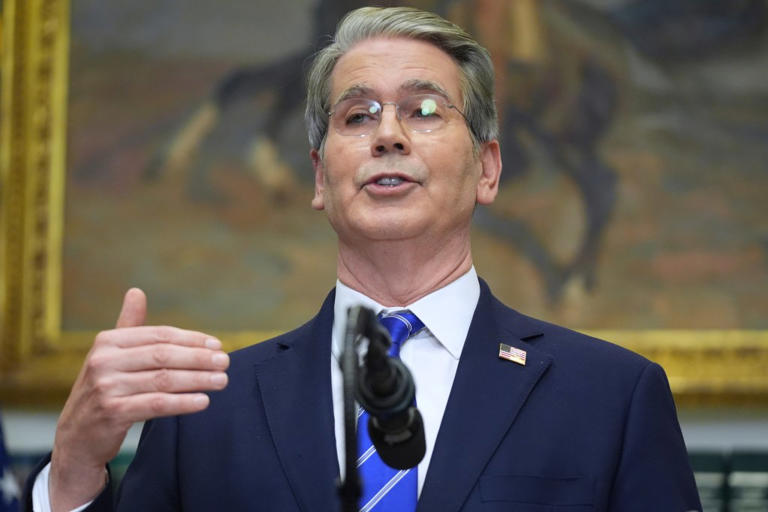

Treasury Secretary Scott Bessent says the Trump administration has a contingency plan to preserve its broad tariff regime even if the U.S. Supreme Court blocks the emergency-powers authority currently used to justify it.
Speaking at the DealBook Summit, Bessent was asked “what kind of planning you’ve been doing” in case the Court strikes down the existing tariff framework. In response, he explained how the White House could reconstruct a similar system using other legal tools.
Why It Matters
The Supreme Court is considering whether Trump can rely on the International Emergency Economic Powers Act to impose wide-ranging tariffs. Lower courts have ruled that the law does not clearly authorize such duties, and a decision is expected this month.
The ruling could significantly alter U.S. trade policy and redefine how much unilateral authority the president has over tariffs. It could influence negotiations with key trading partners and open the door to refund claims from some importers.
What To Know
Bessent sat down with New York Times journalist Andrew Ross Sorkin at the DealBook Summit on December 3 at New York’s Lincoln Center. Sorkin began by focusing on what he called the most profound philosophical and practical shift in U.S. economic strategy: the turn toward tariffs.
He asked Bessent to describe how his views on tariffs had changed—especially given that Bessent previously suggested tariffs were inflationary and unlikely under Trump—and to explain why his stance shifted after becoming Treasury Secretary.
“I have been very consistent on this, the tariffs are a shrinking ice cube,” Bessent said, arguing that the ultimate objective is “to rebalance trade and to bring back domestic production.” He also stated, “I don’t believe tariffs are a tax.”
Bessent Challenges Media Narrative On Supreme Court Signals
Bessent said a decision from the Court could arrive “at any moment,” but expressed “optimism” about the outcome. He pushed back on media reports suggesting several justices appeared wary of the administration’s legal rationale.
Referencing Justice Amy Coney Barrett’s remark that dismantling the tariffs “would be a mess,” Bessent argued that her comment was misunderstood. He said Barrett “actually meant it as we’ve got to be very judicious… very prudent about doing this.”
At the same time, Bessent confirmed that the administration has prepared fallback options in case the Court rules against it.
“We can recreate the exact tariff structure with 301s, with 232s, with the—I think they’re called 122s,” he said, citing three separate statutory authorities that can be used for trade actions.
While some tools, such as Section 122, do not permit long-term tariffs, others could be used to reestablish much of the current regime.
What Are 301s, 232s And 122s?
Section 301 of the Trade Act of 1974 allows the U.S. to impose tariffs or other trade measures in response to unfair foreign trade practices, such as intellectual property theft or discriminatory barriers to U.S. goods.
Section 232 of the Trade Expansion Act of 1962 authorizes tariffs on imports that threaten U.S. national security, giving the government power to limit goods like steel or aluminum if they are deemed essential to defense or critical infrastructure.
Section 122 of the Trade Act of 1974 permits the president to impose temporary tariffs or quotas—generally for up to 150 days—when the U.S. faces large and serious balance-of-payments deficits, making it a more short-term tool compared with Sections 301 and 232.
Bessent said the Supreme Court case partly centers on how far presidential emergency powers extend.
He argued that the fentanyl crisis provides a clear justification for invoking such powers, pointing to China’s recent cooperation in response to U.S. tariff threats. “If the fentanyl crisis wasn’t an emergency… then what was?” Bessent said.
He also noted that when China introduced new licensing rules related to rare-earth elements, “President Trump was able to threaten them with a 100% tariff. They immediately came to the negotiating table.”
Economic Stakes: Tariffs, Inflation, And Refund Risks
Bessent also weighed in on the potential financial fallout if the Court orders the tariffs unwound.
He pointed to reports that Costco may pursue refunds, and questioned how such refunds would work if foreign suppliers had already cut their pre-tariff prices. Those reductions, he said, complicate any effort to determine what should be reimbursed.
According to Bessent, the administration’s tariff policy is not mainly about raising revenue, but about rebalancing trade and expanding domestic industry.
He characterized China as “a very different economic animal” that is prepared to lower export prices, saying Chinese producers have “consistently cut prices” in response to U.S. measures.
Pressed on whether tariffs fuel inflation, Bessent disagreed with that characterization, arguing that any price impact is a one-time adjustment, not an ongoing driver of inflation.
He brushed aside concerns from analysts, including Federal Reserve Chair Jerome Powell, who has said tariffs tend to push prices higher relative to the Fed’s 2 percent inflation goal. Bessent maintained that the slice of the economy directly affected by tariffs is relatively small.
Even if the Court rules against the administration, Bessent said the broader goals of its strategy would remain unchanged.
“The ultimate goal is to rebalance trade and to bring back domestic production,” he reiterated. If current authorities are narrowed, he emphasized, the administration still has several legal avenues to pursue its tariff agenda.
Bessent warned that eliminating the tariffs would ultimately hurt Americans, saying: “Everyone says it will be a loss for the administration. I think it’ll be a loss for the American people.”
What Happens Next
The Supreme Court’s upcoming decision on tariff authority will determine whether the administration can keep its existing system in place or must quickly rebuild it using alternative trade statutes.
A ruling against the White House could trigger refund claims, disrupt ongoing negotiations, and force a broad legal and economic reset. A favorable ruling, however, would leave the current strategy largely intact and reinforce the president’s power to wield tariffs as a central tool of U.S. trade policy.