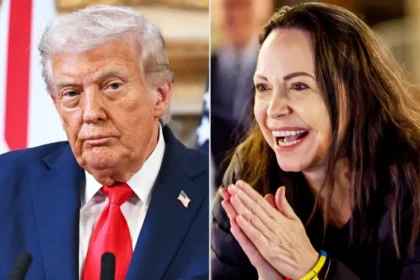
Kevin Hassett, director of the National Economic Council and widely seen as the leading contender to become the next Federal Reserve chair, argued on Thursday that President Donald Trump’s expansive tariff strategy is playing a meaningful role in confronting America’s $38 trillion national debt. Speaking with billionaire David Rubenstein, cofounder of the Carlyle Group, Hassett said the first step in addressing the debt is to shrink it relative to the size of the economy: “And we clearly are doing that with the big reductions in the deficit right now.”
Hassett said he is optimistic not only about overall economic growth but also about “the fact that we have tariff revenue and we’ve got a lot more spending restraint than was here in the past.” He emphasized that tariffs are a core pillar of Trump’s economic agenda and claimed “a lot of the revenue coming into the Treasury” now stems from those import duties. Hassett framed tariffs as part of a broader supply-side approach that, in his view, can accelerate growth, expand the tax base, and ultimately help ease the nation’s debt load over time.
His comments came just a day after Treasury Secretary Scott Bessent offered a more cautious take at the DealBook Summit in New York, likening tariff revenue to a “shrinking ice cube” rather than a durable solution to fiscal imbalances. Bessent’s perspective aligns with a recent Congressional Budget Office estimate that projected expected savings on the national debt had dropped by $1 trillion between August and November, as successive trade deals pushed down the effective tariff rate. Research from Pantheon Macroeconomics similarly found that tariffs have generated about $100 billion less than the White House initially projected, largely because imports from China have fallen sharply.
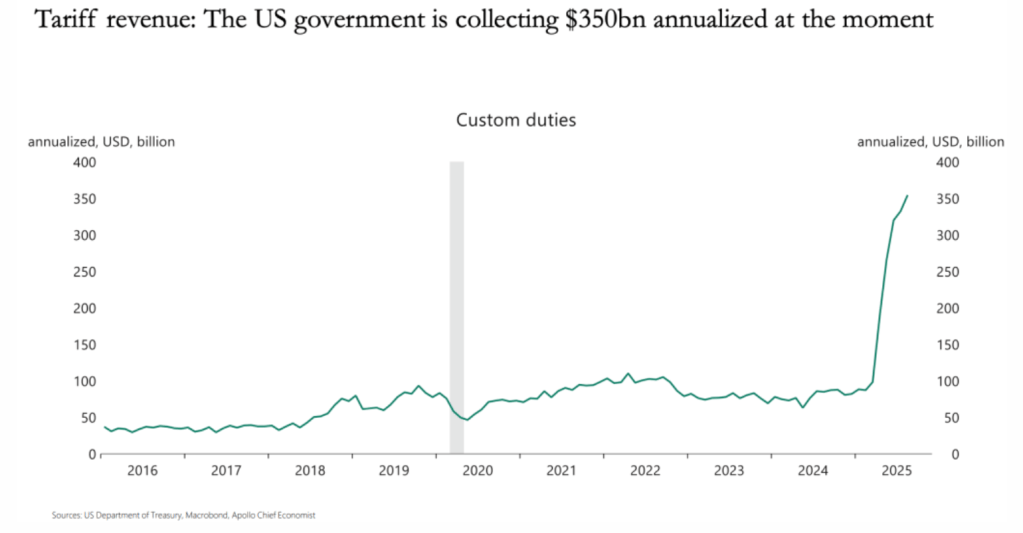
Even so, the jump in tariff receipts from 2024 to 2025 has been striking—roughly three to four times higher than the prior year, according to calculations by Torsten Slok, chief economist at Apollo Global Management. Yet Hassett’s assertion that the administration is demonstrating spending restraint has been disputed by budget watchdog groups such as the Peter G. Peterson Institute and the Committee for a Responsible Federal Budget. The former has pointed out that the debt’s $1 trillion increase in just two months marked the fastest pace of growth ever recorded outside the pandemic period.
In his interview with the New York Times’ Andrew Ross Sorkin, Bessent defended the overall tariff strategy, maintaining that while tariffs are currently generating significant revenue and are “good for labor,” the long-term objective is to rebalance trade and revive domestic manufacturing capacity, not to provide a permanent funding stream for the federal government.
Supreme Court scrutiny
The comments from Hassett and Bessent come as the Supreme Court considers whether Trump exceeded his authority by using the 1977 International Emergency Economic Powers Act to impose tariffs far more broadly than previous presidents. Bessent said on Wednesday that if the Court ultimately strikes down a large portion of the tariff measures, it would represent “a loss for the administration” and “a loss for the American people.”
Hassett, for his part, argued that invoking an economic emergency was justified by the social fallout from decades of large trade deficits and declining fortunes for American workers, pointing to “deaths of despair,” often involving fentanyl, as evidence of that damage. He said the administration is confident the Supreme Court will uphold Trump’s use of emergency powers to levy import charges. Hassett also pushed back on the idea that tariffs are inherently inflationary, describing them instead as a one-time price shock rather than an ongoing driver of inflation—a point Bessent also reinforced in his conversation with Ross Sorkin.