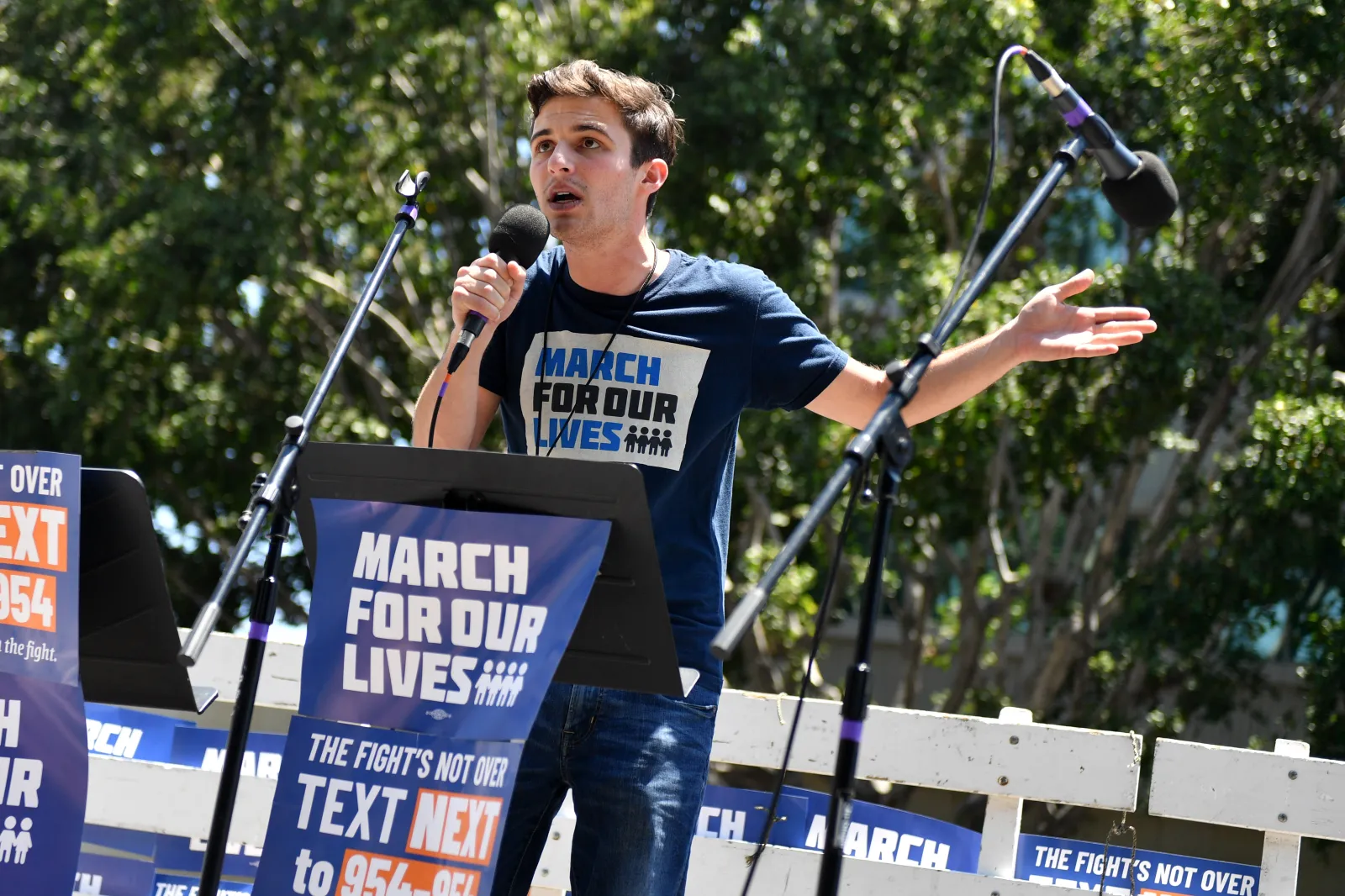

Cameron Kasky could become one of the youngest members of Congress if he manages to win the crowded race to replace New York’s retiring 12th District Democratic Representative Jerrold Nadler, 78, next year. Though he’s only in his mid-twenties, the longtime political activist is already well-accustomed to the spotlight — and to taking bold swings in pursuit of change.
Kasky survived the 2018 mass shooting at Marjory Stoneman Douglas High School in Florida, where 17 people were killed and 18 others wounded. In the aftermath, he co-founded the student-led group Never Again MSD, which pushed for stricter gun regulations to prevent future shootings, and he helped organize the nationwide March for Our Lives demonstrations in March 2018.
That experience gave Kasky a national platform and connected him with people across the country, but it also came with a heavy emotional cost. “I had to watch so many people burst into tears right before my eyes and tell me that I gave them hope. But I had lost hope myself,” the 25-year-old, who identifies as a democratic socialist, told Newsweek in a Zoom interview on Wednesday.
Over time, however, Kasky says that disillusionment shifted into resolve. “I lacked the understanding that change takes longer than we thought it would,” he reflected.
Now he wants to carry that fight into Congress, centering his campaign on an unapologetically progressive platform. His priorities include passing Medicare-for-All, tackling affordability, abolishing Immigration and Customs Enforcement (ICE), taking on what he calls “AI oligarchs,” and ending all U.S. funding to Israel, among other goals.
A Progressive Opening for Democrats?
Kasky’s agenda appears to mesh with the mood of many left-leaning voters in New York City.
Mayor-elect Zohran Mamdani recently scored a major upset in the nation’s largest city, decisively defeating former New York Governor Andrew Cuomo first in the Democratic primary and again in last month’s general election. Mamdani’s win followed a staunchly progressive campaign centered on affordability, taxing the wealthy, and condemning Israel’s war in Gaza — despite millions in billionaire-backed spending aimed at boosting his opponent.
“The people in this district want progressive leadership in the country, and that is my agenda,” Kasky told Newsweek. Like many Democratic voters, he believes the party needs to rethink its priorities and approach.
Kasky said he plans to “create new opportunities to be disruptive because the Democrats’ job right now is to be an opposition party,” arguing that more traditional Democrats “are failing to put up a meaningful opposition” to President Donald Trump and Republicans. In his view, Democratic lawmakers must be willing “to put your body” and even “your political career on the line.”
“You cannot be a tame politician right now just because you think that’s what’s going to get you re-elected,” he said.
His push comes at a time when the current Democratic leadership is historically unpopular in multiple polls, and many progressive voters are calling for sweeping reforms. A November survey by Data for Progress found that Medicare-for-All — long dismissed by critics as fringe or “socialist” — is supported by nearly two-thirds of voters, including a majority of independents and almost half of Republicans. Polling released by Gallup in September showed favorable views of socialism reaching 66 percent among Democrats.
“The Democratic Party needs to catch up,” Kasky said. “And part of my agenda is making sure that the Democratic Party does not leave immigrants behind. It does not leave people broke because they’re seeking healthcare. And it does not leave people around the world subject to genocidal wars using our money.”
Why He Wants to Abolish ICE
Trump campaigned heavily on cracking down on undocumented immigrants and has pushed that pledge aggressively. According to the Department of Homeland Security (DHS), more than two million immigrants have left the U.S. this year — including 1.9 million voluntary self-deportations and more than 593,000 forced deportations. While Trump’s campaign rhetoric heavily emphasized targeting criminals, ICE’s actions have also ensnared people with legal visas, permanent residents, and even some U.S. citizens.
“ICE infringes upon the rights not only of immigrants who deserve to be safe and prosperous in this country because of how much they contribute to our society and to our economy,” Kasky argued. “But they’re also an excuse for the president to have a private police force to punish his enemies and infringe upon the rights of Americans.”
For Kasky, partial measures aren’t enough. He believes reforms or simply defunding the agency will fall short. “We need immigration resources in this country that make it easier for people to become citizens, not harder,” he said.
“We are going to be facing an issue where we see net negative migration in this country, and if you look at the other countries that have net negative migration, that is not a group of countries that the richest country in the world should be grouped with,” he warned.
His Push to Cut U.S. Funding to Israel
Kasky frames his opposition to U.S. funding for Israel in deeply personal terms. As a Jewish American, he says he believes Israel’s actions toward Palestinians in Gaza and the West Bank ultimately make people like him less safe.
“The way for Israelis to be safe and the way for Jewish people around the world to be safe is for this to end, for the largest,” he said. “I want Jewish people around the world to be safe. I am Jewish people. I would like to be safe. And what the state of Israel is doing in our name is not only completely unacceptable, it is bad for our people and will have consequences that a lot of individuals are willfully blind to.”
His campaign calls for “cut[ting] off all funding to the state of Israel and plac[ing] sanctions until their expansionist violence is completely rooted out.”
“This is not a defensive war that the state of Israel is trying to convince us that it is through one of the weakest propaganda campaigns I’ve seen in history,” Kasky said. “Placing tough sanctions on the state of Israel and using our influence to end the genocide that they have been carrying out is what is best for Jewish people around the world.”
Many critics of Israel, along with international human rights organizations — including an independent United Nations commission — have accused the country of committing genocide against Palestinians. Israel and its supporters vehemently reject those accusations, insisting they are defending themselves against antisemitic extremists who seek their destruction.
The conflict stretches back decades, but the latest war began on October 7, 2023, when the Palestinian militant group Hamas launched attacks in Israel that killed roughly 1,200 people and resulted in 251 hostages being taken. Israel responded with a military campaign in Gaza that has killed more than 70,000 Palestinians, according to Gaza’s health ministry, as cited by the Associated Press. A ceasefire agreement brokered with help from the Trump administration was implemented in October, but Israeli strikes in Gaza have continued and the death toll has kept rising.
Navigating a Packed New York Primary
Although Kasky is one of the best-known contenders in the race for Nadler’s seat, the Democratic primary is crowded. According to The New York Times, at least 10 candidates have declared. Given that Nadler secured reelection in 2024 with just over 80 percent of the vote, whoever wins the Democratic primary is widely expected to become the 12th District’s next representative.
Other leading contenders include Jack Schlossberg, grandson of former President John F. Kennedy; New York State Assembly Member Alex Bores; New York City Council Member Erik Bottcher; New York State Assembly Member Micah Lasher; attorney and journalist Jami Floyd; and civil rights attorney Laura Dunn.
Kasky argues that what distinguishes him most is the breadth and specificity of his proposals. “Policy. That’s the big one for me,” he said.
“Each of them have maybe spoken about one or two things. But in terms of comprehensive platform, I’m leading on policy, I’m running on policy, and I’m calling on my opponents to be a bit more transparent about what people are going to be voting for,” he added.
Whether his platform and message resonate enough to send him to Congress will ultimately be up to voters in New York’s 12th District. The date of the Democratic primary has not yet been set, but the general election is scheduled for November 3 next year.