
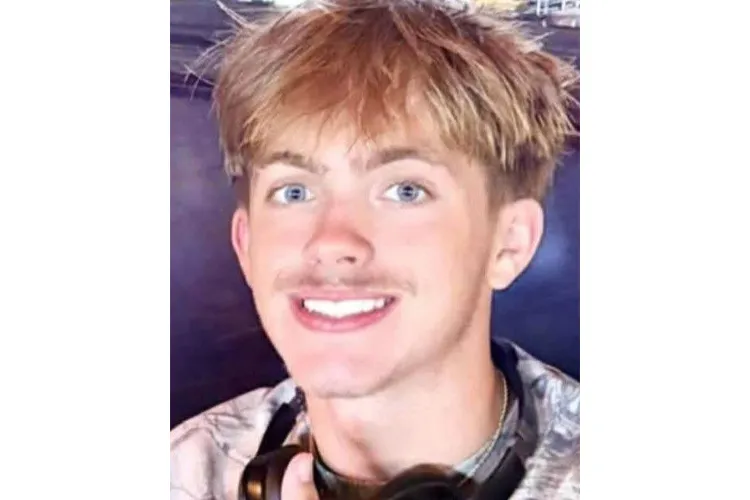

A 15-year-old boy died by suicide just hours after his family says he was targeted in a brutal online sextortion scheme and bombarded with messages from an unknown number.
High school sophomore Bryce Tate was found dead from a self-inflicted gunshot wound at his home in Cross Lanes, W. Va., at 7:10 p.m. on Nov. 6, according to a Nov. 21 news release from the Kanawha County Sheriff’s Office (KCSO). Investigators with the KCSO Digital Forensic Lab later determined that at 4:37 p.m. that same day, “he was targeted in an online sextortion scheme,” the release said.
Sextortion occurs when victims are coerced into taking and sending sexually explicit photos or videos and are then immediately threatened with exposure unless they pay or comply, according to the FBI. Scammers often threaten to send the material to a victim’s family, friends or school if demands are not met.
Bryce’s father, Adam Tate, told The New York Post that his son believed he was talking to “a local 17-year-old girl.” The person behind the number had enough information about Bryce’s life to seem real, Adam said — knowing where he worked out, who his friends were and which high school he attended.
According to Adam, the scammer sent Bryce explicit photos of a young girl — believed to be another victim — and then pressured him to send similar images in return.
:max_bytes(150000):strip_icc():focal(509x312:511x314):format(webp)/Bryce-Tate-2-120925-815001c2a9fb4aa6832a0e4fc5f6d273.jpg)
In many sextortion cases, once the images are sent, the scammers begin demanding money and threatening to release the photos. They may ask for payment via Cash App, Venmo, gift cards or cryptocurrency, which can be difficult to trace. If a victim can’t pay, scammers may escalate to threats of violence.
In Bryce’s case, the scammers allegedly demanded $500, Adam told The New York Post. Bryce didn’t have that amount and reportedly offered his “last $30” instead.
His family says the scammers then told the teen to kill himself, saying his “life is already over.”
“They say it’s suicide, but in my book it is 100% murder,” Adam told The New York Post. “They’re godless demons, in my opinion. Just cowards, awful individuals, worse than criminals.”
In the 20 minutes before Bryce died, the scammers allegedly sent him about 120 messages. Adam said that rapid-fire messaging is meant to trap victims in a state of panic and “tunnel vision,” making it feel impossible to put the phone down.
Speaking to WSAZ, Adam said the scammers “bombard victims with relentless threats, isolation tactics, and fabricated shame, convincing them, in a matter of hours, that their world is irreparably destroyed and that reaching out would only amplify the ruin.”
He added that “the insidious power of these predators” was strong enough to “shatter” what he described as a very close family.
“We had open communication, and Bryce knew he could confide in us about absolutely anything without judgment,” Adam told WSAZ. “These cowards, operating from the shadows, exploit vulnerability with ruthless efficiency.”
He believes the pressure campaign went far beyond manipulation. “This isn’t just manipulation — it’s a calculated assault on the innocent, preying on trust and fear to drive permanent, devastating decisions before loved ones can intervene,” Adam told WSAZ. “I consider it to be the murder of my innocent son.”
According to The New York Post, data from the National Center for Missing and Exploited Children show there were more than 33,000 reports of child sextortion in 2024.
KCSO said in its Nov. 21 release that the FBI’s Pittsburgh field office would be handling the investigation into Bryce’s case.
Now, Adam and West Virginia lawmakers are working to pass “Bryce’s Law,” a proposed cyberbullying bill aimed at creating tougher penalties for crimes that result in self-harm or suicide.
Despite the family’s strong bond and the “safe space” they tried to create, Adam said it’s “not enough” to shield kids from these types of schemes. “[Families] have to be aware of what the threat is. You have to have that conversation,” he said.
KCSO Sgt. Jeremy Burns urged families to tighten online privacy settings for kids, recommending that young people keep social media profiles private. “Make sure it’s set so that you have to authorize who follows you,” he said, per The New York Post.
If a young person is being exploited online, authorities stress that they are the victim of a crime — not at fault — and should seek help.
If you or someone you know is experiencing sextortion or online exploitation, contact your local FBI field office, call 1-800-CALL-FBI, or submit a tip online at tips.fbi.gov.


