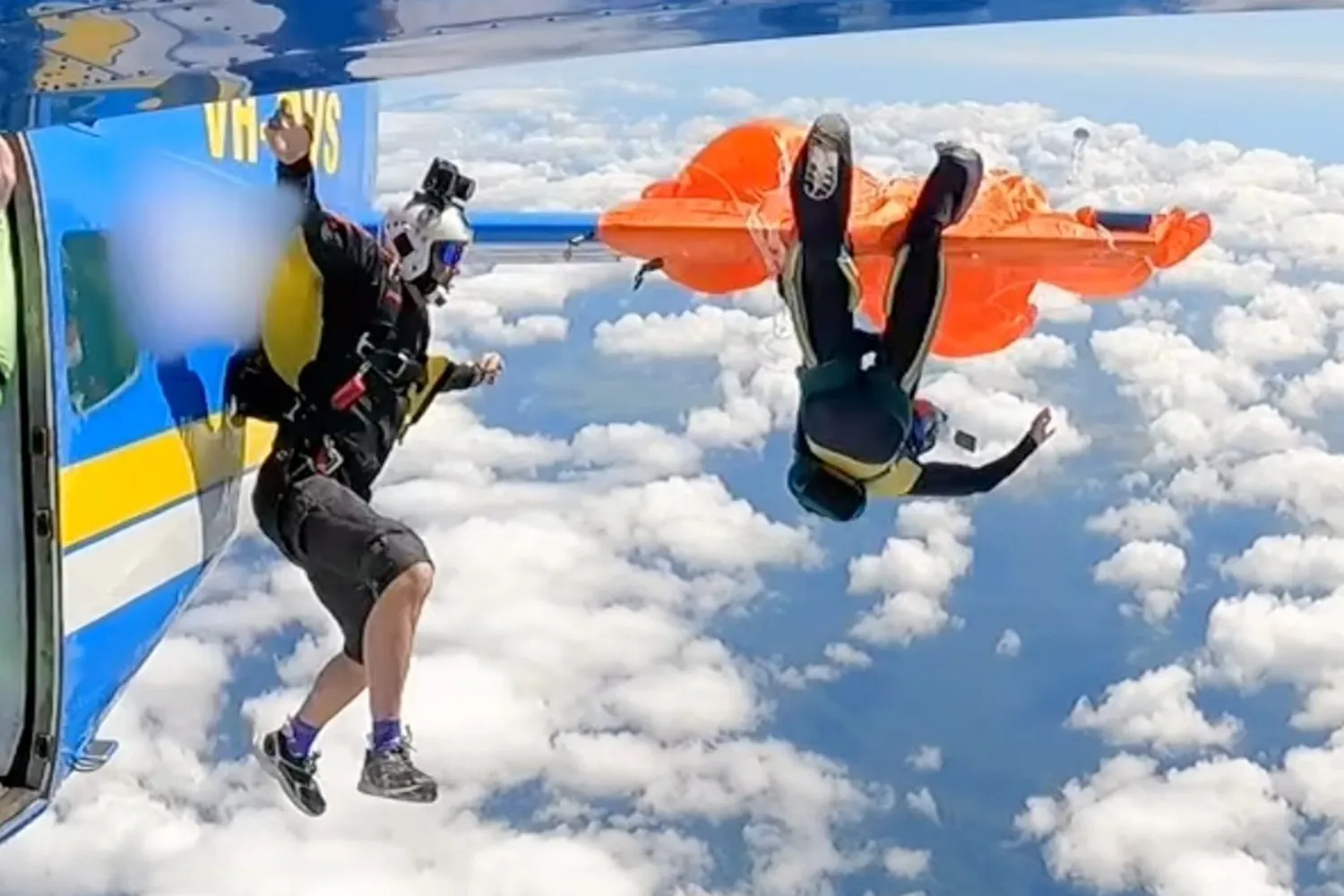

A skydiver in Australia was caught on video dangling beneath a plane after their reserve parachute became tangled around the aircraft’s tail during a jump.
On Sept. 20, a Cessna Caravan hired by Far North Freefall Club (FNFF) departed from Tully Airport in Far North Queensland for a planned 16-way formation skydive. According to an Australian Transport Safety Bureau (ATSB) media release, the jump was intended to be filmed at 15,000 feet by a parachuting camera operator. The ATSB also released video documenting the incident.
The aircraft, carrying 17 parachutists plus the pilot, took off at 9:50 a.m. local time. An investigation summary confirmed this timeline.
Once at altitude, the pilot signaled for the jump run to begin. As the first parachutist climbed out of the roller door, the “handle for their reserve parachute snagged on the wing flap,” the ATSB explained. This caused the reserve chute to deploy unexpectedly.
The sudden deployment pulled the skydiver backward, causing their legs to strike the aircraft’s left horizontal stabilizer, which sustained significant damage. The reserve parachute then wrapped around the stabilizer, leaving the parachutist hanging below the aircraft.
ATSB Chief Commissioner Angus Mitchell said the pilot “recalled feeling the aircraft suddenly pitch up, and observed the airspeed rapidly decreasing.” Initially believing the aircraft had stalled, the pilot pushed the control column forward and added power before being informed that a skydiver was caught on the tailplane. They then reduced power.
Thirteen parachutists exited the aircraft during the emergency, while two remained at the doorway watching the trapped jumper cut 11 lines from their reserve parachute with a hook knife. Severing the lines allowed the canopy to tear away and freed the skydiver.
Once released, the skydiver dropped into freefall and deployed their main parachute. Despite becoming briefly entangled with remnants of the reserve chute, the main canopy fully inflated, allowing for a safe landing. The skydiver suffered only minor injuries.
With all jumpers out, the pilot evaluated the aircraft’s handling. The damaged tailplane still carried a portion of the torn reserve chute, limiting pitch control. By maintaining forward pressure, they were able to achieve a gradual descent. Retracting the flap improved rudder, aileron, and elevator authority enough to continue flying the aircraft.
Mitchell stressed the importance of equipment awareness and carrying a hook knife during jumps.
“Carrying a hook knife, although it is not a regulatory requirement, could be lifesaving in the event of a premature reserve parachute deployment,” he said.
The pilot had been wearing an emergency parachute in case an evacuation became necessary and declared a Mayday before eventually landing the aircraft safely.
The ATSB investigation also found that the aircraft had not been loaded within its correct weight and balance envelope, though this factor did not contribute to the accident.
The agency did not provide additional details when contacted, and attempts to reach the Far North Freefall Club for comment were not immediately successful.