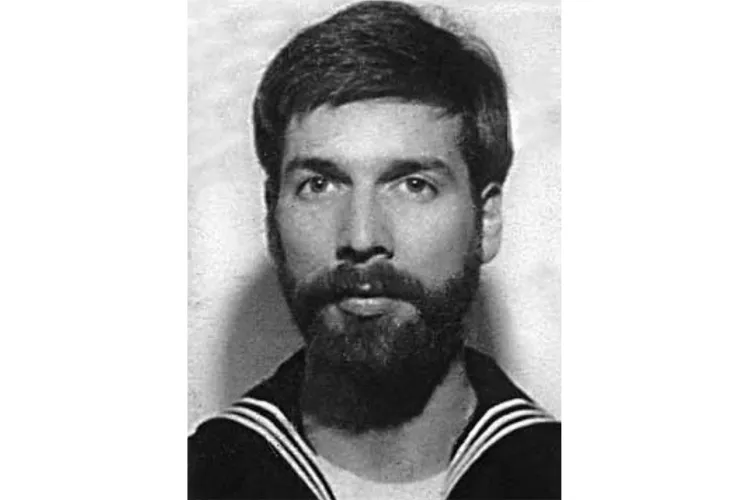

When a U.S. Navy photoanalyst vanished from the United States in 1986, no one knew where he’d gone. Two years later, he resurfaced on the other side of the world — in Russia, living under a new name.
By 1989, American officials were already suspicious that Glenn Michael Souther had betrayed his country. An obituary in Moscow that year seemed to confirm it, revealing just how much he had allegedly done for the Soviet Union before his death at 32.
Described in the obituary as Mikhail Orlov, Souther was celebrated in the Soviet press as a master spy who had provided “precious” secrets, including detailed U.S. contingency plans for nuclear war with the Soviet Union. His work reportedly earned him the rank of major in the KGB. But that life came at a cost: on June 22, he died by suicide after inhaling exhaust fumes from his car.
KGB chief Vladimir Kryuchkov was quoted at the time as saying that Souther’s “nervous system could not stand the pressure’’ of life in the U.S.S.R.
Back in the United States, however, friends were stunned to learn he had been spying. Those who knew him from his years at Virginia’s Old Dominion University remembered him as a hard-partying extrovert — “the life of the party,” not a secretive traitor.
Born Jan. 30, 1957, Souther was the son of an office manager at the company that made Wonder Bread and a secretary. He grew up in a blue-collar Indiana neighborhood and was an average student who ran track in high school.
“Glenn was a nice, straightforward guy, like the rest of us,” recalled former track teammate Tom Rasch, who said Souther never seemed especially interested in politics or foreign affairs.
After graduating, Souther enlisted in the Navy. He served on the aircraft carrier USS Nimitz from 1976 to 1978, then was transferred to the Sixth Fleet in Italy. During that time, he got married and had a child. Investigators later concluded that Souther was likely recruited by the KGB while he was stationed in Italy.
In 1982, he was assigned to Maryland and later honorably discharged, then joined the Naval Reserve in Norfolk. There, he worked analyzing satellite photographs and allegedly had access to highly classified military information.
While serving in the reserves, Souther began taking Russian studies courses at Old Dominion University and quickly built a reputation as a party lover.
“He was the guy at parties who always put on a lamp shade,” said Barbara Fahey, whose husband, John, was Souther’s adviser in Russian studies.
Yet not everyone saw him as just a carefree jokester. One fellow student recalled that he once called to ask about Russian-language tutoring. About an hour after that phone call, he showed up at her door, speaking what she described as “fluent” Russian and rambling. During that first meeting, she said, he suddenly brought up a rape allegation that had been made against him the previous year. While it’s unclear what became of that allegation, the student later said Souther “obviously was crazy.”
Even his professors struggled to pin him down. One called him one of his “worst students,” while another saw something else entirely. Leonid Mihalap, a Russian professor at Old Dominion, said Souther’s command of the language was so advanced that he suspected Souther might actually be a spy.
“He submitted a term paper on the Russian poet Vladimir Mayakovsky that was so excellent and flawless it occurred to me that only a Russian could have written it,” Mihalap said.
At one point, Souther’s estranged wife went to Navy authorities, telling them she believed he was spying for the Soviet Union. An investigation at the time found no proof and the case went nowhere. Only years later, as suspicions mounted, did officials revisit her warning.
Facing increasing scrutiny, Souther quietly left the United States after graduating from Old Dominion and slipped away to Moscow. He did not publicly reappear until 1988, when he announced that he had defected and began criticizing U.S. nuclear arms policies and intelligence operations.
In Russia, he reportedly remarried — this time to a Russian woman — and had another child, though little is known about his day-to-day life there before his death in 1989.
Some who knew him believed that rejection played a role in his decision to defect, particularly after he was turned down for Naval Officer Candidate School. Barbara Fahey later reflected that he might have been driven by a desire to prove himself.
“I think he decided to defect because he wasn’t making it here,” she said. “So he said, ‘Well, I’ll show you!’ ”