
This Christmas season, a handful of churches are reshaping traditional Nativity displays to comment on heightened and contentious federal immigration enforcement — a move that has sparked both support and criticism.
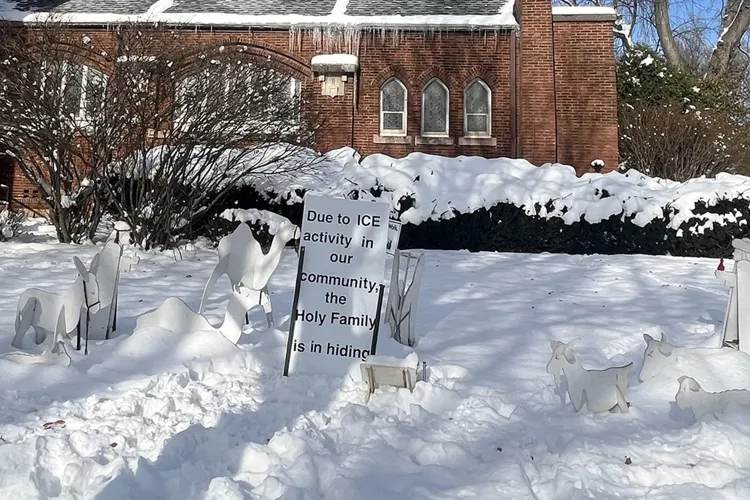
In River Forest, Illinois, Urban Village Church — affiliated with the United Methodist Church — placed a large sign alongside its outdoor Nativity scene reading: “Due to ICE activity in our community, the Holy Family is in hiding.”
About an hour away in Evanston, Lake Street Church adjusted its front-lawn display to show baby Jesus with zip-tied hands and Mary wearing a gas mask. A sign nearby read, “Joseph didn’t make it,” according to the Associated Press and the Chicago Sun-Times.
“This installation is not subtle because the crisis it addresses is not abstract,” the church wrote in a social media post. “We hope viewers will join the conversation about what sanctuary means when families fleeing violence are met with separation, detention, and dehumanization. We further hope that conversation will move people to action, regardless of faith or philosophical background.”
In Dedham, Massachusetts, St. Susanna Parish also drew attention — and controversy — after it temporarily replaced statues of Jesus, Mary, and Joseph with a sign that read, “ICE was here,” Fox affiliate WFXT, ABC affiliate WCVB and public radio station WBUR reported.
In an email interview, Urban Village Church Pastor Abby Holcombe explained her congregation’s decision to connect the Nativity story to the experiences of immigrant families.
“We are firmly rooted in a Gospel that compels us to speak to real issues,” Holcombe said. “When one member of our community suffers, we all suffer.”
:max_bytes(150000):strip_icc():focal(999x0:1001x2):format(webp)/Urban-Village-Church-121325-1-563270111e40429dae3a4e24caabe624.jpg)
“Jesus taught that when we welcome the stranger, we welcome him,” she added. “Being a disciple of Jesus Christ requires that we welcome immigrants and migrants, that we advocate for their well-being and abundant life.”
Father Stephen Josoma of St. Susanna Parish voiced similar concerns in remarks to WBUR, saying the idea for the display grew out of conversations with refugee families.
“These are folks who carry a lot of scars with them,” Josoma told the station. “Some of them are physical scars, but most are emotional. They’ve seen their folks killed in front of them.”
“What is the objective by doing this? To help people recognize the plight of people who are really in dire need, and how are we treating them,” he continued.
After the Massachusetts display began attracting broader attention, the Archdiocese of Boston called for the “ICE was here” sign to be removed and for the traditional manger scene to be restored.
“The people of God have the right to expect that, when they come to church, they will encounter genuine opportunities for prayer and Catholic worship—not divisive political messaging,” the archdiocese said in a statement shared with WFXT. “St. Susanna Parish neither requested nor received permission from the Archdiocese to depart from this canonical norm or to place a politically divisive display outside the church. The display should be removed, and the manger restored to its proper sacred purpose.”
:max_bytes(150000):strip_icc():focal(749x0:751x2):format(webp)/nativity-ice-sign-121625-2-0fb11b04fd054d98bb4482dc9653f7fd.jpg)
In a statement shared on Tuesday, Dec. 9, Department of Homeland Security Assistant Secretary Tricia McLaughlin argued that “not only is this ‘nativity’ scene offensive to Christians, but it is also depicting something that would NEVER happen given that ICE is not separating infants or children from their families.”
Despite calls to take the sign down, Josoma previously said the display would remain in place until additional conversations with Archbishop Richard Henning.
In a separate statement, St. Susanna Parish defended the approach by pointing to other themed Nativity displays, saying, “The Vatican itself displays different themed nativities each year, highlighting social issues to contemporary life.”
“Some of these have also been controversial (like one focused on the plight of refugees in 2016) all moving beyond static traditional figures and designed to evoke emotion and dialogue,” the parish continued. “Our hope was to similarly evoke dialogue around an issue that is at the heart of contemporary life. That some do not agree with our message does not render our display sacrilegious or is the cause of any ‘scandal’ to the faithful.”
“Any divisiveness is a reflection of our polarized society, much of which originates with the changing, unjust policies and laws of the current US Administration, not emanating from a nativity display outside a church in Dedham,” the statement added.
In an email on Monday, Dec. 15, Josoma said there were no new updates. The Archdiocese of Boston did not immediately respond to a request for additional comment.
Holcombe said St. Susanna Parish’s display helped inspire the sign Urban Village Church installed on Dec. 7.
“I told the pastoral staff I planned to do something with the nativity that tied the story of Jesus’s birth together with the plight of migrant families,” she said.
While the Illinois church has received some “hate mail and phone calls,” Holcombe said local church leadership has not demanded any changes.
“I have received encouragement from clergy colleagues across the country,” she said. “I have also received positive emails from people of faith in different states as well. I have received complete support from my congregation and staff.”
Holcombe added that she hopes the display prompts viewers to recognize dignity in every person — including immigrants, refugees, and people of color.
“This nativity is a visual reminder of what happened throughout the Chicagoland area these past few months, a reminder that the attacks on our immigrant neighbors are attacks on God’s own self,” Holcombe said. “We believe that God cares deeply for those who suffer. We believe that God is near to those who are vulnerable. We believe God is on the side of the oppressed.”