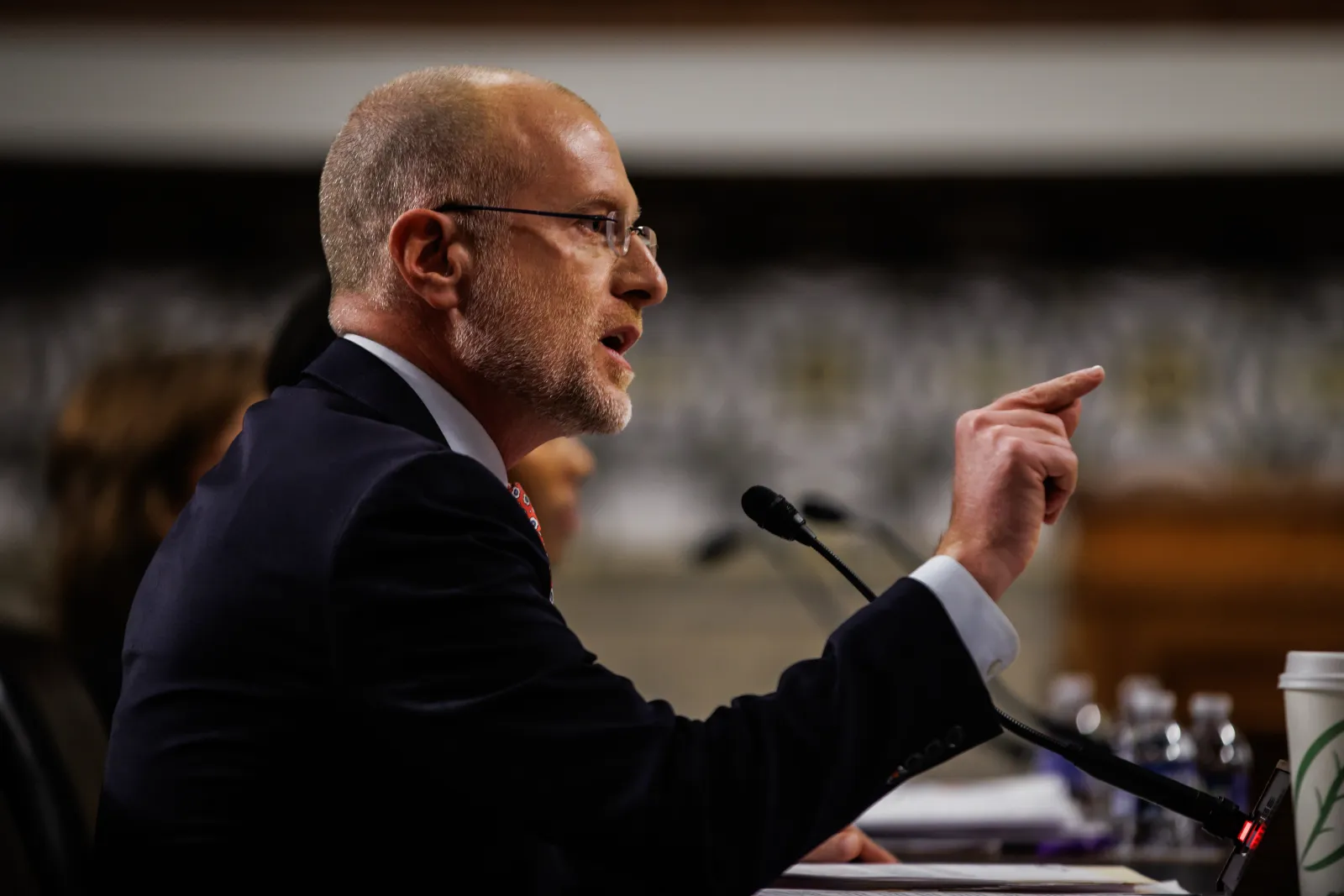

Democratic senators sharply challenged Federal Communications Commission Chairman Brendan Carr on Wednesday, accusing him of using the agency’s power to pressure broadcasters — including urging action against ABC late-night host Jimmy Kimmel — in ways they argued conflict with First Amendment protections and the FCC’s long-standing posture as a regulator insulated from partisan politics.
The tense exchange unfolded during a Senate Commerce Committee hearing that took an unusual twist when lawmakers and staff observed that the FCC’s website description was changed mid-hearing, removing the word “independent” from language that had described the commission as an “independent U.S. government agency overseen by Congress.”
Why it matters
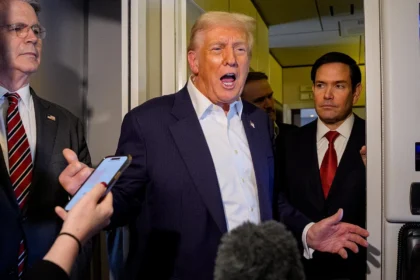
The hearing took place amid a broader escalation in President Donald Trump’s confrontations with the media in his second term. Trump has pursued lawsuits against outlets whose coverage he opposes and has repeatedly floated the idea of revoking broadcast licenses. Earlier Wednesday, he criticized NBC over an interview with Democratic Sen. Raphael Warnock, writing on Truth Social that the network “should be ashamed of themselves.”
What happened at the hearing
Carr declined to disavow his earlier comments about Kimmel and, when pressed, suggested the FCC is not insulated from presidential influence.
“The FCC is not an independent agency,” Carr said.
Democrats questioned whether Carr viewed Trump as his boss or had taken direction from the president or his inner circle. Carr largely avoided direct answers, but underscored his alignment with the administration.
“President Trump has designated me as chairman of the FCC,” Carr said. “I think it comes as no surprise that I’m aligned with President Trump on policy.”
Sen. Ben Ray Luján, D-N.M., responded by pointing to the FCC’s own website language at the time, which described the agency as independent. Not long afterward, lawmakers and aides noticed the wording had been updated to remove “independent” from the mission description.
An FCC spokesperson told NBC News Wednesday, “With the change in Administration earlier this year, the FCC’s website and materials required updating. That work continues to ensure that they reflect the positions of the agency’s new leadership.”
Democrats said the mid-hearing change reinforced their concern that the FCC was moving away from its traditional role as an autonomous regulator and toward political loyalty.
The Kimmel dispute and the “public interest” standard
Over the course of the roughly 2½-hour hearing, Democrats repeatedly returned to Carr’s reaction to Kimmel’s remarks about the September killing of conservative activist Charlie Kirk, a Trump ally and prominent right-wing figure. After those remarks, Carr publicly criticized ABC and suggested the network could face heightened regulatory scrutiny — language Democrats and some media advocates compared to intimidation.
Carr defended his actions as enforcement of existing laws that apply stricter standards to broadcast networks than to cable or streaming platforms. He argued the FCC has failed in recent years to uphold the “public interest standard” embedded in federal communications law.
“The FCC has walked away from enforcing the public interest standard,” Carr said.
Democrats rejected that rationale, accusing Carr of twisting the standard to punish speech he and the administration oppose.
Republicans shift focus
Republican senators pushed back, arguing Democrats were selectively outraged and pointing to what they described as First Amendment violations under former President Joe Biden. GOP members largely redirected the discussion to other issues, including spectrum auctions, undersea cable infrastructure, algorithms, and robocalls, spending limited time on Carr’s comments about Kimmel.
Committee Chairman Sen. Ted Cruz, R-Texas, had previously described Carr’s remarks as akin to those of a mob boss and called them “dangerous as hell.” On Wednesday, however, Cruz adopted a notably softer approach, calling Kimmel “tasteless” and “unfunny” while shifting criticism toward the Biden administration. Carr echoed those arguments.
“Joe Biden is no longer president,” Sen. Amy Klobuchar, D-Minn., interjected at one point.
Other commissioners weigh in
The hearing also featured testimony from the FCC’s other commissioners. Anna M. Gomez, a Biden appointee, said the agency’s actions had harmed its standing as an expert, independent regulator.
“Nowhere is that departure more concerning than its actions to intimidate government critics, pressure media companies and challenge the boundaries of the First Amendment,” Gomez said.
Carr’s record and political ties
Carr was nominated to the FCC by both Trump and Biden and confirmed unanimously by the Senate three times. More recently, he has embraced increasingly conservative positions, including authoring a section on the FCC for “Project 2025,” a policy blueprint aimed at reshaping the federal government in a second Trump term.
Since becoming chairman this year, Carr has opened separate investigations into all three major broadcast networks. After Kimmel’s comments about Kirk, Carr warned broadcasters they could face consequences if they did not act, saying, “We can do this the easy way or the hard way.”
When questioned after the hearing about Cruz’s earlier criticism of those remarks, Carr did not address it directly.
“I think the hearing went really well,” Carr said.
What people are saying
Trump wrote Wednesday on Truth Social, “The public airwaves, which these networks are using at no charge, should not be allowed to get away with this any longer. They should be properly licensed, and pay significant amounts of money for using this very valuable public space.”
Democratic Sen. Ed Markey of Massachusetts told Carr, “You are weaponizing the public interest standard,” and called on him to resign.
Katherine Jacobsen, U.S., Canada, and Caribbean program coordinator for the Committee to Protect Journalists (CPJ), said in a statement that Carr’s comments about the agency being “not formally” independent carried troubling implications for media freedom and aligned with CPJ concerns about punitive targeting driven by political agenda — a trajectory she said should alarm Americans who value First Amendment rights and a free press.
What happens next
The conflict is likely to intensify in the coming weeks as Senate Democrats consider oversight hearings or legislative steps intended to reinforce the FCC’s independence. Carr is expected to continue defending the agency’s enforcement posture, while broadcasters and media advocacy organizations may pursue judicial review if the commission advances formal actions. Any FCC action against a network would likely face court challenges on First Amendment grounds, potentially pulling the judiciary deeper into the growing dispute between the commission and the media.