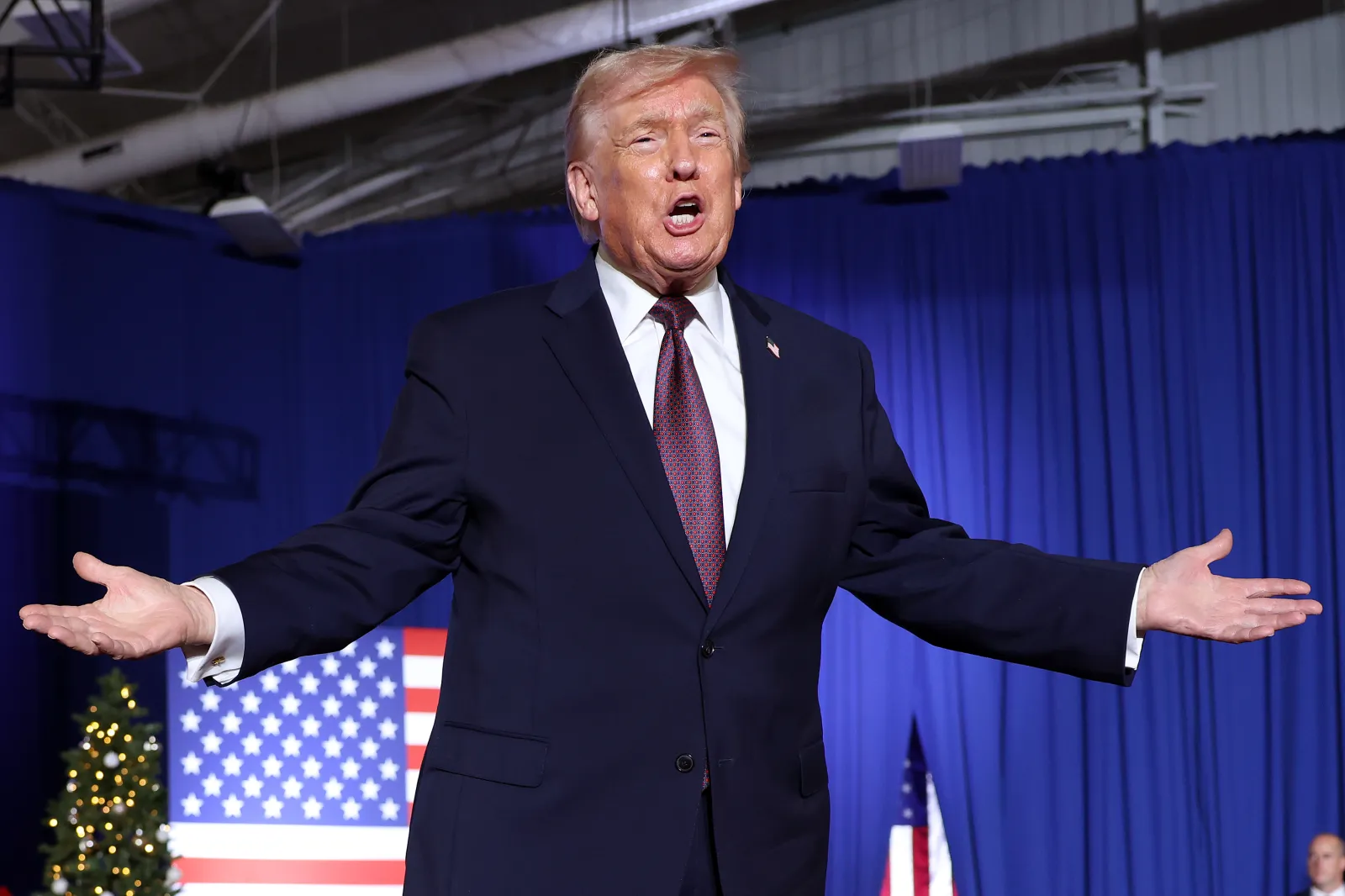

Nearly a year into President Donald Trump’s second term, the economy continues to weigh on his approval rating as many voters remain worried about inflation and day-to-day costs—an anxiety that has challenged recent presidents of both parties. A new report released Tuesday found the U.S. economy expanded at a faster clip in the third quarter than it did at the same point under several recent first-year administrations.
Why it matters
The economy has long been treated as a central yardstick for presidential performance. While growth, prices, and employment are shaped by forces well beyond any single administration, voters often expect presidents to set fiscal and regulatory policies that support stability and affordability.
Affordability has become a focal point of political attacks on Trump’s administration. Critics argue prices have not fallen enough over the past year, despite campaign promises to ease cost pressures. Trump has countered that he inherited a weakened economy from President Joe Biden and says his policies are turning it around. How voters feel about the economy is widely expected to influence the 2026 midterm environment.
What to know
There are multiple ways to assess economic performance, and different metrics can tell different stories.
GDP
Gross domestic product (GDP) rose at a 4.3 percent rate in the third quarter of 2025, according to the Bureau of Economic Analysis. The Associated Press described the figure as “surprisingly strong.” The report said growth was powered by consumer spending, exports, and government outlays, while declines in investment partially offset those gains.
That pace exceeds third-quarter growth recorded during the first year of several recent presidencies. GDP grew 3.3 percent in the third quarter of 2021 and 3.2 percent in the third quarter of 2017 (Trump’s first term). In 2019, third-quarter GDP growth was 1.4 percent.
Inflation
In a recent address, Trump said the country is positioned for an “economic boom, the likes of which the world has never seen,” pointing to his administration’s record on easing inflation.
Inflation is lower than it was during the early period of the Biden presidency. As of November 2025, the U.S. inflation rate was 2.7 percent, compared with 6.8 percent in November 2021, when the country was still grappling with the economic aftershocks of the COVID-19 pandemic.
At the same point in Trump’s first term and during former President Barack Obama’s first term, inflation was lower—2.2 percent in 2017 and 1.8 percent in 2009, according to the Bureau of Labor Statistics.
Ethan Kaplan, a University of Maryland economics professor, said presidents’ policies typically don’t have their full effect in the first year, and inherited conditions and outside events can play a larger role. He pointed to Obama entering office as the Great Recession began, limiting the possibility of a rapid rebound.
Kaplan said Biden took office as the U.S. economy began recovering from the pandemic, a period marked by elevated inflation and unemployment. He added that some trends affecting Trump’s second term—such as rising unemployment—showed signs of developing earlier.
“Trump inherited an economy that was going down and in the first months continued to go down, but started to rise around March or April,” Kaplan said, attributing part of the shift to factors outside the administration’s control, including a surge in energy demand tied to data centers and AI-driven expansion.
Kaplan also said the broader effects of Trump’s tariffs are more likely to be felt over the long run, arguing they may not be “as devastating” in the short term but could weigh on longer-term outcomes, including domestic innovation.
Trade
Trump has made the trade balance a central theme of his economic agenda. He has implemented tariffs on imported goods aimed at shrinking the trade deficit and encouraging domestic job growth. Critics argue these tariffs are being passed along to consumers and contributing to higher prices.
From January through September, the trade deficit narrowed sharply—about 144 percent—based on Federal Reserve Bank of St. Louis data. The deficit stands at roughly $52.8 billion. That is lower than the comparable point during Biden’s term, when it was about $75 billion—an increase of 16 percent compared to January 2021, according to the same data.
In Trump’s first term, the trade deficit was about $41.6 billion in September. It was about $35.2 billion at the same point in Obama’s tenure. The deficit fell 10 percent in the first nine months of Obama’s term and by slightly less than 5 percent during the first nine months of Trump’s first term.
Unemployment
The unemployment rate in November was 4.6 percent. That compares with 4.2 percent in November 2017 and November 2021, and 9.9 percent in November 2009, according to the St. Louis Fed.
Housing
Housing costs have continued to rise across administrations, per St. Louis Fed data. As of the second quarter of 2025—the latest available—the average U.S. housing cost was $410,800. That compares with $367,800 at the same point in Biden’s presidency and $318,200 at the same point in Trump’s first term.
During Obama’s presidency, the average housing price was $220,900 in the second quarter of his first year in office, shortly after the Great Recession.
Gas prices
Gas prices remain a high-profile measure of affordability. St. Louis Fed data shows gas averaged $3.228 per gallon in November, compared with $3.482 in Biden’s first November. In November 2017, gas averaged $2.548 per gallon; in November 2009, it averaged $2.660.
Stock market
Trump has frequently cited the stock market as a marker of economic success.
As of December 19, the Dow closed at 48,134.89. The Dow was up 14 percent as of Friday—smaller than the 17 percent increase at the same point in 2021 and the 25 percent increase in 2017. In 2009, amid the Great Recession, the Dow rose 18 percent by December 18.
Consumer sentiment, however, has weakened. The University of Michigan’s consumer sentiment index was 51 in November, compared with 67.4 in Biden’s first year, 98.5 in Trump’s first year of his first term, and 67.4 during Obama’s first year.
What people are saying
White House spokesperson Kush Desai said in a statement: “There is no comparison here. Joe Biden presided over a generational inflation and affordability crisis that was entirely of his own making. And while Biden downplayed and ignored this reality, President Trump has been focused on turning the page on the Biden economic disaster since Day One—with inflation cooled and real wages up, the Administration continues to focus on delivering more economic relief for the American people.”
CNN data analyst Harry Enten wrote in a November 10 post on X: “Oy vey! Breaking records you don’t wanna break: November has the worst ever consumer sentiment of current conditions since 1951. ~80% of pure independents disapprove of Trump on the economy. This holds & the GOP is likely waving adios to their House & maybe Senate majorities.”
What happens next
How inflation, growth, and jobs trends evolve over the coming months could shape the political outlook for Republicans as they try to limit midterm losses. With affordability still top of mind for many households, voter perceptions of the economy are likely to remain a decisive factor in how the president’s performance is judged.