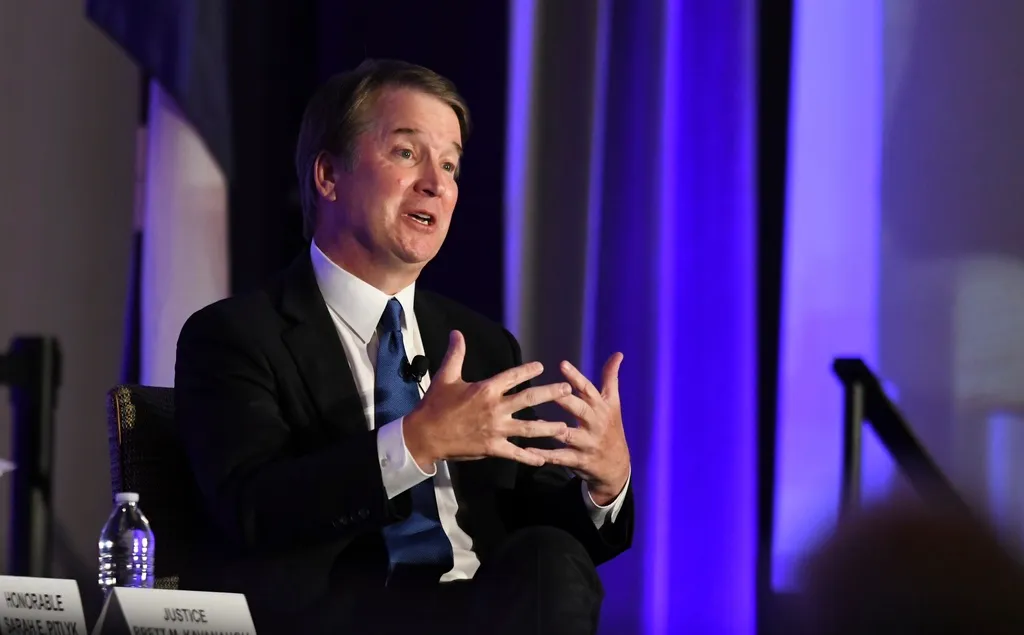

Justice Brett Kavanaugh said the Supreme Court’s decision on President Donald Trump’s National Guard deployment in Illinois may carry consequences that extend beyond the current dispute, potentially influencing how future crises are handled.
On Tuesday, the Court denied an application to stay a lower court ruling that blocked the deployment of troops intended to support the Trump administration’s immigration enforcement efforts. Kavanaugh agreed with the outcome but signaled unease about the broader implications.
“The Court’s legal interpretation, as I understand it, could lead to potentially significant implications for future crises that we cannot now foresee,” Kavanaugh said.
Why It Matters
The decision stands out as an uncommon instance in which the Supreme Court—despite its 6-3 conservative majority—did not side with the Trump administration. In other cases, the Court has backed the administration on issues including immigration enforcement and federal agency cuts.
Immigration enforcement has been a central priority for President Donald Trump’s administration. The Department of Homeland Security announced on December 10 that its enforcement operations have resulted in more than 605,000 deportations since January 20. The agency also said 1.9 million people have voluntarily self-deported since January 2025.
What To Know
The Trump administration called up National Guard troops in October to protect federal personnel and property in Illinois, arguing that immigration enforcement efforts in Chicago had faced major resistance and, in some cases, violence.
Illinois sued, and a district court barred the federal deployment.
Supreme Court Ruling Today: No National Guard Deployment
In its order, the Court said the U.S. government “has not carried its burden” to show that the law “permits the President to federalize the Guard in the exercise of inherent authority to protect federal personnel and property in Illinois.”
Kavanaugh, while joining the Court’s result, wrote separately to highlight how the ruling could constrain a president’s options in scenarios far removed from immigration enforcement.
He offered a hypothetical: a mob quickly gathers outside a federal courthouse in Philadelphia, threatens to storm the building, attack federal officials, and destroy the courthouse—while local authorities and security are overwhelmed and federal military forces can’t arrive in time. In that scenario, Kavanaugh suggested, the Court’s order could mean that “even in those circumstances the President presumably could not federalize the National Guard.”
Dissents From Alito, Thomas, and Gorsuch
Justice Samuel Alito dissented, joined by Justice Clarence Thomas. Justice Neil Gorsuch also filed a separate dissent.
Alito argued that regardless of one’s view of the administration’s immigration strategy or ICE operations, federal officers should not be left vulnerable to serious harm.
“Whatever one may think about the current administration’s enforcement of the immigration laws or the way ICE has conducted its operations, the protection of federal officers from potentially lethal attacks should not be thwarted. I therefore respectfully dissent,” Alito wrote.
Who Deploys the National Guard?
National Guard troops are typically under the control of state governors. However, the president can deploy them under certain circumstances, including in response to civil unrest, TIME reported.
What People Are Saying
The Supreme Court, in a majority opinion: “At this preliminary stage, the Government has failed to identify a source of authority that would allow the military to execute the laws in Illinois.”
Supreme Court Justice Brett Kavanaugh, in a concurring opinion: “The potential consequences, combined with the novelty and difficulty of the statutory issues addressed by the Court, underscore why I would not opine more broadly than necessary to resolve this application.”
Supreme Court Justice Samuel Alito, in a dissenting opinion: “In this case, the Court has no good reason to stray beyond the issues that the parties chose to present, and based on those arguments, the Court should grant the application. There is no basis for rejecting the President’s determination that he was unable to execute the federal immigration laws using the civilian law enforcement resources at his command. In concluding otherwise, the District Court likely committed both legal and factual error.”
What Happens Next
The Court’s order is not a final ruling. Still, it may influence other pending lawsuits challenging Trump’s attempts to deploy the National Guard in other Democratic-led cities.