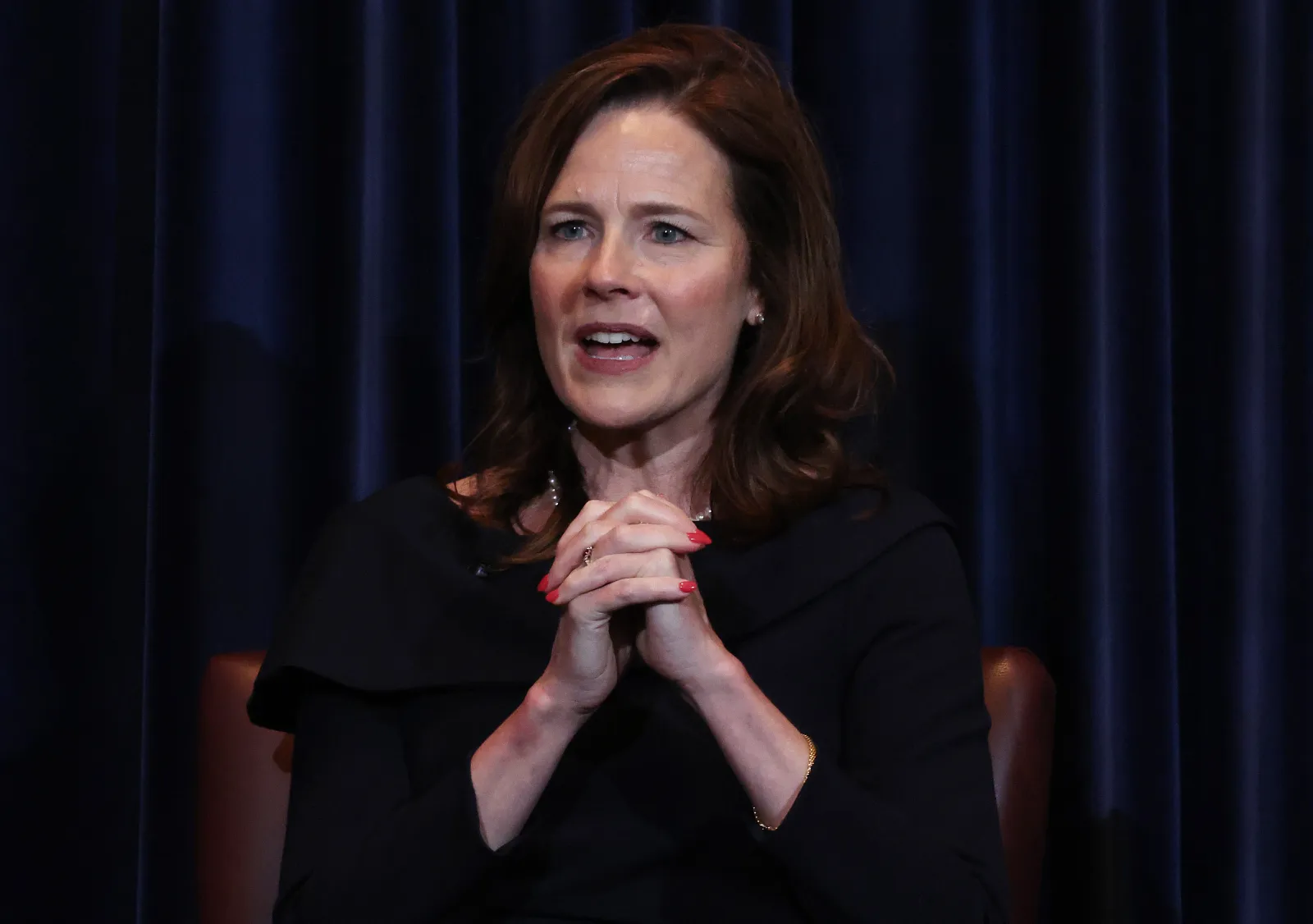

Supreme Court Justice Amy Coney Barrett is warning that free speech in the United Kingdom is under pressure, arguing that unpopular or “non-mainstream” views are increasingly being treated as unacceptable — and, in some cases, criminal.
Barrett made the comments in an interview with Bishop Robert Barron on an episode of his podcast Bishop Barron Presents, released Sunday.
“Think about what’s happening with respect to free speech rights in the U.K.,” Barrett said during a discussion about the purpose of law. “Contrary opinions or opinions that are not in the mainstream are not being tolerated, and they’re even being criminalized. Because of the First Amendment, that can’t happen here.”
Why It Matters
Barrett’s remarks arrive amid heightened scrutiny of how Britain regulates and polices speech, a debate that has drawn attention from U.S. officials in recent months, including Vice President JD Vance.
Critics have focused in particular on the Online Safety Act, rolled out this year, which requires social media companies to remove illegal content from their platforms. Some argue it is being enforced too broadly and has led to the removal or suppression of lawful speech.
Others point to high-profile incidents that, they say, illustrate the growing tension between public-order enforcement and freedom of expression. These include a case involving a British Catholic woman charged for silently praying outside an abortion facility under a new buffer zone law. Separately, police in London and Manchester have said they would arrest people who chant “globalize the intifada,” which has also prompted concerns from free-speech advocates.
What To Know
In the interview, Barron referenced the Catholic thinker John Courtney Murray, who argued that peace in a pluralistic society depends on shared principles. He asked whether what Catholics call “natural law” or “basic moral intuitions” can still play a meaningful role today.
Barrett responded that the U.S. Constitution can serve that stabilizing function — particularly through speech and religious-liberty protections.
“If we think about free speech or freedom of religion, I think we can see those guarantees as a way in which they can function as articles of peace,” she said.
She argued that the First Amendment not only permits expression but also obliges society to tolerate disagreement by limiting what the government can punish.
“I think the First Amendment protects, guarantees, forces us to respect one another and to respect disagreement. There’s a tolerance of different faiths, a tolerance of different ideas…we can see what would happen if you didn’t have the guarantee to hold that in place.”
Barrett, a devout Catholic, joined the Supreme Court in 2020 after President Donald Trump appointed her to replace the late Justice Ruth Bader Ginsburg. Her confirmation helped solidify a conservative supermajority on the court, which later overturned the constitutional right to abortion in 2022.
What People Are Saying
Vice President JD Vance said at the Munich Security Conference earlier this year: “In Britain and across Europe, free speech, I fear, is in retreat.”
He added: “I will admit that sometimes the loudest voices for censorship have come, not from within Europe, but from within my own country.”
A U.S. State Department report on human rights practices in the U.K. released over the summer said “significant human rights issues” in the country included “credible reports of serious restrictions on freedom of expression, including enforcement of or threat of criminal or civil laws in order to limit expression.”
British Prime Minister Sir Keir Starmer told reporters in September: “Free speech is one of the founding values of the United Kingdom, and we protect it jealously and fiercely and always will.”
He added: “I draw a limit between free speech and the speech of those that want to peddle pedophilia and suicide (on) social media to children. Therefore, I’m all for free speech, but I’m also for protecting children from things that will harm them.”
What Happens Next
The debate over free speech in the U.K. is likely to intensify in the months ahead, as officials, critics, and civil-liberties groups continue to clash over where enforcement ends and censorship begins.