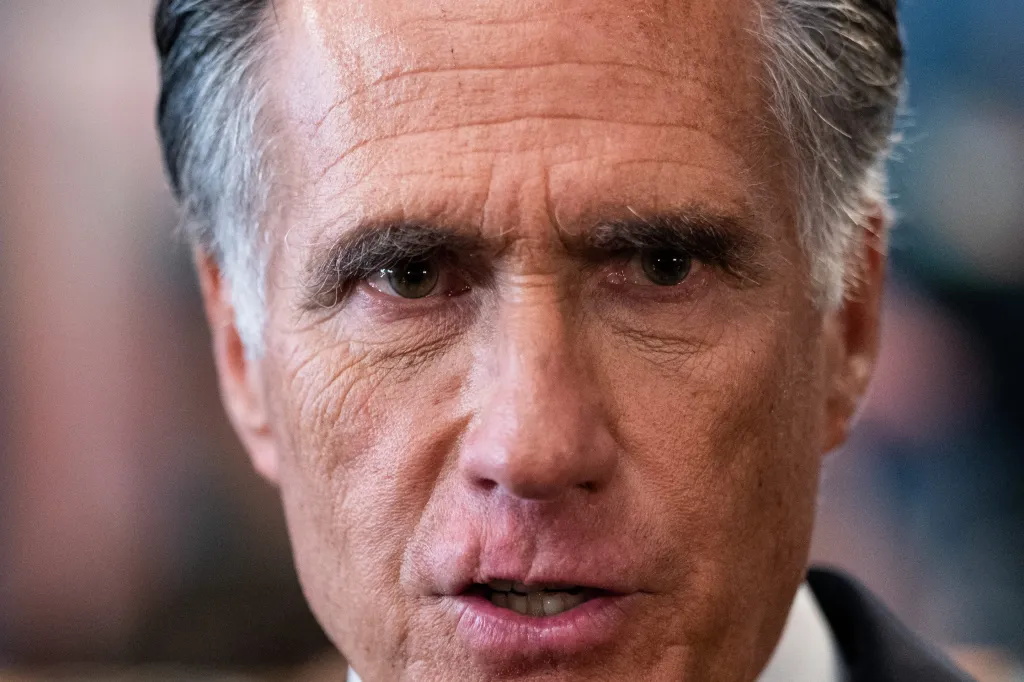

Mitt Romney, the 2012 Republican presidential nominee and former U.S. senator from Utah, built much of his political brand around fiscal restraint and lower taxes. In a Friday op-ed for The New York Times, however, he argued the country’s debt trajectory has become so dangerous that higher taxes on wealthy Americans—including people like him—should be part of the solution.
Romney warned that the U.S. is nearing what he described as an economic “cliff,” pointing to projections that the Social Security Trust Fund could become insolvent in 2034, citing an estimate from the CRFB. If lawmakers fail to act, he said, benefits could be cut by about 23%, leaving Washington with grim options: borrow trillions more (potentially at steep interest rates) or rely on money creation that could destabilize the economy.
“Today, all of us, including our grandmas, truly are headed for a cliff,” Romney wrote. He argued that the moment demands a break from the usual partisan script. “Typically, Democrats insist on higher taxes, and Republicans insist on lower spending,” he continued, adding that the scale of the debt and the closeness of the deadline mean “both are necessary.”
He framed the warning against the backdrop of a rapidly expanding national balance sheet. The national debt is now above $38 trillion, and Romney noted that interest payments topped $1 trillion last year for the first time—overtaking both Medicare and national defense—while projected annual debt-service costs are expected to rise further in coming years.
Romney also took aim at recent efforts to cut spending through aggressive reductions, writing that “DOGE took a slash-and-burn approach to budget cutting and failed spectacularly.” He cited a Yale University Budget Lab report that he said suggested the effort may have cost the government more than it saved.
Most of his essay, though, focused on taxes—particularly how the tax code treats high earners and large fortunes.
A major shift: Romney said he no longer opposes raising the wage cap for payroll taxes. Currently, the Social Security payroll tax applies only up to $176,100 in earnings. “I long opposed increasing the income level on which FICA employment taxes are applied (this year, the cap is $176,100),” he wrote. “No longer; the consequences of the cliff have changed my mind.”
He also called for closing what he described as tax “caverns” that disproportionately benefit the ultra-wealthy. One target was the step-up in basis rule, which can erase capital gains tax liability on appreciated assets passed to heirs. Romney argued the provision should be eliminated for estates above $100 million, using Tesla CEO Elon Musk as an example of how vast gains can escape taxation.
“If he had originally purchased his Tesla stock with, say, $1 billion and held it until his death and if it was then worth $500 billion, he would never pay the 24% federal capital gains tax on the $499 billion profit,” Romney wrote, arguing the rule effectively allows enormous capital gains to go untaxed indefinitely. He acknowledged the policy rationale for family farms and long-held small businesses, but said it is now commonly used to shield billionaire-scale wealth.
Romney also endorsed changes to the carried interest rules that allow some investment managers to have compensation taxed at capital gains rates—often around 15%—instead of ordinary income rates that can reach 37%. He further suggested curbing certain like-kind exchanges and depreciation practices that can reduce taxable income.
“I believe in free enterprise, and I believe all Americans should be able to strive for financial success,” Romney concluded. “But we have reached a point where any mix of solutions to our nation’s economic problems is going to involve the wealthiest Americans contributing more.”
Romney—reported to be worth roughly $254 million and previously among the wealthiest members of Congress—has long drawn attention for his own tax profile, including an effective tax rate of 13.9% during the 2012 presidential campaign.
The argument drew immediate pushback from conservative voices. On Sunday, The Wall Street Journal editorial board published a sharp rebuttal, noting Romney’s career at Bain Capital and contending that higher taxes make it harder for others to build wealth—asking whether a younger Romney “still on the make” would have supported the same approach.