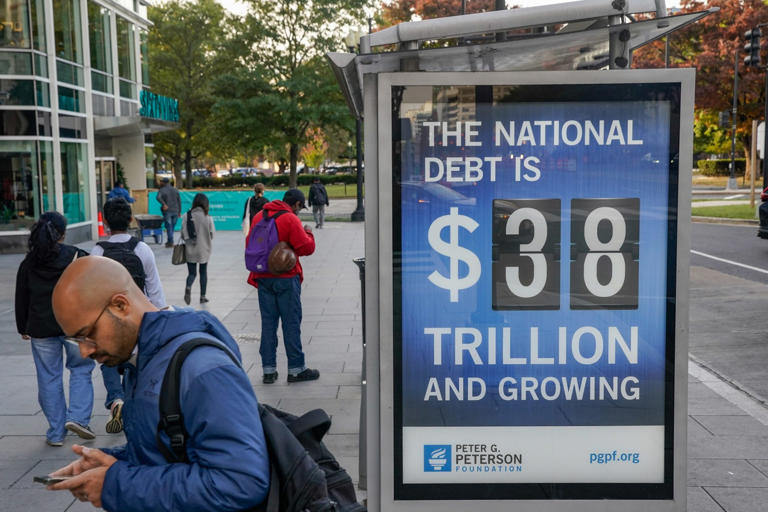

Who holds U.S. government debt has changed dramatically over the last decade, moving away from foreign governments—often steadier, less price-sensitive buyers—and toward private investors focused on returns.
That shift could make the U.S. financial system more vulnerable during periods of market stress, argues Geng Ngarmboonanant, a JPMorgan managing director and former deputy chief of staff to Treasury Secretary Janet Yellen, in a New York Times op-ed published Friday.
Ngarmboonanant notes that foreign governments made up more than 40% of Treasury holdings in the early 2010s, a sharp rise from just over 10% in the mid-1990s. He describes that era as one in which a dependable base of official foreign buyers helped the U.S. finance itself at unusually low borrowing costs.
“Those easy times are over,” he wrote, pointing out that foreign governments now account for less than 15% of the overall Treasury market.
Importantly, he doesn’t claim foreign holders have fled the market. Instead, he argues they’ve largely maintained their Treasury positions while failing to expand purchases to match the rapid growth in U.S. borrowing—especially as total U.S. debt has climbed past $38 trillion.
As foreign official demand has become a smaller share of the market, private investors have taken on a bigger role in absorbing new Treasury issuance. But those investors are more likely to push for higher yields and adjust positions quickly, which can contribute to greater rate volatility, he said.
He singled out hedge funds as a particular concern for policymakers, noting their footprint in the Treasury market has roughly doubled over the last four years. He also pointed to the fact that the largest share of U.S. debt held outside the country is now attributed to the Cayman Islands—often used as a legal base for hedge funds.
Ngarmboonanant connects this evolving investor mix to what he calls “unusual turbulence” during recent market shocks, even though Treasuries have traditionally served as a crisis-era safe haven. He includes the abrupt selloff following President Donald Trump’s surprise “Liberation Day” tariffs as one example.
He also cautioned against relying on optimistic narratives—whether AI-driven productivity gains, stablecoins, Federal Reserve rate cuts, or inflation—as a substitute for fiscal discipline. In his view, those hopes won’t satisfy lenders for long.
“Financial engineering and false hopes won’t keep America’s lenders happy,” he wrote. “Only a credible plan to restrain deficits and control our debt will ultimately do that.”
The idea that bond investors can discipline policymakers has long been captured by the phrase “bond vigilantes,” coined by Wall Street veteran Ed Yardeni in the 1980s. Recent bond-market turmoil after Trump announced global tariffs in April was widely seen as a factor behind his decision to pull back from the harshest rates—prompting economist Nouriel Roubini to remark that “the most powerful people in the world are the bond vigilantes.”
Not everyone buys that argument. Analysts at Piper Sandler have pushed back on the notion that bond vigilantes have real leverage, pointing to the bond market’s failure to stop deficits from ballooning and to Trump’s continued efforts to advance his broader tariff agenda.
Still, concern about the long-term debt picture appears to be spreading across the political spectrum. Mitt Romney, the longtime Republican and former presidential candidate, has recently suggested higher taxes on the wealthy as the Social Security Trust Fund approaches a projected insolvency date in 2034.
“Today, all of us, including our grandmas, truly are headed for a cliff,” he warned in a recent New York Times op-ed. “Typically, Democrats insist on higher taxes, and Republicans insist on lower spending. But given the magnitude of our national debt as well as the proximity of the cliff, both are necessary.”