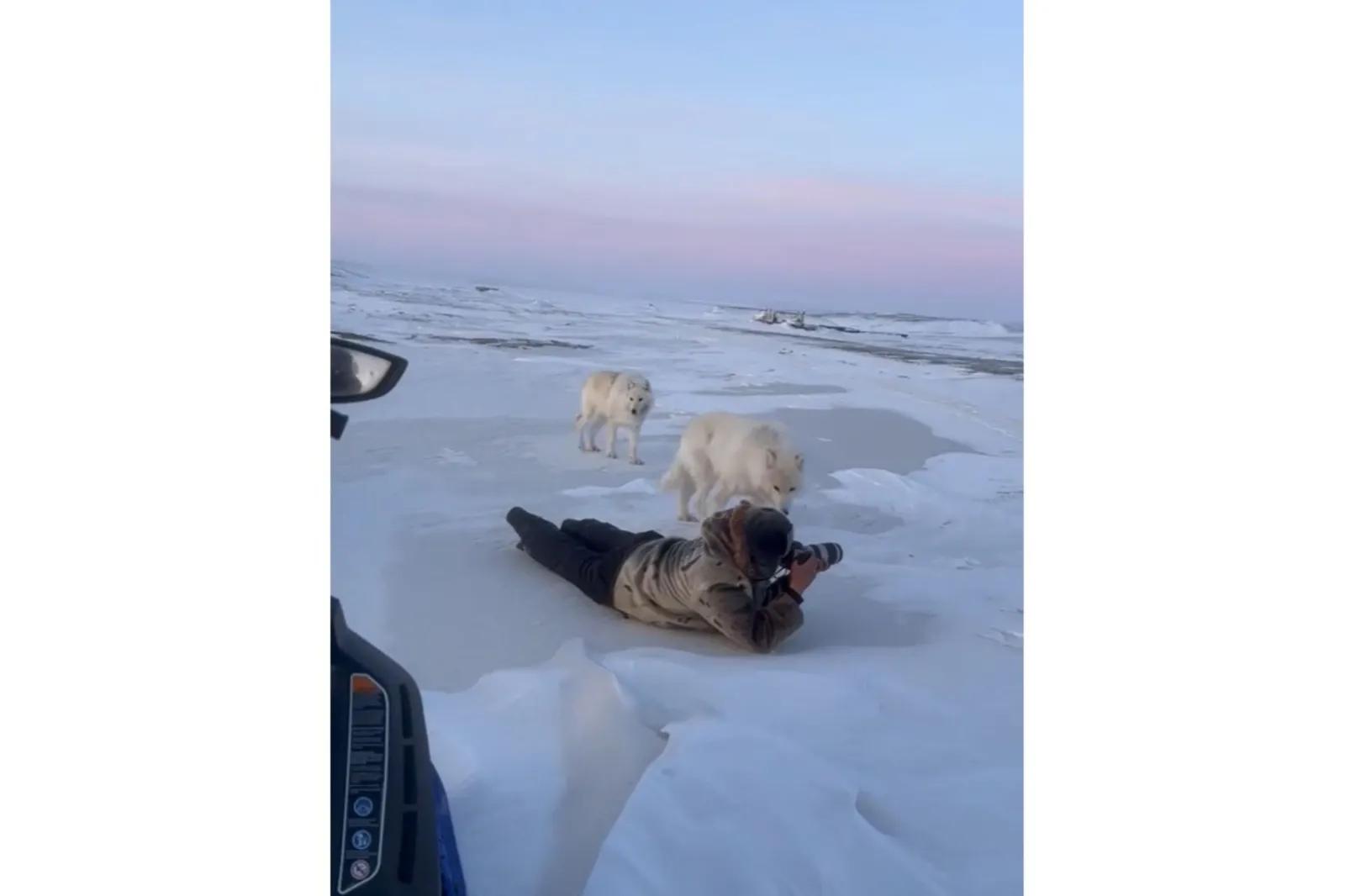

A striking run-in between photographers and a pair of Arctic wolves near Eureka—a research base on Ellesmere Island—has drawn massive attention on TikTok.
The video was posted by 32-year-old Terry Noah under the handle @silas.pijamini, and it has racked up 24.9 million views since it went up earlier this year on April 13.
In the clip, two photographers lie flat on the ice with cameras ready, staying low as two Arctic wolves steadily make their way toward them. One wolf comes close enough to settle down beside one of the photographers, creating an unforgettable moment of quiet proximity. After lingering for a bit, both wolves stand and walk off together into the distance before the video cuts.
Noah told Newsweek the encounter happened during a guided trip. “This was taken near Eureka, Ellesmere Island. I was guiding my clients on my Searching for the Arctic Wolf Tour,” he said.
Noah runs Ausuittuq Adventures, a guiding and outfitting company based in Grise Fiord in Canada’s Nunavut territory. Grise Fiord—also known as Auyuittuq, meaning “the land that never melts” in the Inuit language—is Canada’s northernmost community. Noah, a lifelong Inuit resident, grew up in the area hunting, traveling, and learning the land firsthand.
He said the moment captured on TikTok was among his first times getting so close to a group of Arctic wolves—and what stood out most was how calm it felt. “I felt humbled, they walk by as if you are just an object out on the land that they wanted to check out and that they are the Alpha, but I did not sense any danger nor were they aggressive towards us,” he told Newsweek.
That comfort in the Arctic environment goes beyond tourism for Noah. He previously worked with Environment Canada and Canadian Wildlife Services as an Inuit field research technician. For the past 15 years, he has guided visitors around Grise Fiord, and in 2019 he launched Ausuittuq Adventures—bringing photographers, tourists, and scientists across the region’s land and sea.
Encounters like this are rare largely because Arctic wolves live so far from routine human activity.
The International Fund for Animal Welfare (IFAW) notes that the Arctic wolf’s habitat is “one of the most remote in the world,” stretching across the Canadian Arctic—including Ellesmere Island and Devon Island—parts of Alaska, and the western and northern shores of Greenland.
“Because of its remoteness, Arctic wolves rarely encounter humans and, unlike most gray wolves, can roam freely across the territories they inhabit,” the IFAW says. The organization adds that Arctic wolves are the only subspecies of gray wolves found across the entirety of their original range.
On conservation status, the IFAW says Arctic wolves are listed on the IUCN Red List as least concern. It adds that while they were listed as vulnerable from 1982 to 1995, their status shifted to least concern in 1996 and has remained there since.
Even so, the group cautions that isolation doesn’t mean immunity. According to the IFAW, Arctic wolves may avoid many of the direct pressures faced by wolves living near people, but “they are still threatened by climate change, the consequences of which could alter their status in the coming years.”