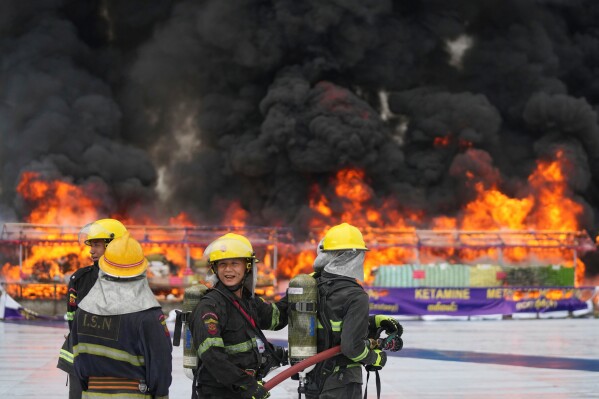

Officials in Myanmar have destroyed nearly $300 million worth of illegal drugs with massive drug-burning ceremonies taking place in cities like Yangon, Mandalay, and Taunggyi
YANGON, Myanmar — Authorities in Myanmar torched nearly $300 million worth of confiscated narcotics on Thursday in coordinated drug-burning ceremonies held across the country’s major cities.
The destroyed drugs included heroin, opium, marijuana, ketamine, methamphetamine pills, and crystal meth (commonly known as “ice”), according to Yangon Police Brigadier General Sein Lwin. Speaking at a ceremony in Yangon, he said more than $117 million worth of illegal substances were incinerated there alone.
The events were held to mark the International Day Against Drug Abuse and Illicit Trafficking and took place simultaneously in Yangon, Mandalay, and Taunggyi — the capital of Shan State, a region notorious for drug production.
State broadcaster MRTV reported that 66 different types of narcotics, with a combined street value of $298 million, were destroyed and buried across the three cities.
The mass destruction comes just weeks after the United Nations warned of unprecedented methamphetamine production and trafficking from Southeast Asia’s notorious Golden Triangle — the region where Myanmar, Laos, and Thailand converge. While historically known for opium and heroin production, the area has increasingly become a global methamphetamine hub.
A May report from the U.N. Office on Drugs and Crime (UNODC) highlighted how Myanmar’s ongoing civil war, sparked by the 2021 military coup, has exacerbated lawlessness in key border regions. These territories are often controlled by ethnic militias, some of whom are deeply involved in the drug trade, allowing narcotics production and trafficking to flourish with minimal central oversight.
Myanmar has long struggled with the twin challenges of armed conflict and drug production. Despite years of crackdowns, the country remains one of the top sources of illegal narcotics destined for East and Southeast Asia. In recent years, drug flows have expanded further into South Asia, especially northeastern India, and are now increasingly routed through Laos and Cambodia, as well as maritime corridors linking Myanmar to Malaysia, Indonesia, and the Philippines.
The UNODC has identified Malaysia’s Sabah state as a key transit point in this growing regional network, as traffickers adapt and expand their smuggling routes to evade enforcement.
Despite high-profile destruction events like Thursday’s, international experts warn that Myanmar’s drug trade remains deeply entrenched — and likely to grow further unless the country sees a return to political stability and stronger rule of law.