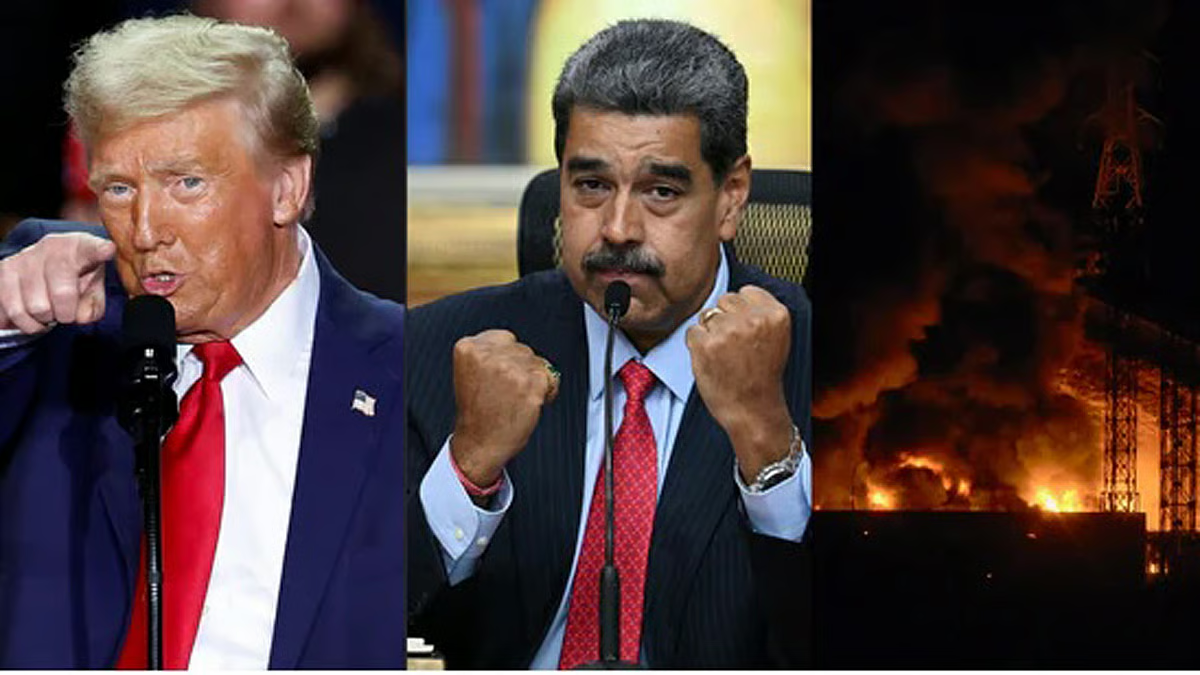

The United States carried out what President Donald Trump described as a “large-scale strike” against Venezuela early Saturday, announcing hours later that President Nicolás Maduro and his wife had been captured and flown out of the country after months of escalating pressure from Washington.
Explosions echoed across Caracas as low-flying aircraft passed over the capital, prompting Venezuela’s government to accuse the United States of striking both civilian and military sites. Officials denounced the operation as an “imperialist attack” and urged citizens to mobilize in response.
Uncertainty quickly spread over who was in control of the country. Maduro’s location was unknown in the immediate aftermath, and it was unclear whether Vice President Delcy Rodríguez had formally assumed power, as Venezuelan law would require. Rodríguez issued a statement shortly after the strike, saying authorities did not know the whereabouts of Maduro or First Lady Cilia Flores and demanding proof that they were alive.
Trump announced the operation on Truth Social shortly after 4:30 a.m. ET, saying Maduro and his wife had been captured and removed from Venezuela in an operation carried out with U.S. law enforcement. He said further details would follow and scheduled a news conference later Saturday.
Questions quickly arose about the legal basis for the action. Sen. Mike Lee, R-Utah, said on X that Secretary of State Marco Rubio had briefed him on the strike and told him Maduro had been arrested by U.S. personnel and would face criminal charges in the United States. The White House did not immediately respond to questions about where Maduro and his wife were being taken. Maduro was indicted in March 2020 in the Southern District of New York on narco-terrorism conspiracy charges.
Maduro had appeared on state television as recently as Friday, meeting with a delegation of Chinese officials in Caracas.
Residents reported at least seven explosions in the capital during the early hours of Saturday, the third day of 2026. Some people rushed into the streets, while others shared accounts online of hearing blasts and seeing aircraft overhead. The operation appeared to last less than 30 minutes, and there was no immediate confirmation of casualties. Trump said the strikes had been carried out “successfully.”
Ahead of the explosions, the Federal Aviation Administration banned U.S. commercial flights from Venezuelan airspace, citing ongoing military activity.
The strike followed months of intensifying U.S. pressure on Maduro. Last week, a drone strike believed to have been carried out by the CIA targeted a docking area allegedly used by Venezuelan drug cartels, marking the first known direct U.S. operation on Venezuelan soil since strikes began in September. Trump has repeatedly warned of possible attacks inside Venezuela, framing them as part of a broader effort to curb drug trafficking. Maduro, in turn, has accused Washington of using military force to try to remove him from power.
In Caracas, reactions were mixed. Armed civilians and members of a pro-government militia appeared in some neighborhoods known as ruling-party strongholds, while other parts of the city remained largely deserted hours after the attack. Power outages were reported in several areas, though traffic continued to move.
Video from Caracas and an unidentified coastal city showed tracer fire and smoke lighting up the night sky amid repeated explosions. Other footage captured cars traveling along a highway as blasts illuminated nearby hills.
“The whole ground shook. This is horrible. We heard explosions and planes,” said Carmen Hidalgo, a 21-year-old office worker who was returning from a birthday party with relatives. “We felt like the air was hitting us.”
Venezuela’s government responded with a call for mass mobilization, urging political and social groups to take to the streets and reject what it called an imperialist assault. Officials said national defense plans had been activated and declared a “state of external disturbance,” a measure that allows authorities to suspend certain rights and expand the role of the armed forces.
A warning posted on the website of the U.S. Embassy in Venezuela advised American citizens in the country to shelter in place, citing reports of explosions in and around Caracas.
Official reaction from Washington was limited in the early hours after the strike. Inquiries to the Pentagon and U.S. Southern Command went unanswered. The FAA also barred U.S. pilots from flying over Venezuela and nearby Curaçao, warning of safety risks linked to ongoing military operations.
Some lawmakers raised constitutional concerns. Lee said he wanted clarity on what legal authority justified the action without a declaration of war or specific authorization for the use of military force. It was not clear whether Congress had been formally notified of the strike, and members of the Armed Services committees had not received briefings, according to a person familiar with the matter.
Criticism of U.S. military activity in the region has been building for months, particularly over strikes on boats suspected of drug smuggling near Venezuela’s coast. Congress has not approved a specific authorization for such operations.
International reaction began to emerge slowly. Cuba, a close ally of the Maduro government, called on the global community to respond, with President Miguel Díaz-Canel Bermúdez describing the strike as a criminal attack on what he called a “zone of peace.” Iran’s Foreign Ministry also condemned the action. Argentina’s President Javier Milei, a close ally of Trump, praised the reported capture of Maduro, celebrating the claim with a familiar pro-freedom slogan.
Since early September, U.S. forces have been targeting boats in the Caribbean and eastern Pacific, with at least 35 strikes and a reported death toll of 115, according to figures released by the Trump administration. The operations followed a major buildup of U.S. military assets off South America, including the deployment of the country’s most advanced aircraft carrier in November, bringing the largest American presence in the region in generations.
Trump has defended the campaign as a necessary escalation to stop the flow of drugs into the United States, asserting that the country is engaged in an armed conflict with drug cartels.