
Daniela Mullins scheduled a routine dermatology appointment after experiencing skin concerns following the birth of her daughter. What she expected to be a standard check-in turned into a life-changing diagnosis.
During a full-body skin exam in April 2025, her new dermatologist took a closer look at a mole on Mullins’ face — one she had first noticed nearly a decade earlier, around June 2015. To Mullins, now 34, the mole appeared ordinary and harmless. Her doctor, however, wasn’t convinced.
“I didn’t notice my mole changing at all,” Mullins says. “It wasn’t until after the diagnosis that I went back and looked at old photos and realized just how much it had changed over time.”
Because Mullins was recently postpartum, her dermatologist recommended waiting six months before performing a biopsy. On Oct. 24, 2025, she finally underwent the procedure. One week later, she received the news: melanoma.
Doctors diagnosed her with Stage 0 skin cancer — also known as carcinoma in situ — meaning the cancer was confined to the top layer of skin and had not spread.
:max_bytes(150000):strip_icc():focal(599x0:601x2):format(webp)/Daniela-Mullins-mole-scar6-1226-da3a9fbc85b043d888f27e1a1bab534f.jpg)
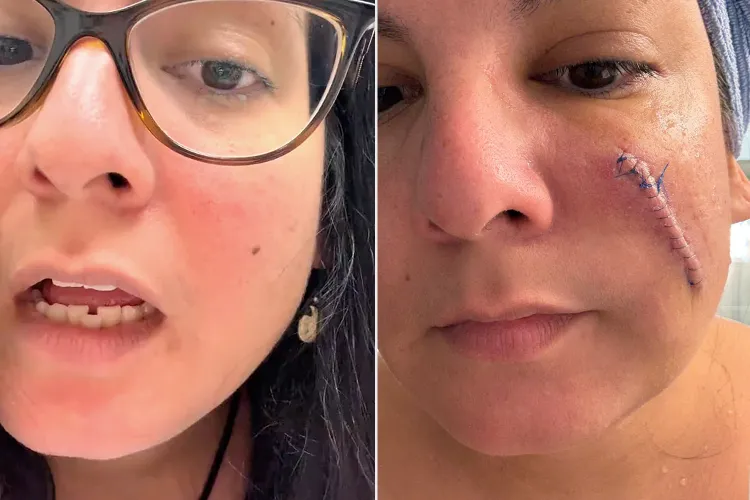
Just before Thanksgiving, Mullins had surgery to remove the mole along with surrounding tissue.
“If I hadn’t already scheduled that skin check, I don’t know when I would have found out,” she says. “I had seen several dermatologists over the years, and no one had ever flagged it before.”
Initially, she felt calm after the procedure. That changed a few days later, when she removed her bandages.
“Two days after I took off the bandage, it really hit me,” she says. “Before that, it was just a diagnosis on paper. Once I saw my face, it became real — not because of how it looked, but because it was tangible.”
Although the mole itself had been small, the incision stretched across much of her cheek, as surgeons removed extra tissue to ensure no cancer cells remained.
Her doctor told her recovery would take time — potentially up to a year — and recommended patience and simple care.
“He said, ‘Just let your body do what it needs to do,’” Mullins recalls.
:max_bytes(150000):strip_icc():focal(599x0:601x2):format(webp)/Daniela-Mullins-mole-scar2-1226-c37005ec1517414fa7fb21481290bfb7.jpg)
Despite the visible scar, Mullins says her primary concern was never cosmetic.
“My number one priority was getting the cancer out and moving forward,” she explains. “Some people do care about scars, and that’s completely valid. But I don’t want my experience to scare anyone away from getting checked.”
Going forward, Mullins will undergo full-body skin exams every four months — a routine she expects to maintain long term due to her increased risk of recurrence.
“Because this happened once, I’m more likely to develop another melanoma,” she says. “Thankfully, it was caught at Stage 0, so I don’t need further treatment like chemotherapy. Now it’s about monitoring my skin and staying aware of any changes.”
She began sharing her journey on TikTok almost spontaneously, and the response surprised her. Her story resonated widely and helped spark conversations around skin cancer awareness — especially among communities that may not see themselves as at risk.
:max_bytes(150000):strip_icc():focal(599x0:601x2):format(webp)/Daniela-Mullins-mole-scar5-1226-8c74cd6c903741fa87c2ea94d0c5b2b6.jpg)
“I’m Latina, and both of my parents are from Peru,” Mullins says. “I never thought this was something I could get. I wasn’t taught that. That realization was eye-opening, and I felt it was important to share.”
While some viewers reacted strongly to the size of her scar, many offered reassurance, reminding her that “a scar is a lifeline” and that survival matters more than appearances.
For others facing a similar diagnosis, Mullins offers simple advice: slow down and trust your medical team.
“Take it one step at a time,” she says. “It’s easy to Google or spiral online, but follow your doctor’s guidance. This is a lot to process, and no one should feel ashamed or go through it alone.”
She also emphasizes the importance of support.
“If you have people around you, lean on them,” she adds. “I don’t think I could have done this without mine.”
The experience has reshaped how Mullins approaches her health heading into 2026 and beyond.
“As a mom, you put yourself last,” she says. “But this diagnosis made me realize how much I’d been neglecting my own health. Now I’m scheduling everything I’ve been putting off — little by little.”
She adds, “I’m trying to be preventative now, instead of facing the consequences of waiting too long.”