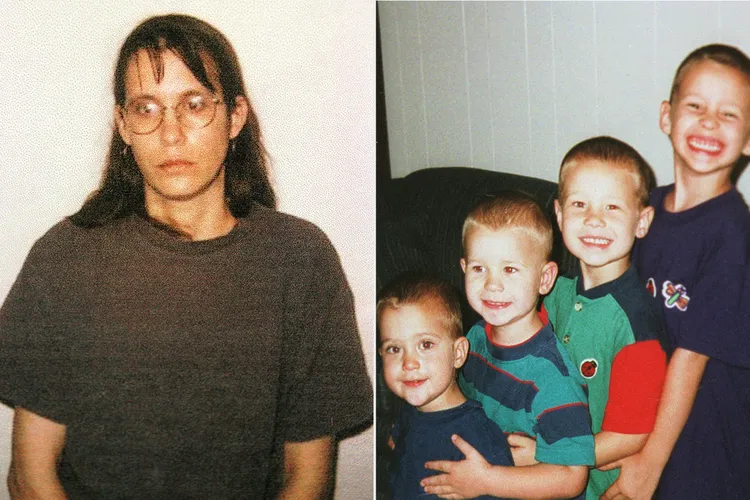

It has been almost 25 years since Andrea Yates drowned her five children in a bathtub at her family’s home in a Houston suburb — a case that quickly became a national flashpoint for debates over postpartum mental illness, criminal responsibility, and the systems meant to protect families in crisis.
Yates had a documented history of postpartum depression and postpartum psychosis. Weeks before the killings, she was taken off a powerful antipsychotic. After drowning Noah, 7, John, 5, Paul, 3, Luke, 2, and Mary, a 6-month-old infant, she arranged their bodies on a bed as if they were sleeping and later told police she had killed them.
In 2002, she was convicted of capital murder and sentenced to life in prison with the possibility of parole after 40 years. That verdict was later overturned on appeal, and at a retrial four years later, she was found not guilty by reason of insanity.
“She just loved those children,” her defense attorney, George Parnham, said in March 2025. “And she, in her psychotic state, believed she was saving their lives, saving their souls.”
Since 2007, Yates has lived in a Texas mental health facility. Although she is eligible for an annual review that could potentially allow her release, she continues to waive that right and remain in treatment.
In 2026, the case drew renewed attention with an Investigation Discovery docuseries that revisited the tragedy and reexamined lingering questions — including whether Yates was influenced by extremist religious teachings. The Cult Behind The Killer: The Andrea Yates Story premiered on HBO Max on Jan. 6 and explored a theory that she may have been manipulated by the teachings of an alleged local cult leader named Michael Woroniecki, per The Hollywood Reporter.
Below is what to know about Yates’ history — and where she is now.
:max_bytes(150000):strip_icc():focal(512x692:514x694):format(webp)/andrea-yates-mugsot-010626-d3ea41d3319f4ea7807ebda5ca4080c6.jpg)
A long history of postpartum illness and psychiatric crises
For years before the killings, Yates struggled with severe mental illness. The Texas Tribune reported that she had previously been hospitalized and had attempted suicide. Witnesses also described troubling behavior at home, including seeing her walk in circles for extended periods.
A longtime friend, Marlene Wark, said Yates was “very happy, very strong” after the birth of her first child, Noah. But her husband, Rusty Yates, later said her condition worsened dramatically after the birth of their fourth child, Luke.
In 1999, months after Luke was born, Yates attempted suicide. She was later prescribed antidepressants and an antipsychotic medication called Haldol. According to her attorney, her mental health declined after she stopped taking it.
:max_bytes(150000):strip_icc():focal(624x269:626x271):format(webp)/andrea-yates-family-portrait_3272-f4f40527ae8d4bc293f6aebf2dee081c.jpg)
The killings in 2001
On June 20, 2001, police responded to a 911 call from a home in Clear Lake, Texas, outside Houston. When officers arrived, they found Yates outside wearing a wet shirt.
She reportedly confessed: “I just killed my children.”
Investigators said Yates later described drowning Luke, Paul, John, and Mary one by one. Her oldest son, Noah, ran after seeing Mary’s body, but she then forced him into the bathtub as well.
Afterward, she placed the four youngest children on a bed and covered them with a sheet before repeatedly calling 911. Doctors later reported that Yates said she believed killing her children was the only way to save them from Satan, according to the Texas Tribune.
A conviction — and then a reversal
In March 2002, Yates was convicted of capital murder and sentenced to life in prison with the possibility of parole after 40 years. TIME reported that jurors rejected her insanity defense because the defense did not convince them she was unable to distinguish right from wrong at the time.
During the trial, experts testified about what Yates told them regarding her motives, including a belief that her children were doomed spiritually because she was “evil.”
In 2005, her conviction was overturned after a major prosecution witness acknowledged an error. California psychiatrist Dr. Park Dietz had testified about a Law & Order episode he said resembled the case — suggesting Yates might have copied the idea. He later learned the episode did not exist.
“Shocked at the possibility of having made a factual error, even one unrelated to Mrs. Yates,” he said in a 2005 statement, per CNN, “I immediately researched the issue, with help from the writers and producers of ‘Law & Order,’ and within hours determined that my recollection was probably incorrect.”
Found not guilty by reason of insanity
At her retrial in July 2006, Yates was found not guilty by reason of insanity. The jury concluded she suffered from postpartum psychosis — a rare disorder associated with delusions and hallucinations — per the Texas Tribune.
Outside the courthouse, Rusty Yates said the verdict reflected a deeper look at what had driven the tragedy.
After the retrial, she was sent to North Texas State Hospital, which The Houston Chronicle described as a maximum-security campus in Vernon, Texas.
:max_bytes(150000):strip_icc():focal(748x360:750x362):format(webp)/andrea-yates-jailhouse-interview-010626-b61d2540edd84f2098e0eb973b29296a.jpg)
Where Andrea Yates is now
Yates has been held at Kerrville State Hospital, a mental health facility in Kerrville, Texas, since 2007. She is eligible for an annual review that could, in theory, lead to release, but she has repeatedly waived that right — including as recently as 2022.
“She’s where she wants to be. Where she needs to be,” Parnham told ABC News in June 2021. “And I mean, hypothetically, where would she go? What would she do?”
:max_bytes(150000):strip_icc():focal(764x241:766x243):format(webp)/andrea-yates-george-parnham_3274-12d7b22b0414440c99a3cce304897967.jpg)
Parnham has said he expects she will likely remain hospitalized for the rest of her life. He has also said she spends time watching old videos of her children and making aprons and cards that are sold anonymously to support the Yates Children Memorial Fund, founded by Parnham and his wife to support women’s mental health. He previously said she was the only patient not allowed to leave the grounds.
In September 2016, Parnham told NBC News that Yates was doing “remarkably well” and had not sought release. “She has excellent care,” he said. “The hospital where she is, there are no razor wires, there’s no bars, there’s no armed guards, no fences.”
Even so, he has said she continues to grieve her children — describing a daily, ongoing mourning for the life that existed before June 20, 2001.