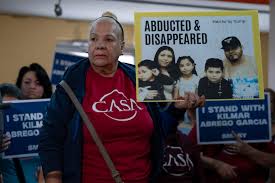

A federal judge in Tennessee has agreed to delay the release of Kilmar Abrego Garcia, a Maryland man facing migrant smuggling charges, after his attorneys raised concerns about what they called the Trump administration’s “contradictory” statements regarding whether he will be deported again.
U.S. Magistrate Judge Barbara D. Holmes issued the order Monday, granting a motion from Abrego Garcia’s defense team to postpone his release until a hearing on July 16, when the court will review the government’s effort to revoke a prior release order.
Abrego Garcia, a Salvadoran national, had previously been deported in March to a notorious work prison in El Salvador — a move the government later admitted was a mistake due to an “administrative error.” Despite that admission, the Biden administration took no immediate action to return him. He was eventually brought back to the U.S. after a federal grand jury in Tennessee indicted him on migrant smuggling charges.
His lawyers are now challenging what they describe as a chaotic legal process, accusing the Department of Homeland Security (DHS) and Department of Justice (DOJ) of offering mixed messages. They allege the government may try to deport him again to a so-called “third country” — one with no legal or familial ties — once he is released from federal custody.
In her ruling, Judge Holmes said Abrego Garcia is entitled to due process and that the court must ensure the government can justify any continued detention under the Bail Reform Act.
“Essentially, Abrego seeks the due process to which he is constitutionally and statutorily entitled,” Holmes wrote in a four-page order. “Namely, whether the government can make the necessary showing under the Bail Reform Act for his detention pending trial.”
The DOJ said it would not oppose a short delay, noting it “intends to see this case to resolution,” though it emphasized that DHS would still follow its own deportation procedures.
Abrego Garcia has pleaded not guilty to charges alleging he helped smuggle thousands of undocumented migrants from Central America into the U.S. between 2016 and 2025, some of whom the government claims were affiliated with MS-13. The indictment stems from a traffic stop in which he was allegedly caught transporting nine undocumented men in a Chevrolet Suburban.
His defense team has called the case a “farce,” pointing out that some of the allegations span nearly a decade and arguing that the government’s shifting position on his legal status undermines its credibility.
Abrego Garcia’s lawyers also proposed a third option: allowing him to return to Maryland under court order, while barring Immigration and Customs Enforcement (ICE) from taking him into custody.
Holmes ultimately agreed to the temporary delay and ruled that Abrego Garcia will remain in U.S. Marshals custody, separate from other detainees, and will be given a “reasonable opportunity” to consult privately with his attorneys.
The case is another flashpoint in the ongoing legal and political battles over immigration enforcement under President Trump’s second term — particularly the administration’s controversial efforts to deport non-citizens to countries where they may have no personal or legal ties.