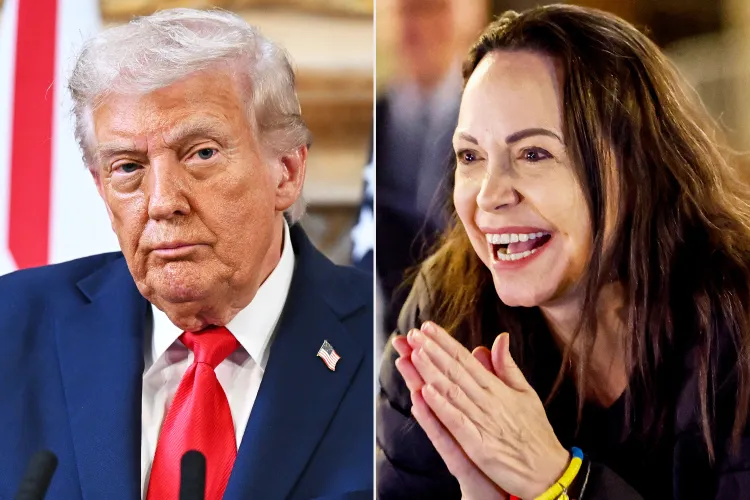

A new report suggests President Donald Trump’s frustration over not receiving the Nobel Peace Prize may have influenced his reluctance to support Venezuelan opposition leader María Corina Machado after the capture of Venezuela’s president, Nicolás Maduro.
In a Sunday, Jan. 4 report, a source told The Washington Post that Machado’s Nobel recognition — announced in October — may have undermined her standing with Trump, who has repeatedly campaigned for the award himself.
“It’d be very tough for her to be the leader,” Trump said on Saturday when asked about Machado, adding that she “doesn’t have the support or the respect within the country.”
On Friday, Oct. 10, it was announced that the Nobel Peace Prize was going to a “brave and committed champion of peace,” as politician Machado, 58, was declared the recipient of the 2025 honor.
Although Machado dedicated the award to Trump, one White House source told the Post that accepting it was viewed as an unforgivable misstep.
:max_bytes(150000):strip_icc():focal(749x0:751x2):format(webp)/Maria-Corina-Machado-010526-2-972a35349ff8431a955b56516ba87fb6.jpg)
“If she had turned it down and said, ‘I can’t accept it because it’s Donald Trump’s,’ she’d be the president of Venezuela today,” the person said.
Machado’s stand-in candidate, Edmundo González, received more than two-thirds of the vote in an election last year, after which Maduro refused to leave office, according to the Post.
Two months later, Machado was awarded the Nobel Prize for her “tireless work promoting democratic rights for the people of Venezuela” and “her struggle to achieve a just and peaceful transition from dictatorship to democracy.”
Since taking office for his second term last year, Trump has adopted the mantra that he deserves the prize for negotiating solutions to multiple “unendable wars.”
One Venezuelan opposition leader said Trump’s comments about Machado on Saturday were difficult for allies to hear, but added that “in every transition, you have to swallow some bitter pills.”
The Venezuelan source also said the next two days could reveal whether Venezuela’s interim leader, Delcy Rodríguez, will help guide a “soft transition” by reshuffling ministers — or instead preserve Maduro’s government under what the source described as “gringo guardianship.”
:max_bytes(150000):strip_icc():focal(749x0:751x2):format(webp)/Maria-Corina-Machado-010526-1-4ab6a908792746de96f8190b266412ac.jpg)
A source identified as a Venezuelan business leader argued that the Trump administration appeared to be working toward an “orderly” political transition, adding that U.S. officials seemed increasingly interested in learning more about Rodríguez in recent months.
That source described Rodríguez, 56, as pragmatic and eager to bring an economic reset, supported by a team of new faces.
Trump issued a warning to Rodríguez on Sunday, following the capture of Maduro and his wife, Cilia Flores.
“If she doesn’t do what’s right, she is going to pay a very big price, probably bigger than Maduro,” Trump, 79, told The Atlantic about the interim leader, following the armed U.S. intervention that led to Maduro’s detainment in the early hours of Saturday.
Trump also discussed Rodríguez while speaking to reporters aboard Air Force One on Sunday, insisting, “We’re in charge,” when asked about Venezuela’s interim leadership.
He added that he hadn’t yet spoken directly with Rodríguez, but said, “Yeah, at the right time I will.”