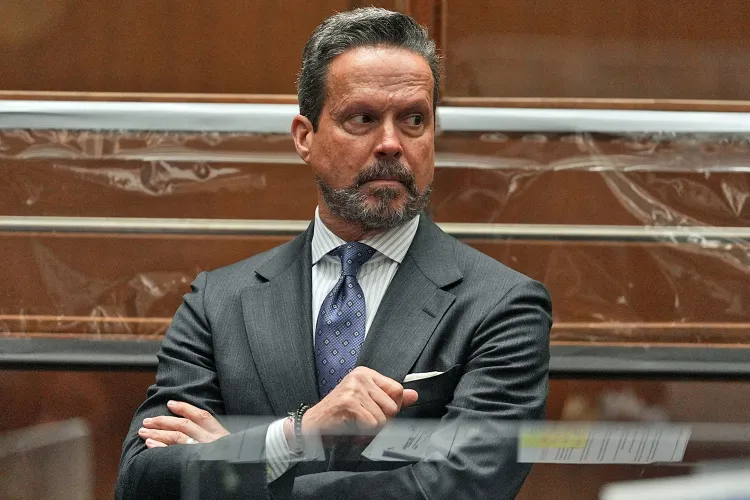

Nick Reiner’s former attorney, Alan Jackson, is opening up about how he thinks about representing clients in high-profile criminal cases.
Jackson, 61, appeared on Kelly Ripa’s Let’s Talk Off Camera on Tuesday, Jan. 13, where the conversation turned to a question many people ask about criminal defense: how an attorney builds a case for someone who may be viewed as guilty.
Ripa, 55, asked Jackson about his decision to withdraw from Reiner’s case on Jan. 7, shortly after Reiner’s arraignment began. Reiner is charged with murder in the stabbing deaths of his parents, Rob Reiner and Michele Singer Reiner. He will now be represented by a public defender.
Jackson told Ripa there are “certain things” he “simply can’t divulge” about the change in counsel. Still, he said his team remains focused on what’s best for Reiner.
“I want him to get the most robust defense that he possibly can get,” Jackson said, adding that he believes Reiner will receive that with the public defender’s office.
:max_bytes(150000):strip_icc():focal(839x308:841x310):format(webp)/alan-jackson-nick-reiner-arraignment2-1726-c543a8302c174f11949ac7a1d9ec7199.jpg)
Ripa also asked how he approaches cases that some people might label “indefensible.”
“There’s very little in the law that’s indefensible,” Jackson said, explaining that he doesn’t see the job as defending a person alone.
“We’re defending the Constitution,” he said. “We’re defending an idea. We’re defending the foundation on which this country was built in terms of its justice system.”
Jackson noted that the U.S. justice system is built around the right to liberty — and that taking someone’s liberty away is a serious act, even when it may be warranted.
“There are certain circumstances in which it’s absolutely appropriate,” he said. “I don’t have a problem with that, if it’s done perfectly.”
With that framework, he added, he tries not to focus on who the defendant is.
“I don’t worry about who the person is,” Jackson said, because “the word indefensible never comes up.”
In his view, a case is “completely defensible” if the government fails to meet its burden.
“It’s completely defensible, no matter who the person is, if the government doesn’t get it right,” he said.
Jackson also acknowledged that mental health can be a factor in some cases — emphasizing that he was speaking generally, not about Reiner’s situation. He described scenarios where a medical episode leads to harm and said society doesn’t treat illness the same way it treats intentional criminal conduct.
“If someone has an epileptic seizure, and they go unconscious and God forbid they’re in a traffic accident and something happens, and people lose their lives, we don’t punish that as a crime,” he said.
:max_bytes(150000):strip_icc():focal(749x0:751x2):format(webp)/nick-reiner-court-sketche-1726-e33c147b894b45ef9c22bc6527d5c1f7.jpg)
He added that the justice system focuses punishment on criminal conduct “where there’s an intent element,” pointing to legal concepts like a not guilty by reason of insanity defense for a defendant who, because of mental illness, “cannot form an intent,” and does not “understand the character and quality of [their] conduct.”
As the conversation continued, Ripa asked Jackson directly whether he has ever taken a case where he believed his client was probably guilty and planned to “razzle-dazzle” a defense.
Jackson said he wouldn’t describe the work that way — and answered “no.”
“I normally don’t make pronouncements one way or the other, about the guilt or innocence of my client, because it doesn’t matter to me,” he said. “I don’t really care.”
Instead, he said, his focus stays on the process.
“I care about the Constitution,” he reiterated. “I care about whether or not the government got their job right.”