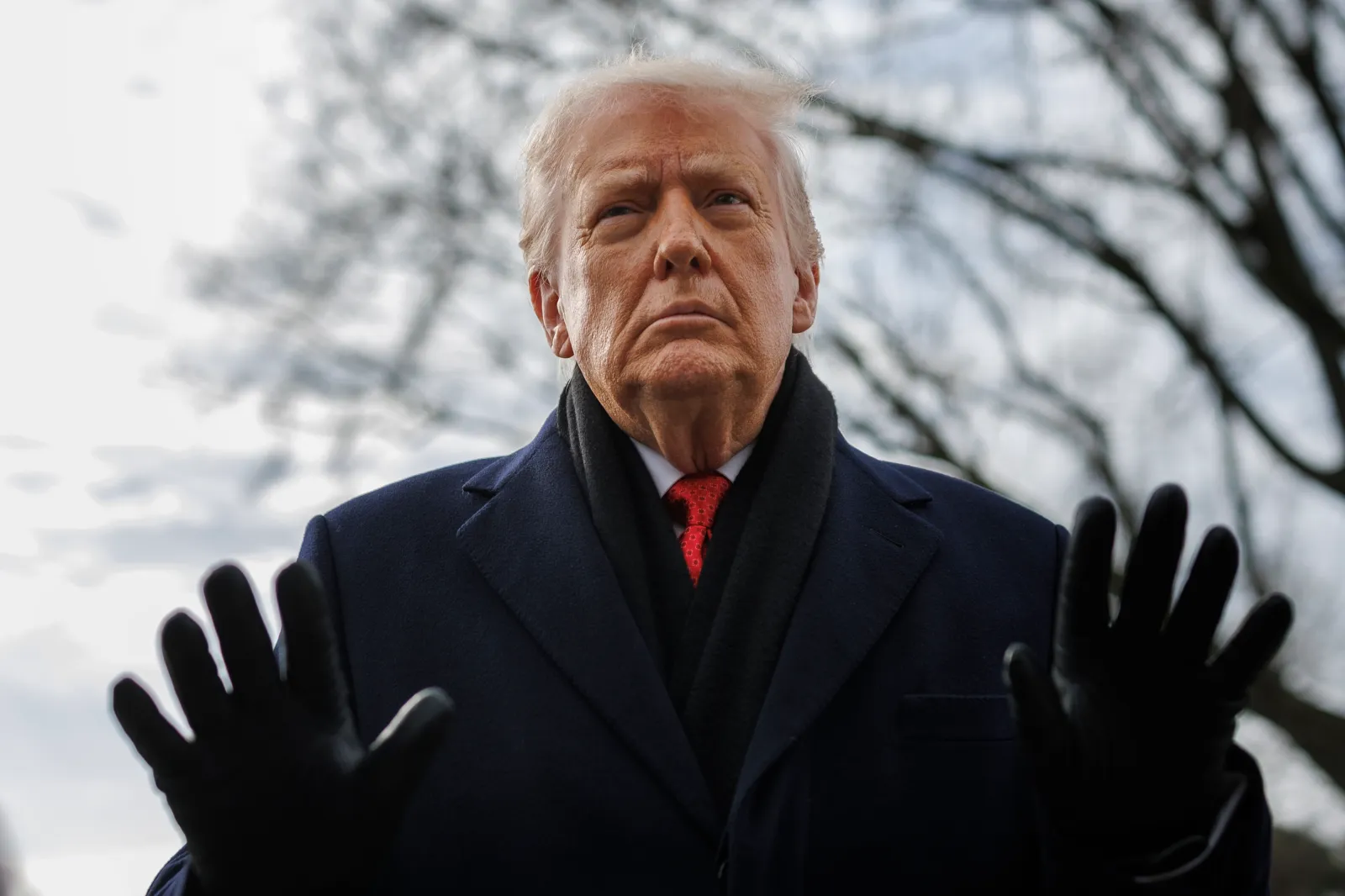

President Donald Trump’s job approval has reached a “politically perilous” level, CNN political director David Chalian said, pointing to a new poll conducted for the network.
In a statement emailed to Newsweek, White House spokeswoman Anna Kelly pushed back on the survey results, saying Trump “is delivering on his promises, and the American people remain firmly aligned with the President’s agenda to Make America Great Again, regardless of the Mainstream Media’s so-called polling.”
Why It Matters
Trump’s approval ratings have fallen notably since he returned to the White House nearly a year ago, a shift from the early period of his second term. The decline is especially evident among independents—an influential voting bloc—raising new questions about the durability of his coalition as Republicans head toward the 2026 midterm elections.
What To Know
A CNN poll conducted by SSRS from January 9–12, 2026, found Trump’s overall job approval at 39 percent, with negative marks across a range of issues.
The survey interviewed 1,209 adults online and by phone and reported a ±3.1 percentage point margin of sampling error. The results indicate Trump’s approval has largely remained in the high 30s to low 40s for much of his second term.
Chalian, discussing the findings on CNN’s News Central, said: “He’s underwater on every issue. This is also a difference from the first term. One of his strong suits in the first term was the economy [and] he pulled better on handling the economy than his overall job approval.”
In the poll, the economy ranked as the country’s top concern by a nearly two-to-one margin over other issues. Yet only about 3 in 10 respondents described economic conditions positively—an assessment that, according to the poll’s findings, has remained relatively steady for the past two years.
A majority of respondents also expressed broader dissatisfaction with Trump’s first year back in office: 58 percent described it as a failure, and 36 percent said he was focused on the right issues.
Chalian highlighted independent voters as a particular warning sign for Republicans, noting that only about 3 in 10 independents approve of Trump’s performance. He said: “I think this is the number that is going to send shivers down the spines of Republicans on Capitol Hill who are on the ballot this year. He is at 29 percent approval among independents. That is politically perilous for his party.”
Among Republicans, Trump’s support remained strong, with nearly 9 in 10 approving, and about half strongly approving. Outside his base, the numbers were weaker: 30 percent approval among Latinos, 30 percent among adults under 35, and 26 percent among people of color. Among white Americans, the poll showed a closer divide—47 percent approve and 52 percent disapprove.
The CNN poll also found 55 percent of Americans believe Trump’s policies are worsening economic conditions, while 58 percent say he has gone too far in using presidential power. Chalian argued the broader picture suggests a disconnect between the administration and public priorities: “This is just a president and a presidency right now that is not aligned with the country’s priorities, and that is going to give real concern to his party in this midterm year.”
Other Polls Show Similar Trend
Other recent surveys cited in the report point in a similar direction:
- A Marist Poll of 1,408 adults conducted January 12–13, 2026 (±3.3 points) found 38 percent approve, 56 percent disapprove, and six percent unsure—net approval –18.
- An Economist/YouGov survey of 1,602 adults conducted January 9–12, 2026 found 40 percent approve, 54 percent disapprove, and six percent undecided—net approval –14 (±3.3 points). The same poll showed Trump at 36 percent approval and 54 percent disapproval among working-class Americans (net –18).
- An AP-NORC poll of 1,203 adults conducted January 8–11, 2026 found 40 percent approve and 59 percent disapprove—net –19 (±3.9 points), using NORC’s probability-based AmeriSpeak Panel.
What People Are Saying
Anna Kelly, the White House spokeswoman, said in her statement to Newsweek: “President Trump took office with a resounding mandate from the nearly 80 million Americans who voted for him to secure our border, end Joe Biden’s inflation crisis, remove criminal illegal aliens from our streets, and restore American Greatness both at home and abroad.
“He has firmly cemented his legacy as the Peace President, having ended eight wars and counting and saving millions of lives. He is delivering on his promises, and the American people remain firmly aligned with the President’s agenda to Make America Great Again, regardless of the Mainstream Media’s so-called polling.”
Chalian told CNN anchor John Berman: “It is really hard to find even a sliver of good news for President Trump in this poll. And it’s worth noting that just compared to less than a year ago, he was at his best political ratings of his career. And that has just gone away. And it is largely due to the economy. And the country thinks that he is focused on the wrong priorities.”
He added: “At the beginning of this term, John, it was immigration that was the strong suit. He pulled better on that issue than he pulled overall. That is not the case now. He is underwater on every single issue tested, and there is no real strong suit. It all kind of looks at that low 40 upper 30 range where you showed his overall approval rating.”
Bruce Stokes, Associate Fellow at Chatham House, wrote: “As US President Donald Trump enters the second year of his second term, polls suggest his domestic popularity is in decline. Various surveys of U.S. public opinion have found that the public disapproves of his handling of key domestic challenges and some of his flagship policies lack support.”
What Happens Next
With economic concerns dominating voter attention and the 2026 midterms approaching, Trump’s numbers—particularly among independents and younger voters—could shape the political environment for both the White House and Republican candidates. If dissatisfaction hardens, it may affect turnout and competitiveness in closely contested races.