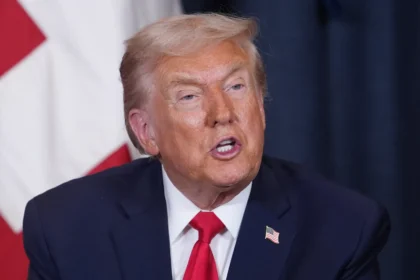
US President Donald Trump’s proposed “Board of Peace” is off to a turbulent start — greeted with skepticism across Europe, criticized by Israel, and cheered by figures close to the Kremlin.
French President Emmanuel Macron quickly rejected Trump’s invitation. The offer was also extended to leaders such as Belarus’s autocratic ruler Alexander Lukashenko, leaving several liberal democracies visibly uncomfortable: unsure how to respond, but wary of angering Trump.
That caution may already look justified. After Macron’s refusal, Trump threatened to hit French champagne with a massive tariff.
“Well, nobody wants him because he’s going to be out of office very soon,” Trump told reporters on Monday. “I’ll put a 200% tariff on his wines and champagnes and he’ll join.”
Trump wants the board’s constitution and mandate formally signed at Davos on Thursday, according to people familiar with the matter. But parts of the draft text have alarmed several invitees, who say the fine print raises serious concerns.
They don’t have much time to decide. The UK, Sweden, the Netherlands, Germany and Canada are expected to join France in refusing to take part in the ceremony, according to people familiar with their thinking.
Trump is also requiring nations to pay $1 billion for permanent membership, Bloomberg reported — a condition the White House has since confirmed. The demand has blindsided leaders and left many bewildered, said people familiar with the discussions.
The board — conceived last year as a Trump-led body meant to oversee redevelopment in post-war Gaza — began losing support over the weekend as invitees started to distance themselves. Those invited range from Canadian Prime Minister Mark Carney to Turkey’s President Recep Tayyip Erdogan.
Much of the discomfort centers on wording in the board’s charter, seen by Bloomberg, that appears to place ultimate decision-making authority in Trump’s hands. That has triggered a cascade of questions — including where the long-term membership payments would go, the people said.
The State Department did not immediately respond to a request for comment.
European allies are working to adjust the terms and coordinate a joint response, according to people familiar with the matter. They are also trying to persuade Arab nations to press Trump for changes.
The episode captures Europe’s broader posture toward Trump’s second term: buy time, show engagement, and try to steer him away from escalation. Those conversations are happening at a sensitive moment, with negotiations ongoing over Russia’s invasion of Ukraine and Trump also threatening to take Greenland, one person said.
Israeli Prime Minister Benjamin Netanyahu was the first to publicly push back. While supportive of the idea of a “Board of Peace” in principle, his office said the makeup of a separate Gaza committee operating under the board was “not coordinated with Israel and runs contrary to its policy,” after officials from Qatar and Turkey were included.
Other invitees signaled they want revisions. Carney said he could support joining “in principle,” but insisted the terms must be discussed — and a person familiar with the matter said Canada would not pay the fee. UK Prime Minister Keir Starmer declined to endorse the board, saying only that he would consult allies on a response.
Not everyone is backing away. Argentina’s Javier Milei said he will become a founding member, and Italy’s Giorgia Meloni has positioned herself as a mediator “ready to do our part.”
China is also said to be on the invite list, though it has not confirmed anything. The Foreign Ministry did not respond to a request for comment on whether it was asked to join.
Former UK Prime Minister Tony Blair — appointed as an executive to the board — has been involved behind the scenes alongside Trump envoys Steve Witkoff and Jared Kushner, the people said. Some said the charter’s terms could still be revised after feedback on the initial draft. Blair’s spokesperson said he was not involved in selecting members and referred questions to the Trump administration.
Privately, senior European officials have been more blunt. Several told Bloomberg they view the initiative as an attempt to build a rival or replacement to the United Nations — an institution Trump has long criticized. They argued the board goes beyond rebuilding Gaza, and that Trump sees it as a tool for shaping other conflicts and steering global affairs.
Some countries may reject the invitation outright. Others — including Canada — may accept in principle while trying to negotiate away the most problematic provisions, people familiar with the matter said.
A few invitees have reacted far more warmly. Hungary’s foreign minister, Peter Szijjarto, called the invitation to Prime Minister Viktor Orban an “honor” and confirmed participation, according to a social media post by spokesperson Zoltan Kovacs. Morocco’s King Mohammed VI has also accepted, the country’s foreign ministry said.
Russian President Vladimir Putin has been invited as well, Kremlin spokesman Dmitry Peskov told reporters on Monday, adding that Moscow would contact the US side to clarify details.
One European official called the invitation absurd given Putin’s ongoing invasion of Ukraine, and said there was little doubt the Russian leader would be eager to accept. The move, the official warned, underlines Europe’s dilemma: cooperate with Trump’s agenda — or risk deepening fractures in the transatlantic alliance.