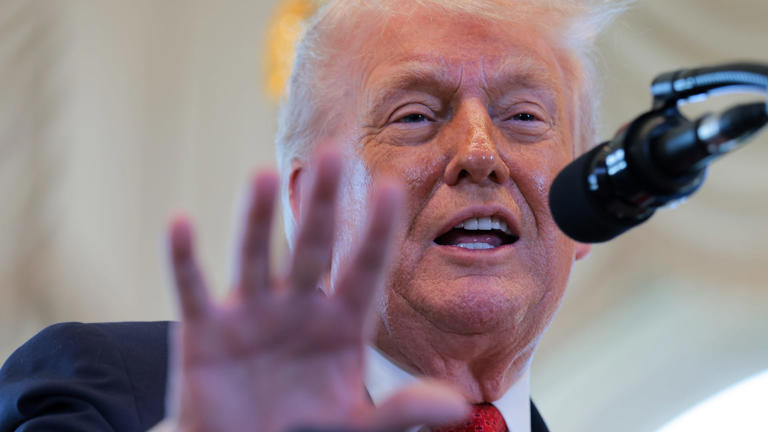

President Donald Trump issued an official proclamation recognizing January 19 as Martin Luther King Jr. Day, urging Americans to “recommit themselves to Dr. King’s dream” after facing criticism earlier in the day from some civil rights organizations.
In the proclamation, Trump said he was committed to ensuring the country is guided by the principles King championed, adding that Americans’ rights are “not granted by government but endowed by Almighty God.”
Trump also highlighted that his administration released a collection of records tied to King’s 1968 assassination, a move that some members of King’s family opposed.
Unlike many past presidential proclamations for the holiday—often centered on continuing the national fight for racial justice—Trump’s statement did not address disparities in how Black Americans are treated in the United States. Instead, the proclamation emphasized themes of “law, order, liberty, and justice for all,” while calling on Americans to “honor our heritage” and “reclaim our freedom.”
The proclamation came after criticism from groups including the NAACP, which publicly questioned why the holiday had not been formally recognized earlier in the day. Before the proclamation was released, NAACP President Derrick Johnson said in a statement that Trump had “zero interest in uniting this country or recognizing its history and diversity.” Johnson also accused Trump of benefiting financially while families lose access to services, and criticized the administration’s deportation efforts, its handling of government files related to Jeffrey Epstein, and other issues.
Trump spent the day at his Mar-a-Lago estate and later attended the National College Football Championship in Miami.
Martin Luther King Jr. Day became a federal holiday after President Ronald Reagan signed the King Holiday Bill into law on November 2, 1983, setting the third Monday in January aside to honor the civil rights leader. Since then, presidents have issued annual proclamations recognizing the holiday, and many have also marked the day through public events such as service activities, speeches, memorial ceremonies, or visits to the King memorial in Washington.
In 2023, President Joe Biden delivered remarks at King’s church. Former President George W. Bush marked the day with public appearances in 2008 and 2007, including volunteer service at a local high school.
Trump’s return to the White House on January 20, 2025, coincided with Martin Luther King Jr. Day. Then-President Joe Biden signed a proclamation before leaving office.
More recently, Trump has faced scrutiny from some groups over administration actions and priorities related to diversity initiatives. The administration removed Martin Luther King Jr. Day and Juneteenth from the National Park Service’s fee-free days list and added Trump’s birthday, according to the article. It also notes the Pentagon paused observance of Black History Month and that Trump has made rolling back diversity, equity, and inclusion programs a key priority of his second term.
During his first term, Trump also marked the holiday through proclamations. Before taking office in 2017, he urged Americans to celebrate King’s legacy after meeting with Martin Luther King III at Trump Tower. In 2018, he signed a proclamation but drew criticism for not making a public appearance. In 2019 and 2020, he signed proclamations and visited the Martin Luther King Jr. Memorial in Washington, D.C., to lay a wreath. He also signed a proclamation in 2021 before leaving office.