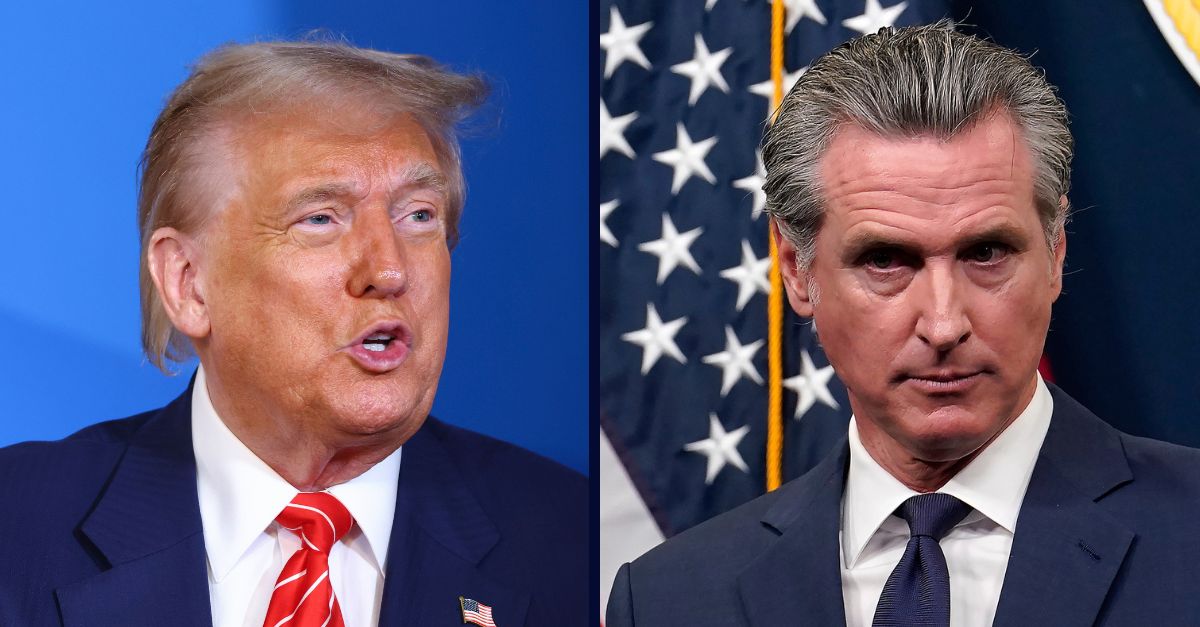

A federal judge has ruled that California Governor Gavin Newsom may proceed with limited discovery in his lawsuit challenging former President Donald Trump’s deployment of National Guard troops in California — and that the case will remain in the Northern District of California.
U.S. District Judge Charles R. Breyer granted Newsom’s request for expedited discovery, but only on the issue of whether the Trump administration violated the Posse Comitatus Act, a federal law that prohibits the use of military personnel for domestic law enforcement without explicit authorization.
The ruling marks the latest development in a legal battle that began after Newsom sued on June 9 to block Trump’s order mobilizing National Guard troops amid anti-ICE protests in Los Angeles. Breyer initially issued a temporary restraining order questioning Trump’s authority, but that decision was stayed by the 9th U.S. Circuit Court of Appeals, which said Trump had likely acted within his legal authority under 10 U.S. Code § 12406 — the statute allowing a president to federalize the Guard.
Despite the stay, Judge Breyer said the administration’s claim — that § 12406 overrides the Posse Comitatus Act entirely — was a “newly minted argument” raised too late and too vaguely for him to accept without further evidence.
“At its broadest, their argument could be construed to say that once the President federalizes the National Guard… the Posse Comitatus Act cannot apply to any federalized National Guard members,” Breyer wrote. “But that would ignore key textual differences between the two laws.”
Breyer added that resolving the issue requires access to the very information Newsom is requesting, such as:
- Records of enforcement activity involving Guard troops.
- Orders or protocols given to them.
- Details on where and how federalized troops operated — including in civilian areas like Los Angeles streets.
- Depositions of officials involved in the deployment decision.
While the Trump administration may still assert executive privilege or other objections to the discovery requests, Breyer said the government’s arguments about burden and overreach were “too abstract and unsubstantiated to prevail” at this stage. He adopted Newsom’s proposed schedule, setting a July 11 deadline for responses and limited depositions, followed by supplemental legal briefings due July 15.
Case Stays in Northern District
In another win for Newsom, Breyer declined the Trump administration’s request to transfer the case to the Central District of California, where the protests occurred.
“Judicial efficiency most strongly counsels against transfer,” Breyer wrote, noting that his court had already reviewed extensive filings and developed a deep familiarity with the case.
He dismissed arguments that Los Angeles was a more appropriate venue, stating the administration had failed to identify any witnesses based there who would be unwilling or unable to testify in San Francisco.
Breyer concluded that while public interest factors weighed against transferring the case, private considerations were neutral. As a result, the case will remain in his courtroom in San Francisco.
The dispute continues to unfold even as the 9th Circuit weighs the broader legality of Trump’s use of the National Guard. For now, Breyer’s ruling clears the way for discovery to move forward — with limits — as California seeks to determine whether the military was improperly used for domestic law enforcement.